- Home
- /
- Sundial Encyclopaedia
- /
- March 2007
March 2007
The articles link to the specific page in a PDF optimised for speed. If you want the whole issue, you can download it here, but the files from earlier years can be quite large.
March 2007
Page 1
Page 1
This editorial announces the winner of the first BSS New Author Award, Geoffrey Lane, for his paper 'Glass Sundials of 17th Century London'. It also mentions the runners-up and encourages members to contribute to the Bulletin. It notes the absence of colour pages in this issue due to unforeseen circumstances, with a double dose planned for the next.
The BSS and Members
March 2007
Page 2
Page 2
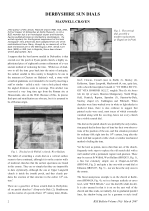
This article provides an overview of sundials found in Derbyshire, from ancient scratch dials on medieval churches to more sophisticated wall and public sundials. It highlights notable examples like the Eyam parish church dial and various works attributed to the Whitehurst family of clockmakers. It also touches on the historical context of timekeeping for ordinary people and the aristocracy.
Dials: Vertical, Restoration projects, Historical Dials, Dials: Cube
March 2007
Page 9
Page 9
This section contains correspondence from readers. Chris Lusby Taylor discusses the use of Hooke’s joint for delineating declining and reclining dials, while Allan Mills replies regarding an error in a previous paper. Tony Ashmore suggests an interpretation for the 'Egyptian Face' design on a sundial pillar at Lord Tennyson's home, attributing it to Ptolemy.
Dials: Unusual, How Sundials Work, Mathematics of Dialling
March 2007
Page 10
Page 10
John Wall explores the hypothetical consequences if the Earth's rotation on its axis were reversed. He details impacts on sunrise/sunset directions, calendar year length, solar day duration, star progression, International Date Line adjustments, and time zones. The article also touches upon how sundials would still function with reversed numerals.
How Sundials Work
March 2007
Page 11
Page 11
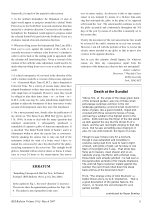
This contribution presents an excerpt from G.K. Chesterton's Father Brown story, 'The strange crime of John Boulnois'. The excerpt provides a vivid description of a garden sundial set on a mound, where a man's figure is seen clinging to it for a moment before falling.
Dials: Horizontal, Book Reviews
March 2007
Page 12
Page 12
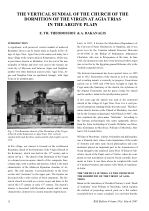
This paper describes a significant, well-preserved medieval Byzantine vertical sundial found at the Church of the Dormition of the Virgin in Agia Trias, Greece. It explores the dial's historical context, its connection to William of Moerbeke's translation of Ptolemy, and its design featuring Greek capital letters for hour lines. The authors also discuss its construction and possible dating.
Dials: Vertical, Historical Dials, Sundial Design & Layout
March 2007
Page 14
Page 14
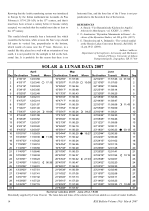
This entry provides tabular data for solar and lunar events for the year 2007. It includes details such as declination, and transit times for various months, and specifically mentions the Summer Solstice date and time. The data was kindly supplied by Fiona Vincent and includes lunar data and solstice times based on reader requests.
March 2007
Page 15
Page 15
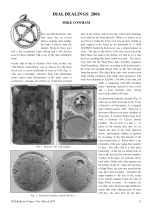
This article reviews sundial sales and auctions from 2006, highlighting notable items such as a 1545 book with an early gold sundial, a perpetual calendar from around 1700, and a brass horary quadrant by Tho: Poole. It also mentions a standing ring dial, a Butterfield dial, and a rare Henry Sutton quadrant with 'New Style' dating.
Dials: Portable, Historical Dials
March 2007
Page 18
Page 18
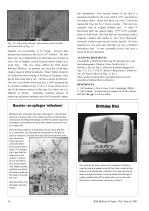
This note follows up on a previous discussion regarding curious holes in the lettering of an old dial at Beccles Church. It reports on a milestone discovered 20 miles from Bury St Edmunds where a similar technique (holes for lead infill) was used, with some lead still in place.
Historical Dials
March 2007
Page 18
Page 18
This short note describes an eightieth birthday cake made for Dr John Lester, which was delineated as a vertical south dial. The humorous observation is made that it might slide off the plate if placed on a wall and questions if it should show 'temporary' hours.
Dials: Vertical
March 2007
Page 19
Page 19
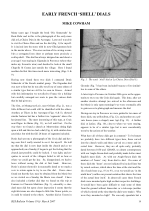
Mike Cowham describes a survey of early French 'shell' dials, often found carved into church walls, dating between 1050 and 1200 AD. He details 11 examples, noting their varying numbers of divisions, high mounting positions, and possible connection to pilgrimage routes. The article speculates on their purpose, mainly to record solar noon and indicate church services.
Dials: Mass Dials, Dials: Vertical, Historical Dials, Sundial Design & Layout
March 2007
Page 24
Page 24
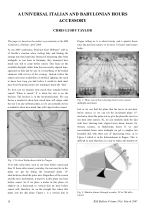
This paper introduces a simple accessory, a three-quarters CD, that can be used with existing horizontal sundials to signify Italian and Babylonian hours. It explains how these hour systems differ from conventional timekeeping and how the accessory allows us to read these hours, using the shadow of the CD.
Dials: Horizontal, How Sundials Work, Dialling Tools, DIY Sundial Projects
March 2007
Page 27
Page 27
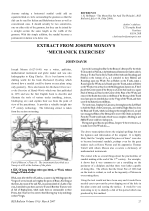
John Davis presents an extract from Joseph Moxon's 1678 book, 'Mechanick Exercises,' detailing a method for laying moldings on round brass pieces without a lathe, invented after the Fire of London. This technique is suggested to have been used for horizontal sundials, offering insight into 17th-century sundial making practices and Moxon's ingenuity.
Dialling Tools, Historical Dials
March 2007
Page 28
Page 28
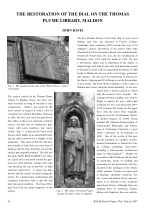
This article details the restoration of a vertical lead sundial on the Thomas Plume Library in Maldon, Essex. It describes the dial's historical context, its construction from lead sheet over oak boards, the damage caused by squirrels, and the repair process including repainting and gilding. The dial is a direct south design and dates from around the turn of the 18th century.
Dials: Vertical, Historical Dials, Restoration projects
March 2007
Page 31
Page 31
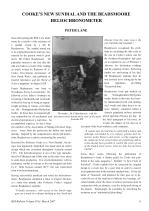
This article discusses Ernest Beadsmoore's construction of a heliochronometer, inspired by Professor W. E. Cooke's 'New Sundial' design published in 1924. It details Beadsmoore's background as an engineer, his process of building and testing the dial, and its impact on local timekeeping precision. Cooke's later 'Sunclock' patent, connecting the dial to a clock for standard time, is also mentioned.
DIY Sundial Projects, Dials: Heliochronometer, Historical Dials, Sundial Design & Layout
March 2007
Page 32
Page 32
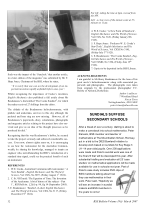
This note announces that sundial-based work, developed by BSS member Peter Ransom, is making a comeback in Key Stage 3 mathematics in schools through the DfES Bowland Initiative. It hopes this will increase interest in sundial making and BSS membership.
The BSS and Members
March 2007
Page 33
Page 33
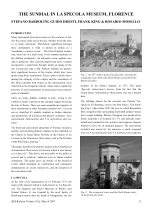
This paper describes the pinhole sundial in the Grand-Ducal Astronomical Observatory (La Specola) in Florence. It covers the observatory's history, the sundial's design as a string-gnomon meridian line, its restoration in 2005, and a comparison of measured zodiac point positions with calculated values. It highlights the instrument's historical importance for astronomical studies and calendar reform.
Dials: Noon Lines, Historical Dials, How Sundials Work, Restoration projects
March 2007
Page 39
Page 39
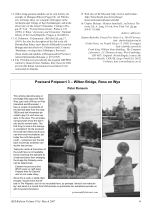
Peter Ransom describes a sundial on Wilton Bridge near Ross on Wye, using postcards from the early 1900s to note a change in its orientation, where the north face now points south. He also deciphers a motto from an old postcard that is no longer readable on the dial itself.
Dials: Multi Faced, Historical Dials, Mottoes
March 2007
Page 40
Page 40
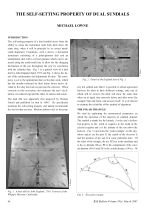
This paper examines the self-setting property of dual sundials, typically consisting of a polar-gnomon dial and an analemmatic dial. It explains the astronomical parameters involved, how rotation affects time indications, and calculates the effectiveness of this alignment method at various latitudes and declinations. It also compares the traditional dual dial with an alternative Foster-Lambert reclining dial.
Dials: Foster-Lambert, Dials: Double Horizontal
March 2007
Page 45
Page 45
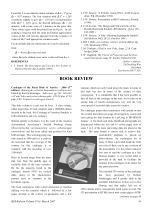
Patrick Powers reviews the 'Catalogue of the Fixed Dials of Austria – 2006 (3rd edition),' edited by Karl Schwazinger. The review highlights the catalogue's comprehensive coverage of over 3500 dials, its German language, and the included CD-ROM version with HTML-based content and PDF explanations.
Book Reviews, Historical Dials, The BSS and Members
March 2007
Page 46
Page 46
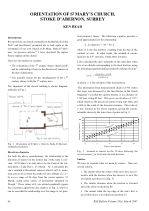
This article re-examines the orientation of St Mary’s Church, Stoke D’Abernon, considering the 7th-century Saxon church and its 13th-century chancel misalignment. It calculates sunrise azimuths for the Feast of the Annunciation, accounting for horizon elevation and atmospheric refraction, to explore the hypothesis that church alignment relates to sunrise on the patron saint's day.
Historical Dials, How Sundials Work