- Home
- /
- Sundial Encyclopaedia
- /
- June 2019
June 2019
The articles link to the specific page in a PDF optimised for speed. If you want the whole issue, you can download it here, but the files from earlier years can be quite large.
June 2019
Page 1
Page 1
Notes that this issue features an extensive report on the BSS 30th Anniversary Conference in Bath. Highlights include the unveiling of David Brown's refurbished armillary dial and the special anniversary cake. Also mentions erudite articles by Ortwin Feustel and Martin Jenkins, and laments the recent deaths of several distinguished diallists and members.
The BSS and Members
June 2019
Page 2
Page 2
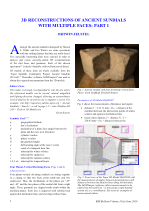
Analyses ancient multi-faced and scaphe marble sundials catalogued by Gibbs and Winter, using 3D models and software (GOM Inspect) to measure parameters for reconstruction. Focuses on dials with planar-vertical deviating faces, hollow spherical faces (scaphe), and hollow conical faces, detailing the geometrical reconstruction and function of hour lines.
Dials: Multi Faced, Dials: Scaphe, Historical Dials
June 2019
Page 6
Page 6
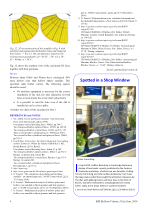
Describes a large slate sundial with a gilded gnomon and flame-like hour lines displayed in a Cambridge bookshop. The dial had originally been intended for a smithy in Buckinghamshire that had subsequently burned down before installation.
Dials: Vertical
June 2019
Page 7
Page 7
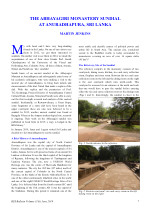
Investigates an ancient horizontal stone sundial (made of quartzofeldspathic gneiss) found at the Abhayagiri Monastery refectory (latitude 8° 24′ N). The dial, now in a museum, has 32 segments, but was likely primarily used to check time (around solar noon) for the monks' daily meal schedule according to Buddhist discipline.
Dials: Unusual, Historical Dials, Sundial Design & Layout
June 2019
Page 10
Page 10
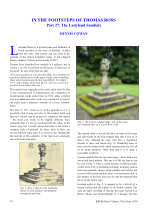
Examines two historical sundials at Ladyland House, Scotland, documented by Thomas Ross. The first is a 1673 lectern dial (star type) on an unusual pedestal. The second is an obelisk capital (dated 1821) on a graceful pedestal, noted as possibly not original to the location, and currently neglected.
Dials: Multi Faced, Historical Dials
June 2019
Page 13
Page 13
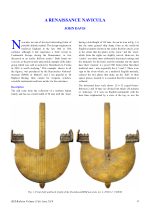
Studies a rare, previously unrecorded Renaissance portable altitude sundial (navicula), acquired by the Bayerisches Nationalmuseum. The brass instrument is ship-shaped and follows the medieval English tradition but uses later numerals. Metallurgical analysis reveals a standard brass alloy, and its engraved date table aligns with 15th-century manuscripts.
Dials: Portable, Historical Dials
June 2019
Page 16
Page 16
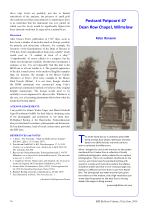
Features a pre-First World War postcard of a three-faced dial on a sandstone pillar (1899) at Dean Row Chapel, Wilmslow, Cheshire. A high-resolution scan confirms the gnomon is missing from the west face, though the supports are still present.
Dials: Multi Faced, Historical Dials
June 2019
Page 17
Page 17
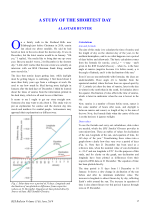
Explains why the latest sunrise (measured in mean time) occurs after the winter solstice (the shortest day). This phenomenon results from the fast-changing value of the Equation of Time near the solstice, causing a nominal delay in sunrise and making evenings appear lighter before the shortest day.
Equation of Time, Mathematics of Dialling
June 2019
Page 19
Page 19
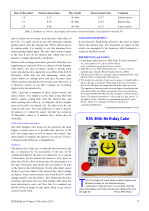
A picture showing the largest of the celebratory cakes baked by Pauline and Michael Faraday that was used for the ceremonial cutting at the 30th Anniversary Conference dinner in Bath.
The BSS and Members
June 2019
Page 20
Page 20
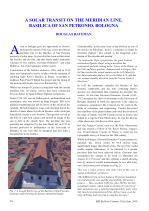
Details the history and functioning of the 66.8-metre meridian line constructed by Giovanni Domenico Cassini in 1655 at San Petronio Basilica. Discusses the earlier Danti line, restorations, the use of Cassini units and Italian hours, and how the line helped confirm Kepler's elliptical orbit theory.
Dials: Noon Lines, Historical Dials
June 2019
Page 26
Page 26
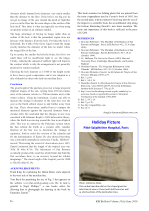
A photograph of a vertical meridian dial on the chapel of the Pitié-Salpêtrière Hospital in Paris. The dial shows solar time of noon ±1 hour (with half-hours) and short sections of the declination lines.
Dials: Noon Lines, Dials: Vertical, Historical Dials
June 2019
Page 27
Page 27
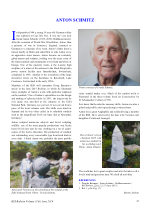
Obituary for BSS member Anton Schmitz (1925–2019), a master German stone mason and sculptor. He was renowned for crafting spherical dials, such as the one at Eifel National Park, and was regarded as one of the most prolific stone sundial makers ever.
The BSS and Members
June 2019
Page 28
Page 28
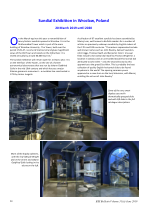
Reports on a new exhibition of 87 historic sundials, assembled by Maciej Lose, in the Mathematical Tower of Wrocław University. The collection includes a rare double horizontal dial by John Allen, and is considered the best collection of quality English horizontal dials globally.
Dials: Double Horizontal, Dials: Horizontal, Historical Dials
June 2019
Page 29
Page 29
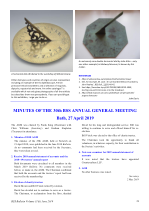
Official minutes of the AGM held during the Bath conference. Notes the receipt of the accounts and trustees' report, the re-election of Bill Visick as a trustee, and the retirement of David Brown.
The BSS and Members
June 2019
Page 30
Page 30
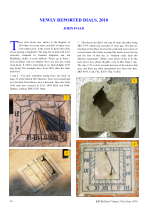
Presents 18 selected entries from the more than 100 dials added to the Fixed Dial Register in 2018. Examples include historical dials by George Adams and Heath and Wing, a Dollond cube dial, a vertical slate dial from 1698, and modern ground-level and wall dials.
Construction Projects, Dials: Equatorial, Dials: Horizontal, Dials: Vertical, Historical Dials
June 2019
Page 34
Page 34
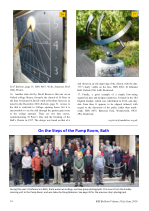
A note accompanying a photograph of the delegates gathered on the steps outside the Pump Room, Bath, during the Sunday morning visit of the BSS 30th Anniversary Conference.
The BSS and Members
June 2019
Page 35
Page 35
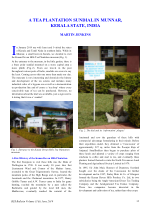
Describes a brass polar sundial found at the Kanan Devan Hills Tea Plantation museum in Munnar. The dial, stamped "ART INDUSTRIAL SCHOOL, NAZARETH, 1913," was made by a vocational school in Tamil Nadu. The capital's angle (10°) is appropriate for Munnar's latitude, though the current setting is inaccurate.
Dials: Polar, Historical Dials
June 2019
Page 38
Page 38
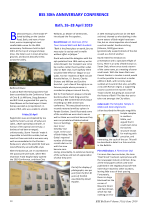
Extensive report on the conference, including the unveiling of an armillary dial plaque in Parade Gardens, tours of local sights, and presentations on ancient solar alignments, Tompion's clocks, the Bologna meridian line, mass dials, and portable sundial design.
The BSS and Members