- Home
- /
- Sundial Encyclopaedia
- /
- October 1991
October 1991
The articles link to the specific page in a PDF optimised for speed. If you want the whole issue, you can download it here, but the files from earlier years can be quite large.
October 1991
Page 1
Page 1
This section features various updates and news, including highlights from the Scientific Instrument Society's Bulletin, recent publicity for the British Sundial Society in national newspapers, details on a holographic sundial ('holodial') developed by Kristina Johnson and Rob Penland, and mentions regular contributions to "Clocks" magazine and "The Clockmaker" magazine. It notes the BSS Chairman's radio talks and lectures.
The BSS and Members
October 1991
Page 2
Page 2
This article discusses William Gilbert of Colchester, Queen Elizabeth I's physician, and his monumental work "De Magnete" published in 1600. It highlights his contributions to the understanding of electricity and magnetism, including his commitment to the Earth rotating around the Sun. The article also touches upon the historical lack of quick dial orientation before the magnetic compass and Gilbert's fleeting reference to sundials in his work.
Historical Dials, Mathematics of Dialling
October 1991
Page 3
Page 3
This text reproduced from 1631 continues John Marr's description of the Hampton Court sundial. It details how to determine various astronomical propositions, such as sunrise, sunset, day/night length, and the Sun's position, using the dial's concave surface and its markings. It also explains how to find the hour of the night by observing stars on the meridian.
Historical Dials, How Sundials Work
October 1991
Page 4
Page 4
This article describes "flower dials," a decorative 19th-century European garden method of telling time using flower beds designed as a clock face. Different flowers open at approximate hourly intervals during summer days, synchronized to local solar time. While less accurate and seasonal than sundials, a smaller version with a central sundial feature is suggested as an attractive garden addition.
Dials: Unusual
October 1991
Page 5
Page 5
This article, originally by Reverend T.W. Cole, discusses 'incised sundials' (scratch or mass dials) found on church stonework in England from Saxon times to the 18th century. It traces their evolution from small, simple markings to larger, more prominent and scientifically designed dials, and highlights early attempts at accuracy, different time systems, and the preservation efforts for these historical artifacts. It also mentions key figures like Dom Ethelbert Horne and A.R. Green.
Restoration projects, Historical Dials, Dials: Mass Dials
October 1991
Page 13
Page 13
This article, a summary of a lecture by Mr. Taylor, examines four equatorial sundials made by John Bonar between 1623 and 1634. These dials feature poetry, zodiac signs, moon age, and compass points with port names, indicating their use for tidal calculations rather than just timekeeping. The article notes Bonar's errors in gnomonics despite his poetic skill and details the current locations of the surviving dials.
Dials: Equatorial, Historical Dials
October 1991
Page 15
Page 15
Gordon E. Taylor reports on the development of the British Sundial Society's computerised sundial register, designed for historical research and restoration. With an estimated 10,000 sundials in the British Isles, the project aims to minimize paperwork by storing key information like location, type, condition, and maker in a database using custom-written programs due to limited funds. Members with computers are invited to assist with data input.
The BSS and Members
October 1991
Page 15
Page 15
This note provides succinct facts about hour angle sundials. It covers topics such as local time variations, the twelve-hour day at equinoxes, dial portability, effects of rotation, limitations of different dial types, gnomon orientation, and the daily and annual changes in sunrise/sunset times and the Equation of Time.
Equation of Time, How Sundials Work
October 1991
Page 16
Page 16
Rene R.-J. Rohr introduces the 18th-century Islamic instrument known as the "da'ire-yi mu'addil" (equatorial circle), used for determining daily and nightly prayer times. Driven by religious prescriptions, Islamic scientists developed sophisticated astronomical and mathematical methods. This instrument, although not mathematically precise, allows for the determination of prayer times, especially night prayers like isha and subh, through observation of the sun and moon's positions.
Dials: Equatorial, Historical Dials, Dials: Nocturnals
October 1991
Page 20
Page 20
Christopher St. J.H. Daniel discusses the significance and selection of emblems for scientific societies, using nautical examples. He explains why the British Sundial Society chose the equinoctial sundial as its emblem, symbolizing gnomonics and its fundamental role in dialling. Despite some member criticism, the equinoctial dial design is deemed simple, clear, and representative of the art's ancient origins and scientific principles.
The BSS and Members
October 1991
Page 21
Page 21
This profile highlights Robert Sylvester, a keen British Sundial Society member from Cumbria, who greatly aids the national sundial record and publishes a newsletter. It also features Ray Hartland, a retired lay reader from Isel church, who has written about the church's ancient scratch dials, suggesting they were better suited to school day hours than church service times. The earliest surviving British sundial, Bewcastle Cross, is mentioned as being in Cumbria.
The BSS and Members
October 1991
Page 22
Page 22
This article describes the Salisbury Cathedral spire as a unique sundial, where its midday shadow crosses an engraved line marked "Meridies" on a low north wall. It notes the popularity of elaborate Scottish multangular dials in the 17th century and details a rare Ivychurch dial in the Salisbury Museum, a local stone multi-faced piece that indicates both time and seasons.
Dials: Multi Faced, Dials: Noon Lines, Historical Dials
October 1991
Page 24
Page 24
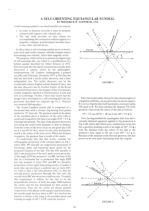
Fred Sawyer presents a self-orienting equiangular sundial, a modification of the Foster-Lambert hybrid dial, capable of correct orientation without external devices. It functions as both a solar clock and a solar compass, determining true celestial north. The design involves a V-shaped gnomon and two sets of hour-markings, allowing for simultaneous readings of Standard and Apparent time and a straightforward orientation process.
Dials: Foster-Lambert, How Sundials Work, Sundial Design & Layout
October 1991
Page 26
Page 26
This section reviews several books related to sundials. "Orologi Solari - Trattato Completo di Gnomonica" by Girolamo Fantoni is praised for its comprehensive mathematical treatment. "Cadrans Solaires, Artissime, Nyons" is a French publicity booklet for replica dials. "The Gift of Shadows" by W.A. Hutchinson is an unusual book with blue-tinted illustrations. "Cambridge Sundials" by Alexis Brookes and Margaret Stanier is a pleasant, illustrated guide to Cambridge dials. "The Earth in Space" is a leaflet for children published as National Maritime Museum Educational Series Information Leaflet No 3.
Book Reviews
October 1991
Page 28
Page 28
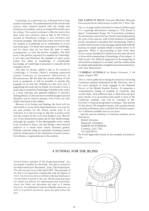
Gerard Sonius developed a sundial for the blind, located at the Bartimeus blind institution in Zeist, Netherlands. This equatorial rotating dial features figures in relief and an electronic device that emits a sound when pointing to the sun. Marks for summer and winter time allow blind users to determine the time in 5-minute intervals, with explanations provided in Braille and print.
Dials: Equatorial, Dials: Unusual, Sundial Design & Layout
October 1991
Page 29
Page 29
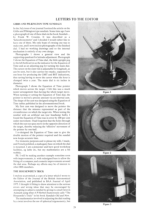
This section includes correspondence from H.R. Mills, who details his homemade "heliochronometer" sundial based on the Gibbs and Pilkington type. He also discusses A.P. Herbert's "Housewife's Trick," warning against adjusting sundials by twisting them in azimuth to correct for BST, as this introduces variable time errors.
DIY Sundial Projects, Dials: Heliochronometer, Equation of Time
October 1991
Page 31
Page 31
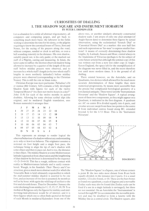
Peter Drinkwater explores historical methods of time determination, focusing on the "Shadow Square" and "Instrumentum Horarum" found on astrolabes and quadrants. He discusses ancient shadow scales, like those from Palladius, and how they were used to estimate time by shadow length, noting the practical, though often imprecise, methods employed by medieval laborers and pilgrims without modern instruments.
How Sundials Work, Historical Dials
October 1991
Page 33
Page 33
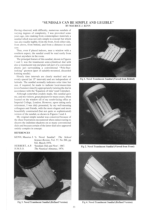
Maurice Kern describes his simple, legible sundial made from commonplace materials, featuring a translucent semi-cylindrical dial and a conventional gnomon. Designed for readability from multiple angles, it indicates solar time and can be adjusted for local mean time or summer time using the Equation of Time, highlighting a frustration with complex and indistinct conventional dials.
Dials: Equatorial, Dials: Unusual, Sundial Design & Layout, DIY Sundial Projects
October 1991
Page 34
Page 34
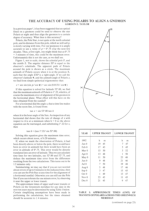
Gordon E. Taylor examines the accuracy of aligning a sundial gnomon using Polaris. He explains that while Polaris is close to the celestial pole, its slight deviation introduces errors. Calculations show a maximum time error of 6.2 minutes for a horizontal dial if Polaris is observed at any time of year, but this can be reduced to 1 minute by observing near upper or lower transit.
Mathematics of Dialling
October 1991
Page 35
Page 35
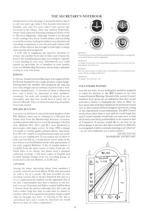
David Young reflects on his ten years in sundial interest and five years since meeting Andrew Somerville, emphasizing the value of personal contact in the field. He encourages members to connect locally and to consider standing for election to the BSS Council. The notebook also includes updates on available back numbers of the BSS Bulletin and a call for member comments on proposed lapel badge designs.
The BSS and Members
October 1991
Page 36
Page 36
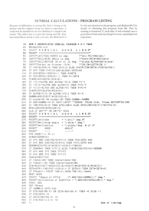
This section provides a listing of a BASIC computer program by H.C. Parr for calculating sundial hour lines, intended to accompany a previous article. The program is designed to save time and prevent errors in sundial computations. Details for obtaining the program on a 5 1/4 inch disk and information about inputting latitude, reclining angle, and declination are included.
Dialling Tools, Mathematics of Dialling
October 1991
Page 37
Page 37
J.A.F. de Rijk describes a new, simple, and more accurate latitude-independent sundial, building upon Freeman's 1978 solution. This type of sundial can indicate local apparent solar time without requiring knowledge of the observer's latitude. The article explains the mathematical principles, focusing on how the product sin(Az)cos(h) and sin(T)cos(δ) are obtained and combined to determine the time (T).
Dials: Unusual, How Sundials Work, Mathematics of Dialling, Sundial Design & Layout