- Home
- /
- Sundial Encyclopaedia
- /
- Dials: Cube
Dials: Cube
March 2023
Page 9
Page 9
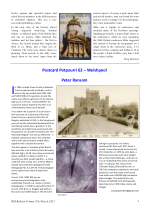
Focuses on a multiple cube/prism dial (SRN 3416) at Powis Castle, identified via a c.1955 Frith’s postcard. The structure is composed of a stone cube dial mated with a Henry Wynne double horizontal dial. It lists south, east, and west vertical dials alongside the double horizontal component.
Dials: Cube, Dials: Double Horizontal, Dials: Multi Faced, Historical Dials
December 2023
Page 44
Page 44
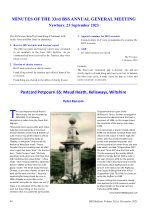
A discussion of a postcard, dated no later than 1906, showing Maud Heath’s Monument (SRN 0401), a stone square pillar from 1698 featuring a three-faced cube dial and multiple mottoes, which was repaired after being damaged in 1996.
Dials: Cube, Dials: Multi Faced, Historical Dials, Mottoes
March 2022
Page 14
Page 14
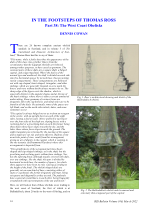
Examination of four ancient obelisk sundials located near the West Coast of Scotland, following descriptions by Thomas Ross. Sites include Ballindalloch, Lochgoilhead, Asknish House, and Mount Stuart. It also reports on the rediscovery of the mutilated Ardgowan lectern sundial and describes a cube dial at Ardgowan.
Dials: Cube, Dials: Multi Faced, Historical Dials, Restoration projects
June 2022
Page 10
Page 10
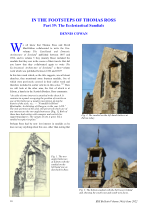
Continuing the series following Thomas Ross, this article examines nine sundials documented in his work on Scottish ecclesiastical architecture. It details the current condition, location, and history of dials found mostly on church walls or associated structures like lych-gates, including cubes and verticals, often noting signs of wear or required restoration.
Dials: Cube, Dials: Multi Faced, Historical Dials, Restoration projects
March 2021
Page 38
Page 38
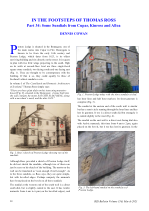
Continues the analysis of Scottish sundials described by Thomas Ross, focusing on several 17th-century examples. These include three square stone vertical dials on Preston Lodge (Cupar), two identical cube sundials at Kinross House, and a diptych sundial in Alloa made by mason Tobias Baak in 1695.
Dials: Cube, Dials: Multi Faced, Dials: Vertical, Historical Dials
September 2021
Page 36
Page 36
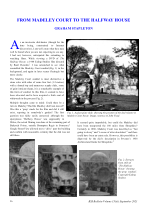
Investigates a distinct cube sundial seen in the film "The Halfway House". The prop was a copy of the famous Madeley Court sundial. Close analysis confirmed it was a non-functional copy, likely based on a Wills’s cigarette card from 1928, and it was broken up after filming.
Dials: Multi Faced, Historical Dials, Dials: Cube, Dials: Scaphe
December 2021
Page 26
Page 26
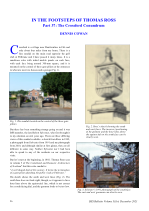
Detailed investigation into the historical changes of a cube sundial at Crossford, Fife, by comparing sketches and photographs from 1892, 1991, and 2010. The study resolved delineation errors, wrong gnomon placements, and incorrect Roman numerals, concluding the errors resulted from a rushed, poor-quality restoration following vehicle damage in the mid-1990s.
Dials: Cube, Historical Dials, Restoration projects
March 2020
Page 38
Page 38
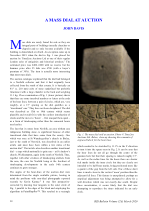
Examines a rare 8½-inch stone cube mass dial (13th or 14th century) sold at auction, originating from South Norfolk. Analysis shows it qualifies as a 'transitional dial' with roughly 15° spacing between lines, possibly reflecting the early use of unequal or equal hours related to clocks. Its existence, along with others in Norfolk, suggests the county was prominent in timekeeping developments in the early 14th century.
Dials: Cube, Dials: Mass Dials, Dials: Unusual, Historical Dials
June 2020
Page 25
Page 25
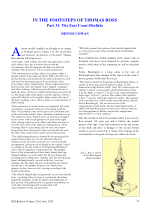
This article examines three Scottish obelisk sundials on the east coast, following the earlier historical descriptions by Thomas Ross. The dials discussed are located at Bonnington, Leven (where a conjectural restoration occurred), and a structure now at Brechin Castle, which may not have originally been an obelisk shaft.
Dials: Cube, Dials: Multi Faced, Historical Dials
December 2020
Page 10
Page 10
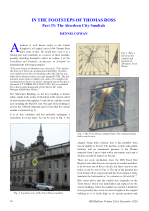
Part 33 explores three Aberdeen sundials mentioned by Thomas Ross in 1890. These include the vertical declining dial on the Municipal Building (Town House), two cubic dials on Andrew Begg's shop dated 1694, and the dial at King’s College Chapel, potentially Scotland’s oldest. The author doubts the 1494 dating of the latter.
Dials: Cube, Dials: Multi Faced, Dials: Vertical, Historical Dials
March 2019
Page 22
Page 22
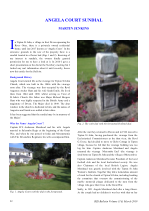
Investigation into the sundial at Angela Court (now Sundial House), East Devon. The assembly consists of an older cube dial topped by a brass Dollond horizontal dial plate engraved with an incorrect latitude (51° 15ʹ). The base has mysterious Latin inscriptions (SOLE, QUARE, SPLENDIDIUS, NECASTI) which are speculated to mean, "Why did you kill the sunshine?" suggesting the dial is a memorial.
Dials: Cube, Dials: Horizontal, Historical Dials, Mottoes
September 2019
Page 34
Page 34
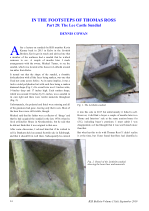
The author investigates a sunken rhombic dodecahedron sundial found in Leitholm. Initially theorised to be the missing multi-faced dial described by Thomas Ross at Lee Castle, this theory was later refuted by evidence showing that broken pieces of the original Lee Castle dial still existed elsewhere in 1984. The Leitholm and Lee Castle dials are likely by the same maker.
Dials: Cube, Dials: Multi Faced, Historical Dials
December 2019
Page 26
Page 26
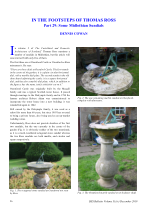
The 29th part of a series documenting sundials mentioned by Thomas Ross, focusing on five examples in Midlothian. The author traces the status and location of three dials at Oxenfoord Castle, a 1745 vertical dial in Dalkeith, and the relocation of a rare lectern sundial from Mid Calder House to Culzean Castle in Ayrshire.
Dials: Cube, Dials: Multi Faced, Dials: Vertical, Historical Dials
March 2018
Page 6
Page 6
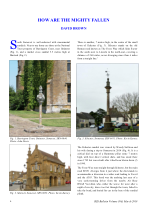
A report on the destruction of the cubical monumental sundial in Ilchester, Somerset, which stands 7 metres high. The sundial, originally built in 1795 and rebuilt in 1990 after being blown down, was pole-axed in 2017 when an intoxicated driver failed to take a bend and struck the plinth.
Dials: Cube, Historical Dials
June 2017
Page 10
Page 10
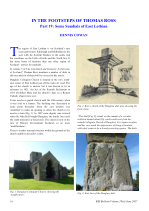
This article covers six sundials in East Lothian, Scotland, previously mentioned by Thomas Ross in volume 5 of his work. Sites detailed include Dunglass Collegiate Church and Nunraw Abbey Tower, noting their history, multi-faceted nature, and current condition or replacement status.
Dials: Cube, Dials: Multi Faced, Historical Dials
December 2017
Page 26
Page 26
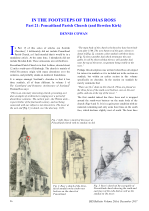
Examines two Scottish churches mentioned by Thomas Ross; Pencaitland Parish Church is unique for having three different sundials, including a multi-faced buttress dial and a cube dial. The dial at Bowden Kirk is a modern replacement that was installed with a major error in canting.
Dials: Cube, Dials: Multi Faced, Dials: Vertical, Historical Dials
December 2017
Page 40
Page 40
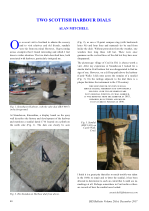
Details a heavily weathered cube dial (1710) with a 32-point compass ring at Stonehaven Harbour, and the remains of a 17th-century dial located on Castle Walk, Crail, which was repaired and moved in the 1880s but is now highly deteriorated.
Dials: Cube, Dials: Horizontal, Historical Dials
December 2016
Page 22
Page 22
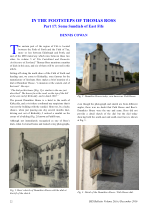
Covers six historical sundials in East Fife documented by Thomas Ross. Examples include the Path House dial (formerly Dunnikier House), the Muckle Yett dial with seven faces including scaphe dials, and cube dials at Kellie Castle (1722) and St Mary’s College (1664).
Dials: Cube, Dials: Multi Faced, Dials: Scaphe, Historical Dials
September 2015
Page 48
Page 48
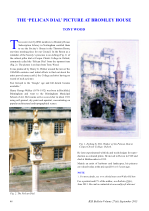
Identifies an etching on loan to the BSS Library at Bromley House as a depiction of the cubical pillar dial, commonly called the ‘Pelican Dial’, at Corpus Christi College, Oxford. The etching was produced by artist Henry G. Walker (1876–1932).
Dials: Multi Faced, Dials: Cube
March 2014
Page 46
Page 46
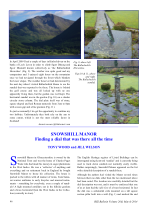
This article describes the unexpected discovery of a substantial cube sundial at Snowshill Manor, Gloucestershire. The dial, constructed of Cotswold limestone and likely dating from 1722, was overlooked because it was built into a wall and had suffered severe erosion, losing its gnomons and delineation, making it resemble an ordinary gatepost.
Dials: Cube, Historical Dials, Restoration projects
December 2014
Page 12
Page 12
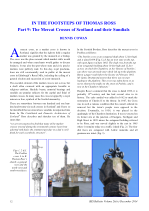
This article examines Scottish mercat (market) crosses that incorporate sundials, such as those described by Thomas Ross. These are symbolic structures, often featuring multi-faced cube dials. Examples discussed include the Peebles cross (1662 cube sundial) and the Airth cross (1697). The author notes the common issues of relocation and subsequent restoration/damage.
Dials: Cube, Dials: Multi Faced, Historical Dials
December 2013
Page 18
Page 18
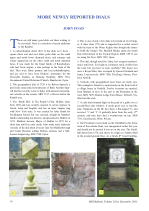
A selection of recent additions to the Sundial Register, including a cuboctahedron (1823), a geographical dial (1720) by Robert Spurrell, the restored 'Smith Dial' (1858), a river bridge dial (1770), and various vertical, cube, and pillar dials across England and Scotland.
Dials: Cube, Dials: Multi Faced, Historical Dials, The BSS and Members
September 2012
Page 45
Page 45
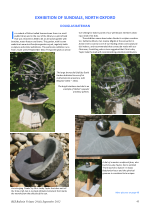
This entry describes a sundial exhibition held from June to September 2012 in the Turrill Sculpture Garden, Summertown, Oxford. It features 11 dials by BSS members, including David Harber's bronze dial and armillary sphere, Chris Lusby Taylor's sculptural "Undial" and "From Sunrise to Sunset" dials, and a cube dial by Harriet James.
Dials: Unusual, The BSS and Members, Dials: Cube, Dials: Armillary Sphere
December 2012
Page 6
Page 6
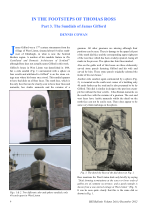
This third part traces sundials attributed to 17th-century Scottish stonemason James Gifford, following Thomas Ross's research. It examines various cube-and-sphere dials in West Linton and Newhall House, as well as the intricate multi-faceted dial at Lennoxlove, detailing their designs, numerals, and historical context within the Scottish Borders region.
Dials: Cube, Dials: Multi Faced, Historical Dials, Sundial Design & Layout
December 2012
Page 21
Page 21
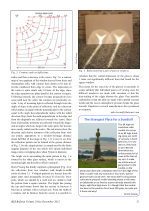
The article describes a 6ft high red sandstone cubic sundial atop an 8ft standing stone north of Luncarty, Perth & Kinross. Situated in a field, the dial's numerals and hour lines are indistinct, but gnomon holes are visible. Its century-long presence and origins remain a mystery.
Dials: Cube, Dials: Unusual, Historical Dials
December 2012
Page 26
Page 26
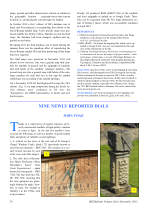
This article reports on nine previously unrecorded or undocumented sundials. Highlights include a 1723 vertical dial at Windsor Castle, a Scottish-style cube dial at Restoration House, a pre-1752 horizontal dial by John Davis of Windsor, and various vertical, geographical, and unusual fixed horizontal analemmatic dials across England.
Dials: Cube, Dials: Horizontal, Dials: Vertical, Historical Dials
March 2008
Page 38
Page 38
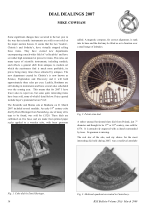
Reports on sundial sales at major auction houses in 2007, noting a shift away from scientific instruments by Christie's and Sotheby's. It details sales at Bonhams, including a 19th-century cube dial, a 17th/18th-century Polish slate dial, and a medieval astrolabe quadrant found in Canterbury. Other notable sales include portable dials by Edm. Culpeper and a double crescent dial by Johann Martin.
Dials: Portable, Historical Dials, Dials: Cube, Dials: Double Horizontal
December 2008
Page 163
Page 163
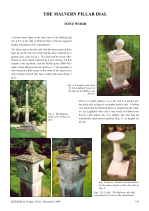
This article reports on the Malvern pillar dial, noting its removal from an old cross shaft and replacement with a gabled cross. The original cube dial has been refurbished or replaced, and is now mounted on a short column in the churchyard. It also mentions a modern cube dial by Liz Leighford based on a similar design.
Dials: Cube, Historical Dials, Restoration projects
March 2007
Page 2
Page 2
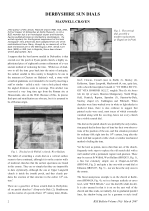
This article provides an overview of sundials found in Derbyshire, from ancient scratch dials on medieval churches to more sophisticated wall and public sundials. It highlights notable examples like the Eyam parish church dial and various works attributed to the Whitehurst family of clockmakers. It also touches on the historical context of timekeeping for ordinary people and the aristocracy.
Dials: Vertical, Restoration projects, Historical Dials, Dials: Cube
July 1997
Page 53
Page 53
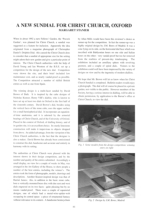
This article describes a new sundial being commissioned for the Fellow's Garden at Christ Church, Oxford. It discusses the design competition and the winning entry.
Dials: Cube, Dials: Multi Faced, Sundial Design & Layout
October 1996
Page 2
Page 2
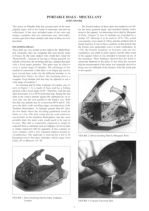
A concluding article in a series about portable dials, detailing lesser-known types such as inclining dials, universal dials, compass dials, cube dials, and novelty items like walking stick dials, with historical context and examples.
Dials: Cube, Dials: Portable, Historical Dials
June 1992
Page 10
Page 10
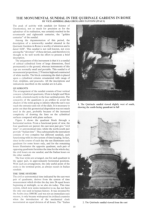
This article describes a unique monumental cubical-cylindrical sundial from 1628 in Rome's Quirinale Gardens, 2.70 meters high, constructed of white marble. It features four concave quadrants indicating both civil/astronomical time and 'Italian time,' reflecting different timekeeping systems. The dial also includes zodiacal curves for calendrical indications and intricate Latin inscriptions from its author Theodosius Rubeus and patron Urbano VIII Barberini.
Dials: Cube, Dials: Multi Faced, Dials: Unusual, Historical Dials
June 1992
Page 30
Page 30
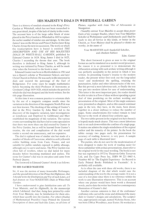
This article details the large cubic sundial erected in Whitehall's Privy Garden in 1622 for King James I, replacing an earlier Caen stone dial. Based on Edmund Gunter's 1624 treatise, it describes the intricate design with multiple dials, including a great horizontal concave. The dial's use led to the discovery of magnetic variation, and its sculptor was Nicholas Stone.
Dials: Cube, Dials: Multi Faced, Historical Dials
October 1992
Page 31
Page 31
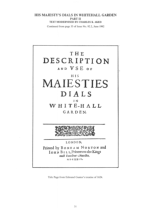
This article, based on Edmund Gunter's 1624 treatise, continues the original description of the intricate multi-faced cubic sundial in Whitehall Gardens. It details the use of various coloured lines (red, yellow, green, blue) on different dial faces to indicate azimuth, altitude, unequal "planetary" hours, sun's rising/setting times, length of day, and even the age of the moon and high water times. Geographical tables for longitude differences are also included.
Dials: Cube, Dials: Multi Faced, Historical Dials