- Home
- /
- Sundial Encyclopaedia
- /
- Roger Bowling
Roger Bowling
December 2013
Page 34
Page 34
Explores the history and significance of lead Blackamoor and Indian figures supporting sundials in Georgian gardens, associating them with the wealth derived from the Atlantic slave trade. There is an inventory of known figures and their sculptors (John Nost I/II, Carpentiere, Cheere).
Dials: Horizontal, Historical Dials, The BSS and Members
September 2010
Page 35
Page 35
This section contains two letters: Maurice J. Kenn congratulates Michael Maltin on his 'Novel Meridian Finder' and discusses the dipleidoscope; Roger Bowling queries if anyone has seen Haidinger’s brushes and the perception of polarised light.
How Sundials Work, Dialling Tools
December 2010
Page 38
Page 38
This article analyses Dante Gabriel Rossetti's painting Beata Beatrix focusing on the symbolic significance of the sundial depicted with its shadow on the hour nine. It delves into Rossetti's personal connection to the number nine, drawing parallels between Dante's love for Beatrice and Rossetti's relationship with Lizzie Siddal, and offers an interpretation of the sundial's deeper meaning within the artwork.
Dials: Horizontal
June 2009
Page 46
Page 46
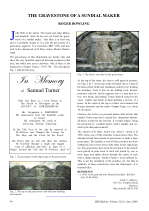
Identifies the gravestone of Samuel Turner (1716-1784), a shepherd who became a dial-maker and engraver. The slate memorial in Market Harborough, likely self-designed, features an engraved west-facing sundial and tells his life story.
Dials: Vertical, Historical Dials
September 2009
Page 32
Page 32
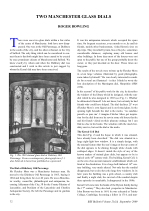
Discusses two now-lost stained-glass sundials from the Manchester area. One, at Didsbury Old Parsonage, was designed in 1903 by Fletcher Moss. The author describes the second, an 18th-century dial at Kersal Cell, and speculates it may have been instigated by its owner, the prominent Jacobite John Byrom.
Dials: Unusual, Dials: Vertical, Historical Dials
March 2008
Page 48
Page 48
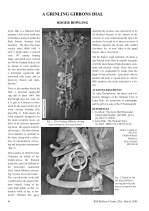
Describes a non-working universal equinoctial ring dial, about 12cm in diameter, incorporated into a 1684 lime-wood carving by Grinling Gibbons. This carving, representing arts and sciences, is located in the saloon of Lyme Hall, alongside other astronomical and navigation instruments, reflecting Sir Richard Legh's interest in the sciences.
Dials: Equatorial, Dials: Unusual, Historical Dials
June 2008
Page 62
Page 62
Michael Maltin speculates on the original location and an engraving error of a Melville dial, suggesting it was for the Midlands but ended up in Salisbury. Roger Bowling shares a 'sad story' about a stolen churchyard dial from Prestbury Parish Church, mistakenly printed reversed in the Bulletin, and mentions its appearance in Alice Morse Earle's book.
Historical Dials
September 2008
Page 121
Page 121
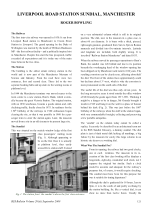
This paper describes the 1833 sundial at Liverpool Road Station, Manchester, the world's oldest extant railway station. It details the brass dial's features, its historical significance in railway timekeeping disputes, and its role as a public relations tool. The original dial is now in a museum, replaced by a 'dummy' dial on site.
Dials: Vertical, Historical Dials, The BSS and Members
March 2007
Page 11
Page 11
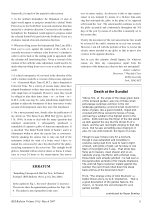
This contribution presents an excerpt from G.K. Chesterton's Father Brown story, 'The strange crime of John Boulnois'. The excerpt provides a vivid description of a garden sundial set on a mound, where a man's figure is seen clinging to it for a moment before falling.
Dials: Horizontal, Book Reviews
September 2007
Page 125
Page 125
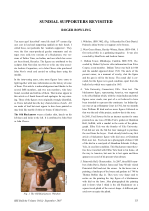
This article updates a previous account of 18th-century lead figures, known as sundial supporters attributed to sculptors John Nost or Andries Carpentiere. It identifies nine newly found figures (Old Blackamoor, Indian, Father Time types) and provides more historical details. These mass-produced garden ornaments show varying locations of extant and lost examples.
September 2006
Page 109
Page 109
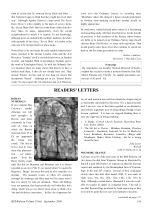
This section features diverse reader contributions. Topics include an anticlockwise convention for Roman numerals on old dials, warnings about Pearson-Page sundial replicas that can cause historical errors, the disappearance of a modern sundial at St. Gregory’s Minster, and a sceptical view on theories regarding continental cathedral meridian lines.
Historical Dials
September 2005
Page 130
Page 130
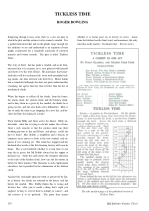
This article discusses a 1918 play that centres on some domestic conflict arising from a man championing a self-made sundial replacing and burying all the clocks in their house, considering it 'honest time'. The play includes accurate detail about sundials and the equation of time.
Book Reviews
June 2002
Page 58
Page 58
Documents rare horizontal scratch dials found in Scottish churchyards and compares them to a similar English example, discussing their form and function.
Dials: Horizontal, Historical Dials, Dials: Mass Dials
January 1997
Page 34
Page 34
The gods, humans, or beasts supporting the escutcheon are called supporters. This article describes figure(s) holding or supporting the dial in place of a plinth.
April 1997
Page 45
Page 45
Sundial supporters - a group of early 18th century lead figures supporting garden dials.