- Home
- /
- Sundial Encyclopaedia
- /
- December 2009
December 2009
The articles link to the specific page in a PDF optimised for speed. If you want the whole issue, you can download it here, but the files from earlier years can be quite large.
December 2009
Page 1
Page 1
Two articles describe dials which make use of the catenary curve while the themes of stolen dials, mass dials and new dials are continued. A ‘Happy Christmas’ and sunny winter solstice to all members!
The BSS and Members
December 2009
Page 2
Page 2
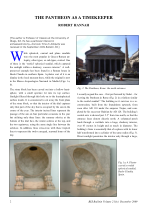
This article argues that the Pantheon in Rome functions as a large-scale timekeeper, similar to a roofed spherical sundial. It examines how sunlight entering through the oculus marks specific times of the year, such as the equinoxes, and compares its astronomical features to those of Nero's Domus Aurea.
Dials: Hemispherical, Dials: Unusual, Historical Dials
December 2009
Page 5
Page 5
The first letter describes an innovative focusing sphere lens made of lucite and copper sulphate, designed for use in a sundial. The second letter confirms that Samuel Turner, a diallist, was also the sculptor of his own tombstone which features a direct west dial.
Dials: Unusual, How Sundials Work, Historical Dials
December 2009
Page 6
Page 6
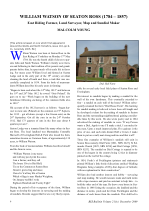
A biography of William Watson, a farmer, surveyor, and self-taught sundial maker from East Yorkshire. The article details his life, his unique 'canted-over gnomon' dial designs, his publication on dialling, and other interests. An addendum discusses the surviving examples of his work.
Dials: Vertical, Historical Dials
December 2009
Page 9
Page 9
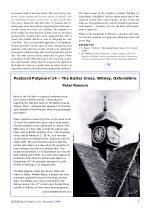
This piece analyses a vintage postcard of the Butter Cross in Witney. By comparing the time shown on the clock with the local solar time on the sundial, and accounting for British Summer Time and the equation of time, the author deduces the exact date the photograph was taken.
Equation of Time, Historical Dials, The BSS and Members
December 2009
Page 10
Page 10
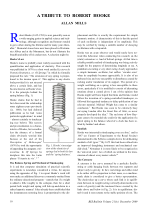
This article celebrates the genius of Robert Hooke, highlighting his key scientific contributions. It covers Hooke's Law and its application to timekeeping, his work on a universal joint for delineating sundials, and his pioneering (though unpublished) insights into the catenary arch. It proposes a sculptural memorial to Hooke.
How Sundials Work, Sundial Design & Layout, Historical Dials
December 2009
Page 13
Page 13
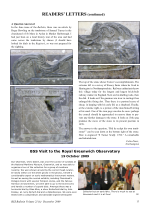
A short report on a British Sundial Society members' visit to the Royal Greenwich Observatory. The group received a guided tour, viewed famous horological exhibits like the Harrison chronometers, and were given special access to handle rare and notable sundials from the museum's storage rooms.
Historical Dials, The BSS and Members
December 2009
Page 14
Page 14
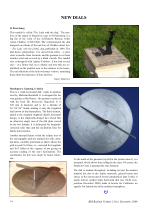
This section presents two new dials. The first is a stone vertical dial near St Petersburg with a theme from a Chekhov story. The second is a 'triple horizontal dial' made of stainless steel for a garden in South Africa, which includes a nocturnal and family anniversary lines.
Dials: Horizontal, Dials: Unusual, Dials: Nocturnals
December 2009
Page 15
Page 15
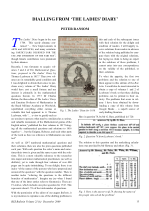
Introducing a series of articles on dialling problems from 'The Ladies’ Diary', a popular 18th-century almanac. The author presents the first question, from 1720, along with its original geometric construction and calculated solution, providing insight into the historical mathematics of dialling.
Mathematics of Dialling, Historical Dials
December 2009
Page 17
Page 17
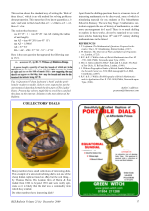
This brief feature highlights a universal inclining dial by the London firm Thomas Harris & Son from a member's collection. The dial is noted as a genuine antique from the 19th-century firm of opticians, rather than a modern replica, and an appeal is made for other members to share their interesting dials.
Dials: Portable, Historical Dials, The BSS and Members
December 2009
Page 18
Page 18
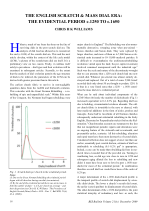
The article analyses the prevalence of scratch and mass dials during the period following the Great Norman Rebuilding. Using a 'life cycle model', it argues that the era was highly dynamic, with dials frequently lost to rebuilding or abandoned, having an average in-use lifespan of about 100 years.
Dials: Mass Dials, Historical Dials
December 2009
Page 19
Page 19
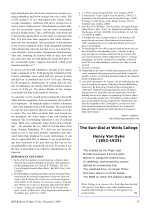
A short poem reflecting on time as shown by a sundial's shadow, which divides the past from the future, leaving only the present 'NOW' in one's hands. An editorial note identifies the dial's location and mentions the poem's frequent use on modern sundials.
Mottoes
December 2009
Page 20
Page 20
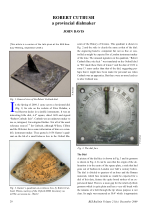
An investigation tracing the history of a 1699 horizontal dial signed by Robert Cutbush. The author identifies the maker as part of a family of Kent clockmakers and discovers that the dial was stolen from Ightham churchyard before 1978. The article concludes with the dial's successful return.
Dials: Horizontal, Historical Dials, Restoration projects
December 2009
Page 23
Page 23
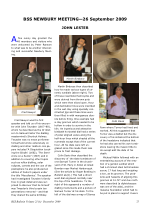
A summary of the autumn meeting of the British Sundial Society. The report covers the day's lectures on a variety of topics, including diallists John Twysden and Robert Cutbush, the creation of ceramic sundials, and Roman dials in Britain, as well as exhibits shared by members.
The BSS and Members
December 2009
Page 26
Page 26
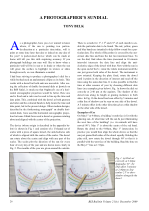
Describes the design and use of a pocket-sized device for photographers to predict the sun's direction at any time of day or year. Based on a horizontal stereographic projection, the instrument uses a rotating dowel aligned with date and time scales to help plan for specific lighting conditions.
DIY Sundial Projects, Dials: Unusual, Sundial Design & Layout
December 2009
Page 28
Page 28
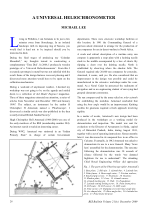
Details the design and construction of a modern, portable heliochronometer. The instrument, inspired by H.C. Armstead's 'Phoeboscope', uses a spot of light on an analemma to provide a numerical time readout. It can be adjusted for latitude, longitude, the equation of time, and summer time.
Construction Projects, Dials: Heliochronometer, Equation of Time
December 2009
Page 33
Page 33
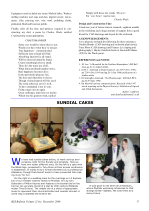
A light-hearted feature showing two sundial-themed cakes. One, with the NASS logo, was for dialmaker Tony Moss upon his retirement. The other was a wedding cake for BSS member, Andrew James, featuring an accurate horizontal dial on the top tier and other personal musical and travel motifs.
The BSS and Members
December 2009
Page 34
Page 34
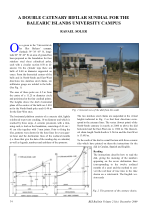
This article describes a large and innovative bifilar sundial. It uses the intersecting shadows cast by two suspended chains hanging in catenary curves to indicate both the time and the date on a large tiled pavement. The article provides a summary of the complex mathematical calculations involved in its design.
Dials: Bifilar, Dials: Unusual, Mathematics of Dialling, Sundial Design & Layout
December 2009
Page 37
Page 37
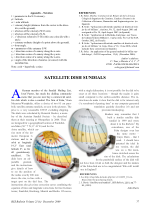
A report on a commercial satellite dish, produced by the German firm Fuba, that incorporates a functional sundial on its parabolic surface. The author notes that the dial is designed for a specific latitude and satellite position and remarks on its similarity to a dish dial he built himself in 1999.
Dials: Vertical, Dials: Unusual
December 2009
Page 38
Page 38
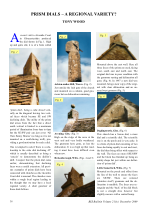
This article examines 'prism dials', a form of multi-faced dial created from a diagonally sliced cube, resulting in south-east and south-west declining faces. The author provides a gazetteer of several examples found within a specific area of Gloucestershire and Wiltshire, questioning if they represent a local style.
Dials: Multi Faced, Dials: Vertical, Historical Dials
December 2009
Page 40
Page 40
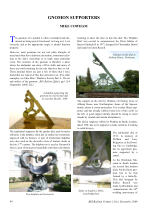
A survey of the artistic and decorative supports used for gnomons on different types of sundials. The article presents numerous photographs of historical and modern examples, including dolphins, snakes, butterflies, skeletons, and intricate scrollwork, and invites readers to share pictures of other interesting designs.
Sundial Design & Layout, Historical Dials
December 2009
Page 43
Page 43
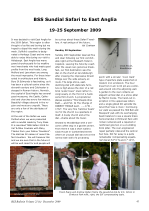
A multi-authored, day-by-day account of the society's annual week-long tour, this year through East Anglia. The report details the many historical and modern dials visited in Suffolk, Norwich, Essex, and surrounding areas, providing a travelogue of the group's discoveries and activities.
Historical Dials, The BSS and Members