- Home
- /
- Sundial Encyclopaedia
- /
- Karlheinz Schaldach
Karlheinz Schaldach
September 2022
Page 34
Page 34
A summary of recent international research into medieval sundials. Highlights the Fachkreis Sonnenuhren database (696 German objects) and debates whether scratch dials are pilgrim symbols. Mentions new findings on medieval texts describing unequal-hour sundials and the construction of polar style dials.
How Sundials Work, Historical Dials, Dials: Mass Dials
December 2018
Page 28
Page 28
Summarises the history of research into medieval sundials, tracing initial interest back to George Victor Du Noyer and Albert Way in the mid-19th century. Highlights the crucial roles of Margaret Gatty (mottoes) and later scholars like Dom Ethelbert Horne in cataloguing scratch dials (mass dials), leading up to the work of Ernst Zinner.
Dials: Mass Dials, Historical Dials
March 2015
Page 2
Page 2
Analysis of a medieval sundial, inaccessible to the public, found in the store-room of the acropolis of Lindos on Rhodes. Carved from white marble, the dial features a circular design with three time lines dividing daylight into four parts. Based on similarity to English examples and the four-division structure unique to Latin Europe, the article suggests Frankish influence and dates its creation to the 14th century for use by the Hospitallers.
Dials: Unusual, Dials: Vertical, Historical Dials
September 2013
Page 6
Page 6
Detailed description and analysis of a solid white marble globe sundial from antiquity (c. 100 BC) found near Heraion. It uses the terminator (boundary of light and shadow) for time indication and features complex line systems representing hours, seasons, and zodiacal signs.
Dials: Hemispherical, Dials: Unusual, Historical Dials, Mathematics of Dialling
February 1998
Page 46
Page 46
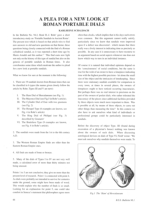
Argues for re-evaluation of Roman portable dials: forms, readings and classification, urging fresh analysis of surviving pieces and their interpretation.
Dials: Portable, Historical Dials
October 1998
Page 44
Page 44
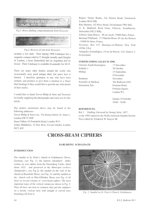
This article investigates the history and interpretation of cross-beam ciphers found on medieval sundials and calendars across Northern and Central Europe. It challenges previous terminologies like 'carpenter's numerals' and 'Styrian ciphers', proposing a new theory that these ciphers originated from condensed counting frames (abaci) used for financial calculations.
Historical Dials, Sundial Design & Layout
October 1996
Page 32
Page 32
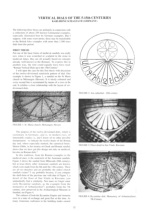
A scholarly examination of vertical sundials from the early medieval to late medieval periods, including typologies, geographic distribution, and functional evolution.
Dials: Vertical, Historical Dials