- Home
- /
- Sundial Encyclopaedia
- /
- February 1990
February 1990
The articles link to the specific page in a PDF optimised for speed. If you want the whole issue, you can download it here, but the files from earlier years can be quite large.
February 1990
Page 2
Page 2
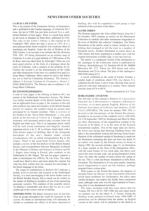
This notice reports the death of Dr. F. A. B. Ward, the first President of the British Sundial Society, at the age of 85. It acknowledges him as the foremost expert on dialling in Britain and a significant figure in mechanical horology, highlighting his work at the Science Museum and his numerous publications and lectures.
The BSS and Members
February 1990
Page 3
Page 3
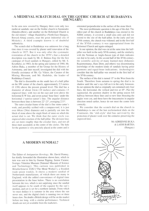
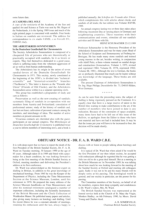
This article details a medieval scratch dial found on the Gothic church in Rudabanya, Hungary, which was uncovered during renovations in 1927 and extensively studied during systematic restoration in the 1970s. The dial, approximately 24cm in diameter with 13 engraved lines, is believed to date from the early 15th century, contemporary with the half-pillar it is on. It is considered one of the last "old-style" ecclesiastical dials on the Continent, preserved by centuries of plaster work
Historical Dials, Dials: Mass Dials
February 1990
Page 4
Page 4
This article, an extract from The Observatory, proposes a method to improve the accuracy of observing shadows by precisely determining the boundary between the shadow and half-shadow using a piece of cardboard on a white screen. This technique can demonstrate the Earth's diurnal motion in seconds and accurately find the noontide shadow position to detect small changes in the Sun's altitude. The author speculates if a similar method was known in pre-telescope times, possibly in connection with structures like the Great Pyramid.
How Sundials Work
February 1990
Page 5
Page 5
This article delves into the history and interpretation of mottoes (inscriptions) found on sundials, noting that their extensive use became popular with the advent of "modern" scientific sundials in the 15th century. It explores various Latin and Greek phrases, often derived from scriptures or classical texts, such as "TEMPVS VMBRA" and "SIC TRANSIT GLORIA MVNDI". The article also discusses how sundials often provide the "Emblem" for common mottoes and the inherent ambiguities in translating Latin inscriptions.
Mottoes
February 1990
Page 8
Page 8
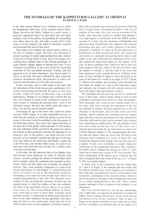
This article describes the sundials located on the Kappelturm (bell tower) of the former Notre-Dame church in Obernai, where 16th-century watchmen improvised sundials scratched directly onto the walls when their mechanical clock malfunctioned. It identifies two sundials on the East face, nine on the South face, and one on the West face. The author notes their inaccurate construction due to the watchmen's lack of gnomonic principles, describing them as "caricatures" of true dials. The article includes detailed figures and footnotes explaining the dial configurations and their historical context, including the use of Roman and Arabic numerals.
Dials: Mass Dials
February 1990
Page 12
Page 12
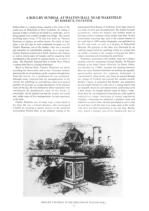
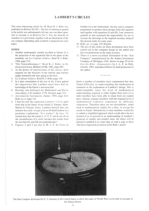
This article focuses on the multi-faceted sandstone sundial dating from 1813 at Walton Hall, the home of Sir Charles Waterton. The sundial was crafted by the self-taught stonemason George Boulby and features a polar axis serving as gnomons, with approximately sixteen dial faces still visible. Each face is designed for a specific part of the world and includes curves indicating zodiacal constellations. The article also speculates on Waterton's potential early interest in sundials, possibly stemming from his time at Stonyhurst College, known for its solar studies
Historical Dials
February 1990
Page 14
Page 14
Easy to Make Wooden Sundials - Instructions and Plans for 5 projects This review covers Milton Stoneman's booklet, which offers step-by-step instructions and templates for constructing various types of sundials, including horizontal, vertical, and equatorial models. It is presented as an accessible introduction to gnomonics, primarily for readers in the United States, and contains sections on sundial history, dial correction, equation of time, longitude, magnetic variation, hour angles, and a list of sundial mottoes. Clockmaking in Oxfordshire 1400-1850 This review discusses Dr. C.F.C. Beeson's book, which, despite its title, includes a small section detailing sundials in Oxfordshire (pages 76-80). It notes that many of these sundials have since vanished but were documented through Beeson's patient research. The review highlights the book's improved indexing and outlines the historical relationship between sundials and mechanical clocks, noting that their partnership ended with the advent of electrical communications
Book Reviews
February 1990
Page 15
Page 15
This article examines Leonard Digges' work, A Prognostication, first published in 1553, which details methods for telling time by the sun and stars using instruments and tables. The accompanying comments describe Digges' instrument as basically a form of equatorial dial with a polar gnomon, which indicates time using a "peculiar Kalendar" for calculations
Book Reviews, Sundial Design & Layout
February 1990
Page 20
Page 20
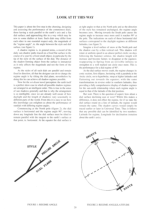
This paper explores the concept of "regime angle" in sundials, defined as the angle between the style and the dial surface. It introduces the idea that the Earth itself acts as a "show case" for various shadow regimes and illustrates how shadow curves change with latitude, showing examples for locations from the North Pole to the South Pole. The article also features Mr. Woodford's "Amundsen" dial
Dials: Unusual, How Sundials Work, Mathematics of Dialling
February 1990
Page 23
Page 23
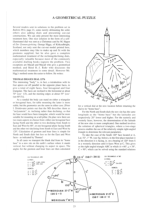
This article presents a geometrical puzzle related to dialling, referencing solutions previously published. It specifically details the "Thomas Digges Dial 1576," which is described as a tetrahedron with eight faces (four hexagonal and four triangular) inclined to the horizontal. The article outlines calculations for determining gnomon and hour lines for various faces and latitudes of this complex dial.
Mathematics of Dialling
February 1990
Page 24
Page 24