- Home
- /
- Sundial Encyclopaedia
- /
- June 2011
June 2011
The articles link to the specific page in a PDF optimised for speed. If you want the whole issue, you can download it here, but the files from earlier years can be quite large.
June 2011
Page 1
Page 1
The editorial discusses the popularity of the previous themed Bulletin on polyhedral dials and plans for future themed issues, acknowledging the difficulty in organising them. It also mentions the delay of the conference report to the September issue to allow for article variety.
The BSS and Members
June 2011
Page 2
Page 2
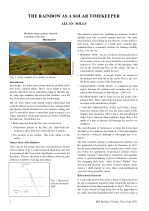
This article explores the rainbow as an alternative solar timekeeping phenomenon, discussing its complex optical properties, formation of primary and secondary bows, and the dispersion of light into colours. It also describes a rainbow dial instrument for time determination.
Dials: Unusual, How Sundials Work, Mathematics of Dialling, Sundial Design & Layout
June 2011
Page 8
Page 8
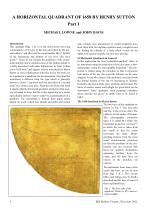
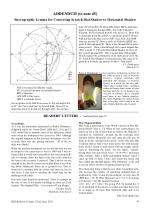
This article describes a unique 17th-century horizontal quadrant by Henry Sutton, detailing its stereographic projection, various scales for altitude, azimuth, time, and astronomical functions. It explains how the instrument, acting as a mechanical analogue computer, finds time from the sun's altitude.
Dialling Tools, Dials: Horizontal, Historical Dials, Mathematics of Dialling
June 2011
Page 13
Page 13
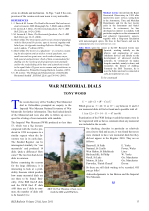
This article discusses the discrepancy in the number of war memorial sundials identified by the British Sundial Society and the Imperial War Museum. It applies a probability theorem to estimate the number of unfound dials and lists several previously unrecorded examples in churches.
Historical Dials
June 2011
Page 14
Page 14
This chronicle by a founding member of the BSS details his career at the National Maritime Museum, his early involvement with sundials, and his experiences designing notable dials like the 'Dolphin' sundial for the Queen's Silver Jubilee, leading up to the formation of the BSS.
Sundial Design & Layout, Construction Projects, Historical Dials, The BSS and Members
June 2011
Page 20
Page 20
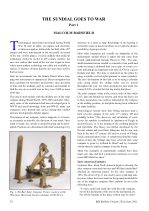
This article explores the military use of solar compasses, particularly during World War II, for navigation in unmapped desert terrains. It describes several models, including the Burt, Abrams, Cole Universal, Bagnold, and Union Observatory sun compasses, highlighting their principles and operational advantages.
Dials: Analemmatic, Dials: Portable, Dialling Tools, Historical Dials
June 2011
Page 25
Page 25
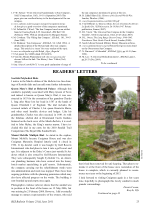
This letter provides additional information on Scottish polyhedral dials, specifically clarifying the history of Queen Mary’s Dial at Holyrood Palace and providing an update on the Mount Melville Multiple Dial's restoration plans after its removal for safekeeping.
Dials: Multi Faced, Restoration projects, Historical Dials
June 2011
Page 26
Page 26
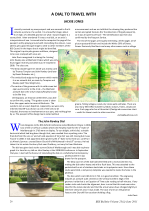
This note describes the discovery of the 'missing' John Rowley azimuth dial from Blenheim Palace, which was identified on a new passport design. It details the dial's distinctive features and its reinstallation in 2008.
Dials: Unusual, Historical Dials, The BSS and Members, Dials: Double Horizontal
June 2011
Page 26
Page 26
This article details the rediscovery and reinstallation of a lost John Rowley azimuth and equation of time dial from Blenheim Palace. It describes its unique features, including the deep double-ogee rim and specific gnomon design, and its historical significance.
Dials: Unusual, Equation of Time, Historical Dials, Restoration projects
June 2011
Page 27
Page 27
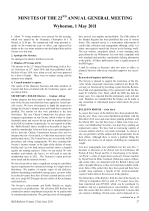
This entry summarises the proceedings of the BSS 22nd Annual General Meeting, including the Chairman's remarks, approval of previous minutes, council member reports (Secretary, Editor, Register, Mass Dial Group, Advertising, Safaris, Treasurer, Membership, Competitions), election of new officers, and post-AGM discussions.
The BSS and Members
June 2011
Page 28
Page 28
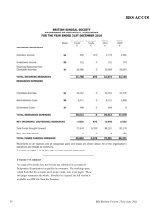
This section provides a summary of the British Sundial Society's accounts for 2010, indicating an underlying decline in funds due to low interest rates and falling membership, necessitating a future increase in subscription rates.
The BSS and Members
June 2011
Page 33
Page 33
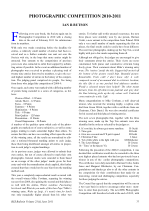
This article reports on the 2010 Photographic Competition, detailing the judging process, the unprecedented triple win by Mike Cowham, and the top ten entries. It also announces the shift to a biennial competition schedule to encourage more participation.
The BSS and Members
June 2011
Page 36
Page 36
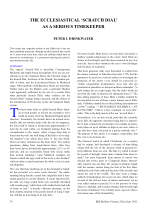
This article argues that medieval 'scratch dials' were serious timekeepers, not just symbolic. It describes their basic form, historical context of temporal hours, and connections to early Church observances and Islamic prayer times, asserting their utility at high latitudes.
Dials: Mass Dials, Historical Dials, How Sundials Work, Mathematics of Dialling
June 2011
Page 43
Page 43
Gordon Taylor describes challenges in orienting the Seven Dials monument. John Foad, the Registrar, corrects the number of war memorial dials in the BSS Register, increasing the total and, consequently, the estimated number of unfound dials using Tony Wood's formula.
Historical Dials, The BSS and Members
June 2011
Page 44
Page 44
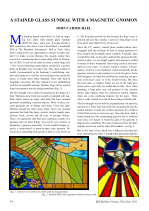
This article details the design and construction of a stained glass sundial featuring a novel magnetic gnomon, shaped like a frog, which attaches without drilling, soldering, or gluing. It explains the experimental process of developing this damage-resistant magnetic attachment.
Dials: Vertical, Sundial Design & Layout, Construction Projects, Dials: Stained Glass
June 2011
Page 48
Page 48
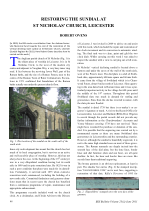
This article describes the restoration of a 1738 vertical declining Swithland slate sundial at St Nicholas’ Church, Leicester. It details the process of in-situ gilding of the numerals and lines, using specific materials and techniques for durability, and notes a previous gnomon replacement in 1896.
Dials: Vertical, Historical Dials, Restoration projects
June 2011
Page 51
Page 51
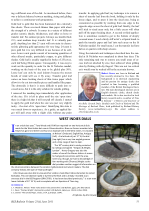
This piece reports on two horizontal sundials found in the West Indies. One at Nelson's Dockyard, Antigua, dated 18th-century and signed Gregory & Wright London, provides new information on makers' interconnections. Another by Henry Pyefinch in Barbados is also mentioned.
Dials: Horizontal, Historical Dials
June 2011
Page 54
Page 54
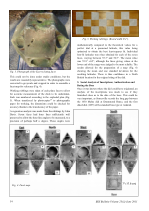
This article describes the discovery and analysis of a 17th-century Scottish polyhedral sundial boss found in Hertfordshire. It establishes the boss's authenticity, its Mylne family provenance, and uses geometric analysis and inscriptions (Acra, Tangier) to date it before 1684, suggesting it's a significant missing link.
Dials: Multi Faced, Historical Dials, Mathematics of Dialling