- Home
- /
- Sundial Encyclopaedia
- /
- December 2010
December 2010
The articles link to the specific page in a PDF optimised for speed. If you want the whole issue, you can download it here, but the files from earlier years can be quite large.
December 2010
Page 1
Page 1
This editorial discusses the suggestion of including author photographs and short descriptions in Bulletin articles. It also mentions the absence of 'Guidelines for Contributors', and the delay of an article on Earth's orbital eccentricity due to illness.
The BSS and Members
December 2010
Page 2
Page 2
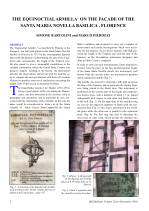
This article describes the Equinoctial Armilla, built by Egnazio Danti in 1573 on the Santa Maria Novella basilica in Florence. Its purpose was to determine the Equinox time and tropical year length, contributing to calendar reform. The article discusses its historical context, Danti's observations, chronological discrepancies, measurement errors due to the armilla's size, and the instrument's features.
Mathematics of Dialling, Historical Dials, Dials: Armillary Sphere
December 2010
Page 7
Page 7
This section includes letters from readers. Frans Maes describes a multi-faceted obelisk sundial in Schwäbisch Gmünd, Germany, similar to one previously discussed. Allan Mills and Michael Lowne provide detailed explanations and practical advice on how to observe the optical phenomenon known as 'Haidinger’s brush,' which appears due to polarized light in the blue sky.
Dials: Multi Faced, How Sundials Work
December 2010
Page 9
Page 9
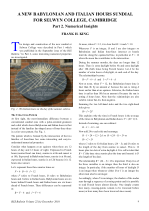
This article is the second part of a series detailing the Selwyn College sundial, focusing on its numerical properties. It explains the criss-cross pattern of Babylonian and Italian hour-lines, their relationship with French hours, and the concept of 'extra daylight.' It also provides methods for setting out these hour-lines.
Dials: Unusual, How Sundials Work, Mathematics of Dialling, Sundial Design & Layout
December 2010
Page 11
Page 11
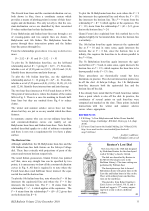
This entry describes a now-lost sundial designed by Nicholaus Kratzer in 1520 for St Mary's churchyard wall in Oxford. Based on a design in Kratzer's MS De Horologiis it showed Babylonian hours in green on the East side, Italian hours in blue on the West, and ordinary hours and declinations on the south face.
Dials: Multi Faced, Dials: Unusual, Historical Dials
December 2010
Page 12
Page 12
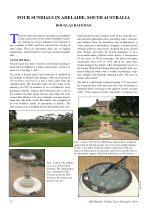
This report details four sundials in Adelaide. It includes the Olde Adelaide Sundial at Carrick Hill House with a unique equation of time reflecting South Australia's time zone, two dials at Seymour College, and an unusual polar meantime dial by Government Astronomer Charles Dodwell in the Pioneer Women’s Memorial Garden.
Dials: Horizontal, Dials: Polar, Dials: Vertical, Historical Dials
December 2010
Page 17
Page 17
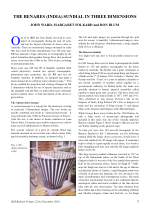
This article discusses the Benares Sundial, one of five equatorial sundial observatories built in India by astronomer prince Sawai Jai Singh II in the 18th century to rectify astrological errors. The authors also describe their work with stereoscopic images and an autocyclostereoscope for viewing 3D images without special glasses, including a 1902 stereograph of the Benares sundial.
Dials: Equatorial, How Sundials Work, Historical Dials
December 2010
Page 20
Page 20
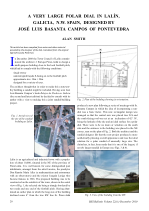
This article describes a very large polar sundial designed by José Luis Basanta Campos for a multi-purpose building in Lalín, Spain. The dial is 20m x 10m on a south-facing roof inclined at the site's latitude, with a 3m gnomon. It shows hour lines from 7:00 am to 5:00 pm and lines of declination for the 20th of each month, applied using weather-resistant adhesive plastic.
Construction Projects, Dials: Polar, Sundial Design & Layout
December 2010
Page 22
Page 22
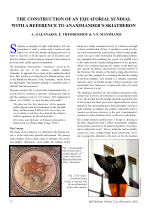
This article describes the design and construction of an equatorial sundial inspired by Anaximander's 'skiatheron,' aiming to be an operational work of art. Made from matted stainless steel, the dial uses dots instead of Arabic or Roman numerals for a timeless aesthetic. It also details the construction process, including computer design, prototyping, and addressing issues like rust and plate bending.
Dials: Equatorial, Sundial Design & Layout, Construction Projects, Historical Dials
December 2010
Page 25
Page 25
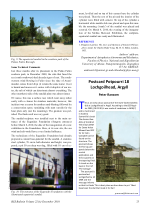
This article describes an early colour postcard of the multi-faceted obelisk dial at Lochgoilhead, Argyll, dating from 1696(?). The sandstone structure features initials DHM and SCC, five square panels, and six panels on the finial. The postcard, postmarked 1909, shows it on the lawn in front of ‘The Cottage.’
Dials: Multi Faced, Historical Dials
December 2010
Page 26
Page 26
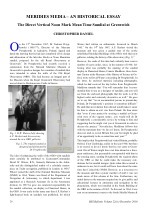
This historical essay details the Meridies Media sundial designed by Dr Tadeusz Przypkowski for the Old Royal Observatory at Greenwich in 1967. It describes the dial's function using an analemma to indicate standard mean time, true noon, and date. The article recounts the author's involvement in its installation, the initial design error, and the eventual reconstruction of the wooden dial in 1969, which remained until 1991.
Dials: Noon Lines, Equation of Time, Historical Dials, Restoration projects
December 2010
Page 31
Page 31
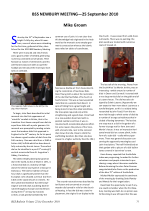
This report summarises the British Sundial Society's Newbury Meeting on 25 September 2010, attended by 36 members. It highlights short talks on scientific sundials in Britain, Essex dial restorations, and Devon/Cornwall dials. Exhibits included devices for determining sun direction, reproductions of historical dials, and modern designs.
Dials: Unusual, Historical Dials, Restoration projects, The BSS and Members
December 2010
Page 33
Page 33
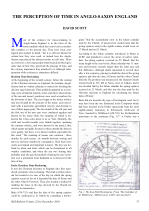
This article explores how time was perceived and reckoned in Anglo-Saxon England, drawing on surviving sundials and manuscripts. It covers heathen time-reckoning based on natural cycles, the introduction of systematic time-reckoning by Christian missions (including the Julian calendar, horologia, and Canonical Hours), and later monastic and village time-marking methods like shadow-length horologia and mass-dials, which evolved until the advent of mechanical clocks.
Dials: Mass Dials, Historical Dials, How Sundials Work
December 2010
Page 37
Page 37
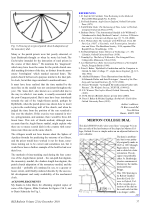
This entry describes the sundial on the east side of the chapel at Merton College, Oxford. Dating possibly from 1629 or 1659, and potentially redesigned by Jo. Bainbridge or Henry Briggs, it uses a simple nodus on an adjacent buttress to cast a shadow with criss-cross lines, although an extension on the south side shown in a 1922 drawing is no longer visible.
Dials: Unusual, Historical Dials
December 2010
Page 38
Page 38
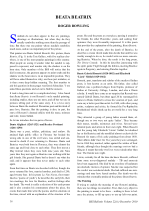
This article analyses Dante Gabriel Rossetti's painting Beata Beatrix focusing on the symbolic significance of the sundial depicted with its shadow on the hour nine. It delves into Rossetti's personal connection to the number nine, drawing parallels between Dante's love for Beatrice and Rossetti's relationship with Lizzie Siddal, and offers an interpretation of the sundial's deeper meaning within the artwork.
Dials: Horizontal
December 2010
Page 41
Page 41
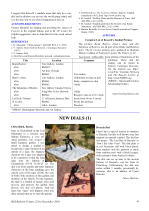
This article presents two new sundial designs. The first is a white marble sundial for a Japanese garden near Chelyabinsk, Russia, featuring a gnomon adapted from the Japanese character for 'tiger' and Japanese characters for hour markings. The second is a Dracula Dial with a gnomon of stainless steel and black lacquer, set near Korporie fortress, which was unfortunately stolen.
Construction Projects, Dials: Unusual, Sundial Design & Layout
December 2010
Page 42
Page 42
This second part of an article series establishes a method for age-ranking English mass and scratch dials (360°, 180°, and 90° types) from c.1250–c.1650. It uses cross-sectional analysis to demonstrate that 360° dials are the oldest, with their use ending around 1500 in favour of 180° and 90° types. The article also accounts for dial loss and regional adoption variations.
How Sundials Work, Historical Dials, Dials: Mass Dials
December 2010
Page 44
Page 44
This article describes a walk-on analemmatic sundial designed for Highlands School in North Vancouver, Canada, using 'Alemma' software. It features a double analemma design to provide direct mean time with minimal error, accommodating the equation of time correction. Parent volunteers built the dial, using plywood jigs and bronze survey markers for permanent reference.
Construction Projects, Dials: Analemmatic, Equation of Time, Sundial Design & Layout
December 2010
Page 45
Page 45
This report covers the fourth BSS Sundial Design Competition, which received 14 entries across restoration, professional, and amateur classes, though no junior entries. Graham Aldred won the Major Prize for his restoration of the Lyme Park dial. Other prizes were awarded for a south-facing vertical dial and highly commended entries for a sun/moon dial, a prototype noon mark dial, and a vertical dial using a 'super ellipse.'
Dials: Unusual, Restoration projects, Sundial Design & Layout, The BSS and Members