- Home
- /
- Sundial Encyclopaedia
- /
- March 2004
March 2004
The articles link to the specific page in a PDF optimised for speed. If you want the whole issue, you can download it here, but the files from earlier years can be quite large.
March 2004
Page 3
Page 3
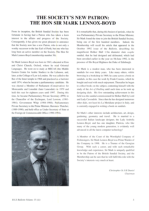
This article announces Sir Mark Lennox-Boyd as the new Patron of the British Sundial Society, succeeding the late Earl of Perth. It details Sir Mark's background, including his education, parliamentary career, and long-standing interest in sundials, noting his design achievements like the Holker Hall scaphe sundial. His diverse interests and expertise are presented as qualifications for this role.
The BSS and Members
March 2004
Page 4
Page 4
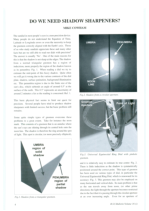
Explores methods to improve the precision of reading sundials, addressing the problem of the penumbra (fuzzy shadow) caused by the sun's finite disc. It discusses various gnomon designs, such as annular gnomons for noon marks, thin rod gnomons, and pinhole or taut wire gnomons, which create sharper shadows for more accurate time-telling.
Dials: Noon Lines, Dials: Portable, How Sundials Work, Sundial Design & Layout
March 2004
Page 6
Page 6
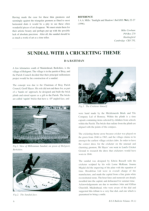
This article describes a millennium sundial project in Holyport, Berkshire, featuring a unique cricketing theme due to the village's history with the sport. Designed by Edwin Russell with cricketer sculptures by Lorne McKean, the dial includes hand-made 'quint' bricks, a time capsule, and hour lines delineated for summer time.
Construction Projects, Dials: Unusual, Sundial Design & Layout
March 2004
Page 7
Page 7
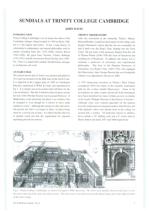
Provides a comprehensive overview of sundials and related astronomical instruments at Trinity College, Cambridge, highlighting the college's rich history in mathematics and natural philosophy. It describes early dials, the Trinity Observatory's instruments including those by Henry Sutton and John England, and more recent installations like the First World War Memorial dial.
Dials: Horizontal, Historical Dials
March 2004
Page 14
Page 14
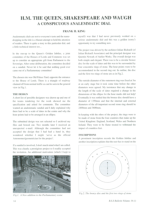
This article details the design and construction of an analemmatic sundial for the Queen's Golden Jubilee, located in Old Palace Yard, opposite the House of Lords. It covers the challenges of designing for a cambered surface, the selection of stone from UK countries, the prominent Shakespearean inscription, and the intricate process of determining the scale of dates for the dial.
Construction Projects, Dials: Analemmatic, Sundial Design & Layout
March 2004
Page 18
Page 18
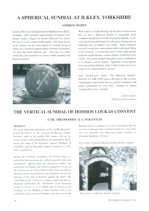
The author describes the rediscovery of a spherical sundial in a garden rockery in Ilkley, Yorkshire. Though eroded, the dial's equatorial line and Roman numerals were visible. The article notes its previous location and the commonality of such dials on gateposts, suggesting a possible need for closer examination of stone balls in similar settings.
Dials: Unusual
March 2004
Page 18
Page 18
This article details the discovery of a previously undocumented vertical sundial at the Hossios Loukas Convent in Greece, a significant Byzantine monument. The simple, scratched dial on the Church of the Theotocos wall, featuring Indo-Arabic numerals, is noted as a rare example of sundials on Byzantine buildings in Greece, with its construction date unknown but post-13th century.
Dials: Vertical, Historical Dials
March 2004
Page 21
Page 21
This article profiles Margaret Gatty (Mrs. Alfred Gatty), highlighting her diverse legacy in children's stories, seaweed studies, and her seminal work, 'The Book of Sundials'. It covers her early life, artistic talents, marriage, motherhood, and scientific interests, emphasising her dedication to collecting sundial mottoes which culminated in her famous book.
Historical Dials, Mottoes
March 2004
Page 25
Page 25
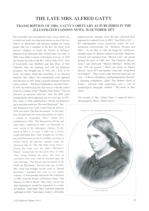
This is a transcription of an obituary for Mrs. Alfred Gatty, originally published in the Illustrated London News. It details her life as a respected author of children's literature, a daughter of Lord Nelson's chaplain, and her various published works, including "The Fairy Godmothers," "Parables from Nature," "British Seaweeds," and "The Book of Sun-Dials."
March 2004
Page 26
Page 26
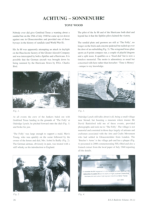
This article recounts an unusual incident from World War II where a German airman, Gottfried Treue, crash-landed at 'The Folly' in Gloucestershire in 1940 and broke his jaw on a sundial. The article describes the octagonal brass dial's features and its unique motto, "Time is Money," noting its current status as a "timeless memorial."
Historical Dials, Mottoes
March 2004
Page 27
Page 27
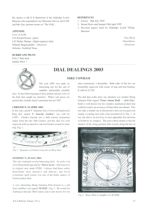
This article reviews notable sundial sales from 2003, highlighting various portable dials sold at auctions like Sotheby's and Christie's. It features different types of dials, including Butterfield dials, Universal Equinoctial Ring dials, String Gnomon dials, Miner's Dials, and a rare Elizabethan compass dial, discussing their features, makers, and sale prices.
Dials: Astrolabe, Dials: Portable, Historical Dials
March 2004
Page 31
Page 31
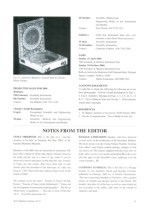
This editorial note covers various topics including an upcoming seminar on "Venus Observed," apologies for errors in the previous December Bulletin, and an announcement about a new booklet on "Guernsey Sundials" by David and Dorothy LeConte. It also mentions the accessibility of this booklet at the BSS Annual Conference.
Book Reviews, The BSS and Members
March 2004
Page 32
Page 32
This is a review of the booklet "Time" by Silke Ackerman and Paul Buck. It praises the booklet's clear and concise presentation of time measurement, including sundials, stars, sand-glasses, water-clocks, and watches. The review highlights its appeal to young readers, inclusion of cut-out models for equatorial sundials and nocturnals, and the provided compass for orientation.
Book Reviews, DIY Sundial Projects
March 2004
Page 33
Page 33
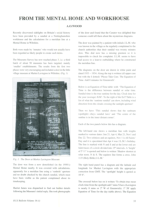
This article explores two historically significant sundial-related discoveries: a door from a demolished Mental Home in Wiltshire covered with calculations for a meridian line, and a scratch dial on the wall of a Nottinghamshire workhouse. It delves into the stories of the 'inmates' who created these and speculates on their accuracy and purpose.
DIY Sundial Projects, Dials: Noon Lines, Historical Dials
March 2004
Page 36
Page 36
This report describes a successful British Sundial Society display at a Fair in Tynemouth's Victorian railway station. The BSS stall showcased various dials, captivating visitors and generating interest, ultimately being remarked upon for overshadowing the station's newly restored clock, symbolising the enduring appeal of sundials.
The BSS and Members
March 2004
Page 38
Page 38

This article details the practical limitations and achievable accuracies when using a magnetic compass to determine true north, especially for diallists. It explains how Earth's magnetic field variations, crustal and external influences, and man-made objects affect compass readings, and provides methods, including online tools, for accurate magnetic variation calculation to assist sundial alignment.
Dialling Tools
March 2004
Page 42
Page 42
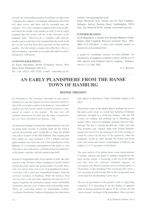
This article introduces a historical etching of a planisphere, an abstract representation of the globe showing time differences across various geographical locations relative to Hamburg's meridian. The author discusses its potential dating, its explicit mention of "sacrilegious art" in relation to sundials, and the varying accuracy of its geographical entries, inviting further information.