- Home
- /
- Sundial Encyclopaedia
- /
- March 2014
March 2014
The articles link to the specific page in a PDF optimised for speed. If you want the whole issue, you can download it here, but the files from earlier years can be quite large.
March 2014
Page 1
Page 1
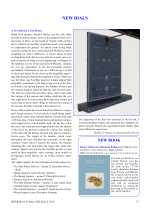
This editorial marks the British Sundial Society's 25th anniversary year and notes the wide range of articles in the Bulletin, spanning prehistory to modern dials. Members are encouraged to research and report on at least one sundial, old or new, in the coming year, leveraging resources like the internet, to ensure the continued breadth of the Bulletin.
The BSS and Members
March 2014
Page 2
Page 2
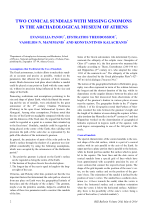
This paper analyses two ancient Greek conical sundials (3156 and 3157) recovered from the Dionysus Theatre. Since their gnomons are lost, geometric characteristics are used, alongside an assumed obliquity of the ecliptic, to calculate their geographical latitude and gnomon length. The calculated design latitudes (33° to 36°) suggest they may have been looted from other Mediterranean regions, rather than being built specifically for Athens (37° 58΄).
Dials: Scaphe, Dials: Unusual, Historical Dials, Mathematics of Dialling
March 2014
Page 8
Page 8
The article examines instances where sundials appear in Sir Arthur Conan Doyle’s Sherlock Holmes stories. Typically, the sundials function as atmospheric features or reference points for leaving messages. The adventure 'The Musgrave Ritual' stands out, as it involves Holmes employing trigonometry to calculate solar altitude and shadow length to solve a coded riddle.
Historical Dials, How Sundials Work
March 2014
Page 10
Page 10
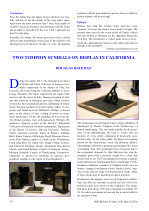
This report discusses two of Thomas Tompion’s rare horizontal sundials displayed at a symposium in California. Only ten Tompion dials are recorded; these included a square dial (c. 1705, latitude 50° 54') and the large circular former Wrest Park dial (c. 1700, adjustable for two latitudes).
Dials: Horizontal, Equation of Time, Historical Dials
March 2014
Page 12
Page 12
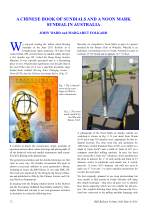
This contribution reviews the book "Moving Stars Changing Scenes – Gems Of The Ancient Chinese Astronomy Relics", a catalogue of historical Chinese solar instruments. Additionally, it details the design and construction of a stainless steel Noon Mark sundial for the Rotary Club of Whyalla, South Australia (33° 02′ S).
Book Reviews, Construction Projects, DIY Sundial Projects, Dials: Noon Lines
March 2014
Page 14
Page 14
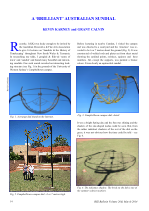
This article describes the Solar Chronograph II, a large equinoctial dial sculpture by Grant Calvin at the University of Western Sydney. The user tells time by lining up so their head shadow eclipses the star-shaped nodus, then turns to look at the nodus which brilliantly eclipses the sun. The design is intended as an educational tool promoting passive solar energy management and sustainable building design.
Construction Projects, Dials: Equatorial, How Sundials Work, Sundial Design & Layout
March 2014
Page 17
Page 17
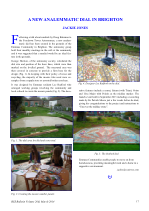
A new analemmatic dial was created in the grounds of the Emmaus Community in Brighton, which supports people moving on from homelessness. Emmaus resident Lee Radford designed the dial, and community members and local schools created the mosaic panels using recycled crockery.
Construction Projects, DIY Sundial Projects, Dials: Analemmatic
March 2014
Page 18
Page 18
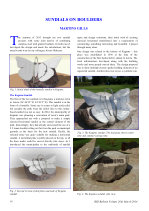
This piece details two stainless steel and granite sundial projects in Latvia. The Kegums Sundial (56°44' N) is a nodus-based butterfly design, inclined at 40 degrees, which displays winter time and summer savings time. The Marsneni Sundial (57°25' N) is an equatorial dial supported by three stones, using dots for hour notation and incorporating Latvian ethnographic signs.
Construction Projects, Dials: Equatorial, Dials: Unusual, Sundial Design & Layout
March 2014
Page 21
Page 21
The author designed a vertical, direct south-facing sundial made of unpolished black marble for his new home in Northern Ireland. The dial uses a horizontal gnomon rod, and the length of the shadow cast at noon indicates the eight traditional calendric events that divide the year, such as the solstices and equinoxes, marked by Neolithic spiral motifs.
Construction Projects, Dials: Vertical, Sundial Design & Layout
March 2014
Page 22
Page 22
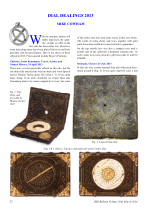
This review covers noteworthy sundials sold at auction in 2013. Highlights include a valuable ebony and ivory diptych dial by Thomas Tucher (1612, £20,000) and a fine late 17th-century silver dial by Henry Wynne (£6,875). Other instruments featured were a declinatory dial by Nicholas Bion and an oval Butterfield-type dial by Choizy.
Dialling Tools, Dials: Portable, Historical Dials
March 2014
Page 25
Page 25
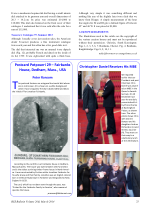
This entry features a postcard depicting an octagonal horizontal dial, dated 1650, bearing the initials IF for Jonathan Fairbanks. The dial is located at Fairbanks House in Dedham, Massachusetts.
Dials: Horizontal, Historical Dials
March 2014
Page 25
Page 25
Christopher Daniel, President and past Chairman of the British Sundial Society, was formally presented with his MBE by Prince Charles at Buckingham Palace on 19 December 2013.
The BSS and Members
March 2014
Page 26
Page 26
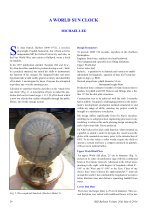
This article describes the author's construction of a brass and stainless steel sun clock based on principles defined by Sir Alan Patrick Herbert. The instrument features two dials (World and outer) and enables precise adjustments for latitude, longitude, and Equation of Time.
March 2014
Page 32
Page 32
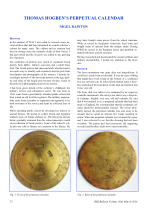
Research into a rare brass perpetual calendar attributed to Thomas Hogben (1702–1774), a surveyor and dialmaker from Kent. The instrument comprises three concentric disks engraved with dates, months, and astronomical signs, and features windows showing day length and sunrise/sunset times. Its construction around 1752 coincided with Britain's adopting the Gregorian calendar.
Dialling Tools, Historical Dials, How Sundials Work
March 2014
Page 35
Page 35
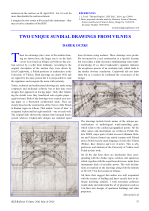
This article analyses two architectural drawings from 1942, likely academic work from the University of Vilnius. Although based on the octagonal Tower of the Winds in Athens, the designs delineate modern equal hours using noduses. They show detailed declining sundials for the location's latitude of 54°41′13ʺ, including declination lines for Zodiac signs.
Historical Dials, Sundial Design & Layout
March 2014
Page 36
Page 36
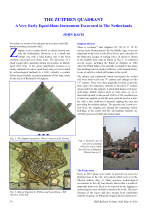
A copper-alloy quadrant excavated in Zutphen is securely dated to c.1300–1320, pushing back the date of known equal-hour quadrants in Europe by nearly a century. The instrument is engraved with an altitude scale, date/declination arcs, and hour lines for equal hours, implying a design latitude of approximately 52.0° N. This find reflects the increasing need for standardised time linked to the spread of tower clocks.
Dials: Astrolabe, Mathematics of Dialling, Dialling Tools, Historical Dials
March 2014
Page 43
Page 43
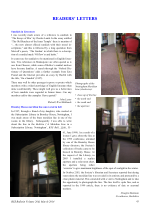
John Lester inquires about further references to sundials in English literature beyond those by Lamb, Marvell, and Chaucer. Douglas Bateman reports that the brass meridian line at Bromley House, Nottingham, mentioned in a 1999 article, has been fully revealed during recent renovations.
Dials: Noon Lines, Historical Dials
March 2014
Page 44
Page 44
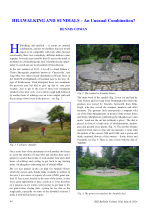
The author combines hillwalking trips in Scotland with sundial observation. Examples include the giant 35-foot gnomon-based dial at Attadale House (2009), a historic horizontal pedestal dial at Attadale made by Gilbert, Wright and Hooke (1794–1805), and a late 18th-century stumpy octagonal facetted dial at Glengarry Castle Hotel.
Dials: Horizontal, Dials: Multi Faced, Historical Dials
March 2014
Page 46
Page 46
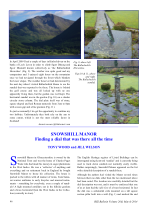
This article describes the unexpected discovery of a substantial cube sundial at Snowshill Manor, Gloucestershire. The dial, constructed of Cotswold limestone and likely dating from 1722, was overlooked because it was built into a wall and had suffered severe erosion, losing its gnomons and delineation, making it resemble an ordinary gatepost.
Dials: Cube, Historical Dials, Restoration projects
March 2014
Page 48
Page 48
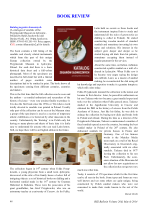
Review of "Katalog zegarów słonecznych" [A catalogue of sundials of the Przypkowski Museum in Jędrzejów, Poland], which lists the museum's complete collection of 378 sundials and related instruments. The collection began in the 19th century and was expanded by Feliks Przypkowski and later his son Tadeusz, who was a famous 20th-century Polish dialmaker.
Book Reviews, Historical Dials