- Home
- /
- Sundial Encyclopaedia
- /
- September 2004
September 2004
The articles link to the specific page in a PDF optimised for speed. If you want the whole issue, you can download it here, but the files from earlier years can be quite large.
September 2004
Page 91
Page 91
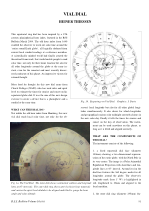
Description and design of an equatorial ‘vial’ ring dial that combines a planisphere with a sundial. Uses a spirit-level alidade and a rotating outer ring to read local apparent time for any longitude, and to estimate sunrise, sunset and the locus of solar midnight across longitudes.
Dials: Equatorial, How Sundials Work, Sundial Design & Layout
September 2004
Page 96
Page 96
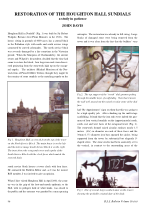
Account of discovering four large vertical dials on an octagonal cupola, surveying gnomon positions, choosing vitreous-enamel steel faces, manufacturing setbacks (overseas enamelling) and the final installation with alignment and conservation choices.
Dials: Multi Faced, Dials: Vertical, Restoration projects
September 2004
Page 100
Page 100
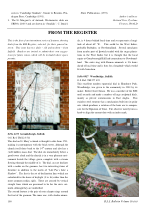
Selections from the BSS Register highlighting notable dials (examples from Suffolk), with location, brief technical notes and historical context for each featured entry.
Historical Dials, The BSS and Members
September 2004
Page 101
Page 101
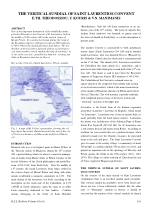
Study of a white marble vertical dial set into the south wall of the convent church: description of its semicircular plate, upside-down placement, ancient Greek numerals and discussion of likely origins (reuse from earlier Latin/antique fabric or a Byzantine installation).
Dials: Vertical, Historical Dials
September 2004
Page 103
Page 103
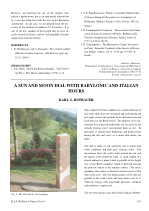
Description of a multi-plane stone dial ensemble that shows Babylonian and Italian hours by day and acts as a moon dial at night; discusses decorative Earth/moon motifs, orientation relative to local and Basel reference planes and how the lunar readout is used.
Dials: Horizontal, Dials: Unusual, How Sundials Work
September 2004
Page 105
Page 105
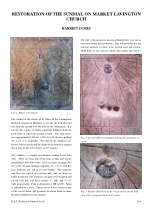
Conservation report for an east-declining carved sandstone dial: cleaning, uncovering original fixing holes, mortar repairs, paint-infill of hour lines and fitting a new brass gnomon; includes measured declination and assessment of layout inaccuracies.
Dials: Vertical, Historical Dials, Restoration projects
September 2004
Page 110
Page 110
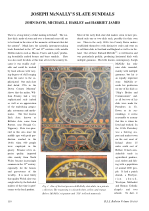
Survey of Joseph McNally’s early 19th-century slate dials (mainly Portaferry area): characteristics of multiple-gnomon plates, chapter rings with alternate longitudes, mottos, colouring evidence and the regional slate-working/dial-making context.
Dials: Vertical, Historical Dials
September 2004
Page 116
Page 116
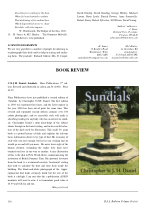
Review of C.St.J.H. Daniel: Sundials: scope, illustration quality, intended audience and strengths/weaknesses for both newcomers and diallists.
Book Reviews
September 2004
Page 118
Page 118
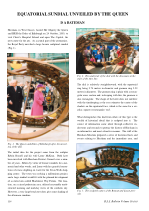
Report of a ceremonial unveiling of a new equatorial sundial: description of the dial type, event context and public/promotional aspects of the installation.
Dials: Equatorial, The BSS and Members
September 2004
Page 120
Page 120
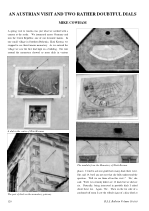
Travelogue describing a visit to several Austrian dials and analysis of two questionable/atypical examples.
Dials: Vertical
September 2004
Page 122
Page 122
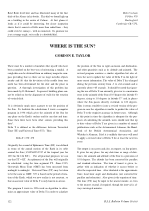
Technical article on computing the Sun’s position for dial work: includes input/output examples (SUNAZALT style), azimuth/altitude tables and worked examples relevant to gnomonic layout and correction calculations.
Mathematics of Dialling
September 2004
Page 124
Page 124
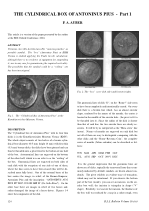
Analysis of the small Roman bronze ‘cylindrical box’ with pierced disks in Vienna; interprets the object as a portable/rolling sundial (viatoria pensilia), applies Padre Secchi calculations and discusses mounting/suspension possibilities and function.
Dials: Portable, Dials: Unusual, Historical Dials