- Home
- /
- Sundial Encyclopaedia
- /
- Malcolm Bishop
Malcolm Bishop
December 2018
Page 30
Page 30
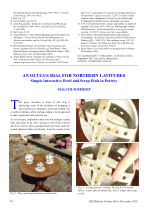
Describes creating miniature equatorial ‘oculus’ or ‘finger’ dials in pottery, inspired by ancient spherical dials. These interactive dials are read by blocking the sun hole with a finger to align the light spot on the vertical datum line, suitable for educational use.
Construction Projects, Dials: Portable, Dials: Scaphe, Dials: Unusual
March 2015
Page 45
Page 45
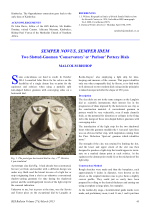
An article detailing the construction of two prototype horizontal pottery dials using a tent-shaped hollow gnomon with a slot. The design is inspired by the rare 18th-century Langlois dial, using a traversing light strip for time measurement during obscured hours and for seasonal indication relative to a fixed datum point. The dials are deemed successful, despite the material's crudity.
Construction Projects, DIY Sundial Projects, Dials: Horizontal, Dials: Unusual
December 2015
Page 27
Page 27
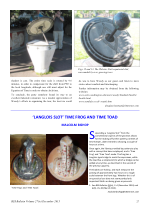
Describes the creation of pottery time-keepers shaped like a frog and a toad. These novel, hollow pieces incorporate a ‘Langlois Slot’ or bridge to mark the equinoxes, measuring the passing of approximately two hours on a rough scale.
DIY Sundial Projects, Dials: Unusual
March 2012
Page 30
Page 30
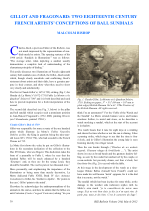
This article discusses two 18th-century French artworks depicting ball sundials: Claude Gillot’s etching for a fable and Jean-Honoré Fragonard’s painting "Rêverie." It argues that while artistically unrealistic, these dials serve a narrative purpose by precisely indicating time to convey moral or emotional messages within their respective contexts.
Dials: Hemispherical, Historical Dials, Sundial Design & Layout
June 2011
Page 54
Page 54
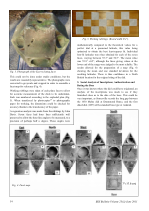
This article describes the discovery and analysis of a 17th-century Scottish polyhedral sundial boss found in Hertfordshire. It establishes the boss's authenticity, its Mylne family provenance, and uses geometric analysis and inscriptions (Acra, Tangier) to date it before 1684, suggesting it's a significant missing link.
Dials: Multi Faced, Historical Dials, Mathematics of Dialling
September 2011
Page 24
Page 24
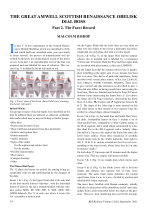
This article, the second part of an examination of the Great Amwell Scottish Renaissance Obelisk Dial Boss, details the archaeological record and incised marks found on its planar and scaphe dial facets. It identifies ten types of marks, including hour lines, solstice/equinox lines, numerals, and place names, discussing the sophisticated design and stonecutting, and determining an optimum latitude of around 55.5° N.
Dials: Multi Faced, Historical Dials