- Home
- /
- Sundial Encyclopaedia
- /
- June 2014
June 2014
The articles link to the specific page in a PDF optimised for speed. If you want the whole issue, you can download it here, but the files from earlier years can be quite large.
June 2014
Page 1
Page 1
This editorial introduces the special issue focusing on ‘decoration on sundials’ to celebrate the British Sundial Society’s 25th anniversary. It notes the intention to focus on the combination of arts and sciences in dials, concentrating particularly on decorative elements and banning complex equations.
June 2014
Page 2
Page 2
Discusses the evolution of terminology in dialling, particularly 'delineation' (functional hour lines) and 'furniture' (other elements like mottoes or mathematical additions). It traces the use of 'furniture' back to 17th-century dialling books by Brown and Leybourn, who viewed these additions as secondary to the basic hours.
Historical Dials, Mathematics of Dialling, Mottoes, Sundial Design & Layout
June 2014
Page 7
Page 7
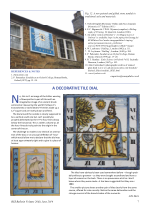
Describes a 12-inch square decorative tile dial featuring an imaginative image of an ancient Greek astronomer (possibly Eratosthenes or Archimedes). Although intended as a vertical south dial, the delineation appears incorrect due to hour lines drooping below the horizontal, leading to a challenge for readers to find a valid orientation.
Dials: Unusual, Dials: Vertical, Historical Dials, Sundial Design & Layout
June 2014
Page 8
Page 8
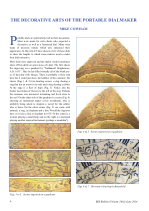
Explores the rich decoration found on portable dials, often made of precious metals or ivory for wealthy clients. Examples include engraved hunting scenes, decorative lettering, book-form dials, and symbolic imagery like 'Old Father Time' and 'The Green Man'. Decoration frequently featured coloured waxes and detailed engraving.
Dials: Portable, Historical Dials, Mottoes, Sundial Design & Layout
June 2014
Page 15
Page 15
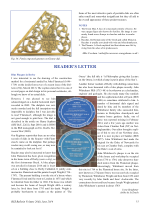
Notes the recent unveiling of blue plaques in Derby commemorating John Flamsteed, the first Astronomer Royal, and John Whitehurst FRS, a renowned clockmaker and sundial maker. It highlights their historical connection, as Whitehurst later occupied a house formerly owned by Flamsteed.
Historical Dials, The BSS and Members
June 2014
Page 16
Page 16
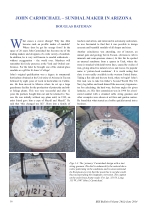
Profiles John Carmichael, detailing his career shift from horticulture to becoming a leading sundial maker in Tucson. It describes his primary design using a stranded cable gnomon, his use of modern software for complex dials (like heliochronometers), and his artistic stained glass dials and durable vitreous enamel finishes.
Construction Projects, Dials: Heliochronometer, Dials: Vertical, Sundial Design & Layout
June 2014
Page 21
Page 21
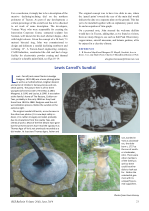
Describes the sundial located at The Rectory, Croft-on-Tees, the home of Lewis Carroll (Charles Lutwidge Dodgson). The extant dial, although corroded, is believed to be signed by Thomas Agar of York and features a substantial gnomon supported by unique pyramid supporters.
Historical Dials, Sundial Design & Layout
June 2014
Page 22
Page 22
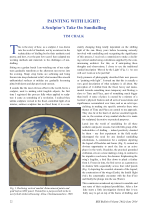
A sculptor reflects on the aesthetic and poetic aspects of sundials, seeing his work as ‘painting with light’. He details several sculptural commissions, including a combined horizontal and equatorial dial with a glass centre, the Scottish Enlightenment lectern dial, and the Robert Burns sculptural sundial.
Construction Projects, Dials: Equatorial, Dials: Vertical, Sundial Design & Layout
June 2014
Page 28
Page 28
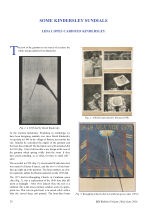
Showcases sundials produced by the Cardozo Kindersley Workshop, focusing on decorative elements like sunbursts at the gnomon root and specialized lettering techniques. Examples include a dial in blue frosted glass and a pair of SE/SW dials using platinum leaf for the furniture.
Construction Projects, Mottoes, Sundial Design & Layout
June 2014
Page 32
Page 32
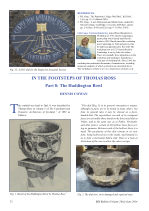
Details the rediscovery of the Haddington Bowl, a unique 17th-century facet-headed dial described by Thomas Ross in 1892. It is a vase-form dial hollowed out to form an internal horizontal dial, featuring cup-hollows (scaphes) and faces acting as gnomons, despite suffering severe damage.
Dials: Scaphe, Dials: Unusual, Historical Dials, Restoration projects
June 2014
Page 34
Page 34
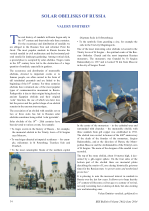
Reviews the history and distribution of sundials in Russia since Peter the Great's reforms. It focuses specifically on solar obelisks, which are tall tetrahedral pyramids used as commemorative monuments, such as the memorable example established in the Trinity Lavra of St Sergius in 1792.
Dials: Multi Faced, Dials: Unusual, Historical Dials
June 2014
Page 35
Page 35
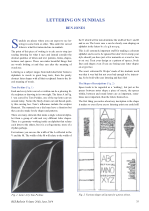
Discusses lettering as a crucial abstract and sculptural element on sundials, emphasizing the importance of space, pattern, and texture over purely literal meaning. The article explores techniques like V-incising, raised letters, anagrams, and double texts to enhance the visual and conceptual structure of the inscriptions.
Mottoes, Sundial Design & Layout
June 2014
Page 39
Page 39
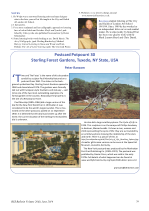
Features postcards illustrating Paul Manship’s decorative sundial, ‘Time and The Fates’, located at Sterling Forest Gardens in Tuxedo, NY. It also references a larger version exhibited at the 1939 New York World Fair, believed to be the world's largest sundial at the time.
Historical Dials, Sundial Design & Layout
June 2014
Page 40
Page 40
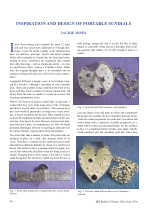
Details the process of creating contemporary silver portable sundials, combining jewellery techniques with accurate gnomonics. The article describes various forms—polar, necklace, and box dials—and unique methods used to achieve decorative surface finishes, such as using sandpaper or wire wool in rolling mills.
Construction Projects, DIY Sundial Projects, Dials: Portable, Sundial Design & Layout
June 2014
Page 43
Page 43
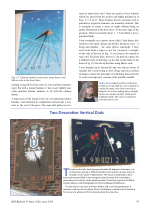
Images and descriptions of two decorated vertical dials are included.
Dials: Vertical, Dials: Unusual
June 2014
Page 44
Page 44
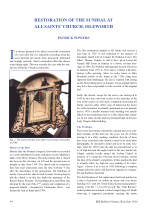
Documents the restoration of a vertical declining dial from All Saints’ Church, Isleworth (originally 1707), which was severely decayed and incorrectly delineated. The restoration included correcting mathematical errors and recreating unique features like solar altitude scales and time arcs for Jamaica, Jerusalem, and Moscow.
Dials: Vertical, Mathematics of Dialling, Restoration projects, Historical Dials
June 2014
Page 47
Page 47
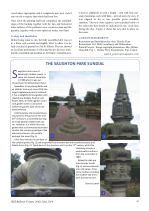
Describes the tall, ornately decorated multi-faced sundial located in the rose garden of Saughton Park, Edinburgh. The upper parts, including four vertical circular dials and a decorative finial, date from the 17th century, while the lower supporting structure resulted from an 1899 restoration.
Dials: Multi Faced, Historical Dials, Sundial Design & Layout
June 2014
Page 48
Page 48
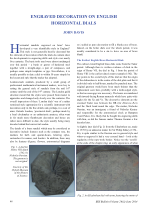
Traces the evolution of decorative styles on English horizontal brass dials from the Tudor era through to the 19th century, contrasting the restrained 'London pattern' with provincial styles. It details decorative elements such as pierced gnomons, the use of oakleaf borders, and the introduction of the Equation of Time scales.
Dials: Horizontal, Equation of Time, Historical Dials, Sundial Design & Layout