- Home
- /
- Sundial Encyclopaedia
- /
- Michael Lowne
Michael Lowne
September 2013
Page 24
Page 24
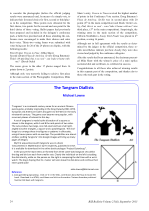
Introduction to Tangrams, an ancient Chinese puzzle game originating in the Song Dynasty (960-1279), involving seven geometric pieces derived from a square dissection. The article relates this puzzle to dialling illustrations, depicting figures formed from Tangram sets observing a sundial.
Dials: Unusual, Sundial Design & Layout
September 2013
Page 40
Page 40
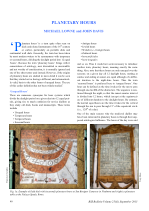
Detailed study differentiating ‘planetary hours’ from seasonal hours. Historically, planetary hours were defined by the time taken for 15-degree intervals of the ecliptic to rise (Sacrobosco’s definition), resulting in hours of unequal duration throughout the day, which are complex to delineate on sundials compared to the simpler seasonal definition.
Historical Dials, How Sundials Work, Mathematics of Dialling, Sundial Design & Layout
September 2012
Page 8
Page 8
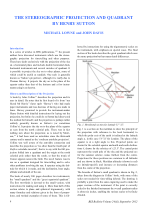
This article explores Henry Sutton's quadrant, which utilises a stereographic projection of the sky onto the equatorial plane, initially conceived by Thomas Harvey. It details the instrument's design, including scales for time-telling and other astronomical problems, and provides instructions for its use, such as finding the time at night using stars.
How Sundials Work, Mathematics of Dialling, Historical Dials
December 2012
Page 11
Page 11
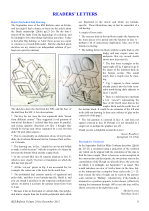
This section features two letters: Michael Lowne corrects a misconception regarding the alignment of the Plough's pointer stars with the pole star for planispheric nocturnals, impacting time readings. Steven Woodbury provides observations and a solution for the Dutch Polyhedral Dial drawing, noting its equatorial and polar dials and non-latitude specificity.
Dials: Multi Faced, Dials: Nocturnals
December 2012
Page 20
Page 20
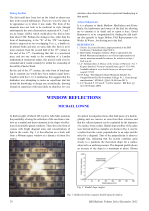
This article investigates the cross-shaped reflections from double-glazed windows, attributing them to the concavity of the glass panes. Optical analysis reveals radial slope profiles and contour maps, showing a central depression. The phenomenon is likely caused by a partial vacuum inside the units, bending the glass inwards, forming distinct V-shaped patterns on narrow windows.
Dials: Reflected, How Sundials Work
June 2011
Page 8
Page 8
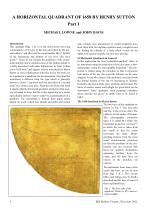
This article describes a unique 17th-century horizontal quadrant by Henry Sutton, detailing its stereographic projection, various scales for altitude, azimuth, time, and astronomical functions. It explains how the instrument, acting as a mechanical analogue computer, finds time from the sun's altitude.
Dialling Tools, Dials: Horizontal, Historical Dials, Mathematics of Dialling
September 2011
Page 34
Page 34
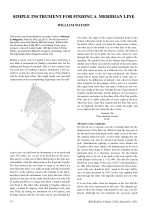
William Watson describes a new instrument for finding a meridian line to aid in sundial making, using two tubes aligned with Polaris and Capella. Michael Lowne comments on the necessity of accounting for Polaris's displacement from the true pole and the stars' right ascension difference for correct alignment, noting potential inaccuracies in Watson's original design and challenges in its use.
How Sundials Work, Mathematics of Dialling, Dialling Tools
September 2011
Page 37
Page 37
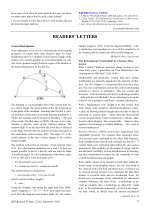
This section compiles several letters from readers. Michael Lowne provides a complex formula for calculating shadow length from gnomon angle. Chris Williams praises Peter Drinkwater's article on scratch dials, linking them to medieval manuscripts. Peter Drinkwater responds on the transmission of scratch dial technology and the function of water clocks. David Young corrects a historical detail about BSS conference venues.
Dials: Mass Dials, Historical Dials, Mathematics of Dialling, The BSS and Members
September 2011
Page 45
Page 45
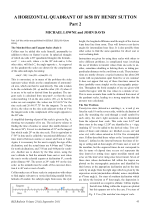
This second part examines the scales and uses of a 1658 horizontal quadrant by Henry Sutton, collaborating with John Collins. It details the matched sine and tangent scales for astronomical calculations, star positions for night-time finding, calendar tables for moon age and high water, and shadow/quadrat scales for measuring building heights. It also provides biographies of Collins, Dary, and Sutton, highlighting their roles in 17th-century London's mathematical community.
How Sundials Work, Mathematics of Dialling, Historical Dials
March 2010
Page 21
Page 21
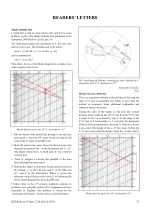
A collection of letters from readers. Topics include a simpler graphical method for using the John Marke altitude dial, a discussion on the nomenclature of mass dials, the 'Sun Position Compass', and the historical connection between clockmakers and dialmakers.
Dials: Mass Dials, Dials: Portable, Mathematics of Dialling, The BSS and Members
June 2010
Page 18
Page 18
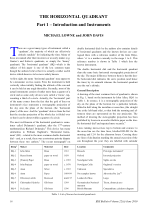
This paper introduces the horizontal quadrant, a less common but useful altitude sundial type, sharing its basic stereographic projection with the double horizontal dial. It discusses its history, including European precursors like Hartmann's compast and Apian's triens, and English developments by Delamain and Oughtred. The article describes the general form and known examples, detailing how it uses the sun's altitude to tell time.
How Sundials Work, Mathematics of Dialling, Historical Dials
September 2010
Page 10
Page 10
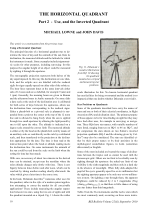
This article details the use of horizontal quadrants for time-finding and surveying, including a rare 'inverted' variant. It describes how to determine time from solar altitude and declination, and from stars at night, discussing the historical accuracy and limitations of these instruments.
How Sundials Work, Mathematics of Dialling, Historical Dials, Dials: Nocturnals
December 2010
Page 7
Page 7
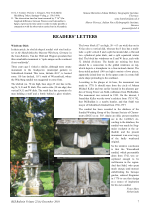
This section includes letters from readers. Frans Maes describes a multi-faceted obelisk sundial in Schwäbisch Gmünd, Germany, similar to one previously discussed. Allan Mills and Michael Lowne provide detailed explanations and practical advice on how to observe the optical phenomenon known as 'Haidinger’s brush,' which appears due to polarized light in the blue sky.
Dials: Multi Faced, How Sundials Work
September 2009
Page 2
Page 2
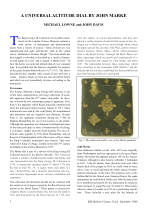
Describes a unique universal altitude dial made by John Marke, possibly for Robert Boyle, now in the London Science Museum. The article details the instrument's provenance, its physical characteristics, and its complex operation as a combined clinometer and sundial. It provides an in-depth analysis of the mathematical principles involved and its potential accuracy.
Dials: Portable, Dials: Unusual, Historical Dials, Mathematics of Dialling
September 2009
Page 20
Page 20
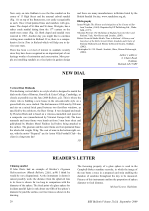
A letter responding to a previous article on Kircher’s 'Organum Heliocausticum'. The author argues that the instrument as depicted could not work because the focal length of the spherical lens is drawn incorrectly.
Dials: Unusual, How Sundials Work
March 2007
Page 40
Page 40
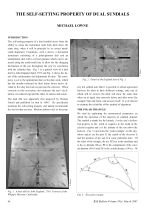
This paper examines the self-setting property of dual sundials, typically consisting of a polar-gnomon dial and an analemmatic dial. It explains the astronomical parameters involved, how rotation affects time indications, and calculates the effectiveness of this alignment method at various latitudes and declinations. It also compares the traditional dual dial with an alternative Foster-Lambert reclining dial.
Dials: Foster-Lambert, Dials: Double Horizontal
September 2007
Page 128
Page 128
This article explores declination lines on sundials as conic sections and details methods for their delineation. It examines two 17th-century horizontal dials by Isaac Symmes (Science Museum, Oxford), noting errors in their declination lines and the presence of seasonal hours and lunar volvelles. A new graphical method for drawing declination lines is also presented.
Historical Dials, How Sundials Work, Mathematics of Dialling, Sundial Design & Layout
February 2006
Page 33
Page 33
This update provides further information on Henry Wynne’s double horizontal dials, including new historical evidence for the Staunton Harold dial’s position from 19th-century maps and photographs. It also discusses the Wrest Park replica and criticises the National Trust’s decision to preserve a bent gnomon on the Powis Castle dial as part of its history.
Restoration projects, Historical Dials, Dials: Double Horizontal
March 2005
Page 3
Page 3
Explores principles and types of moondials, including tabular, volvelle, graphical and adjustable designs. Analyses moon’s orbital motion, parallax, illumination, and visual limitations under moonlight. Proposes improvements to enhance accuracy towards that of simple sundials, and presents prototype experimental dials demonstrating refined timekeeping performance.
Dials: Nocturnals
September 2005
Page 104
Page 104
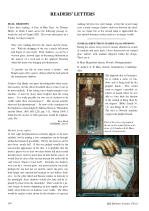
Contains a series of letters from readers. Topics include a discussion on whether two shadows from the sun and moon can be seen simultaneously, a stained glass sundial in a church, and the origins of an equation of time table.
June 2003
Page 47
Page 47
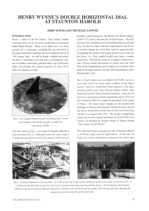
An analysis of one of the most sophisticated 17th-century dials made by Henry Wynne. The article describes the history, features (including its use as a moondial, star dial, and geographical dial), and modern restoration efforts of this large bronze dial.
Dials: Double Horizontal, Historical Dials, Restoration projects
June 2001
Page 47
Page 47
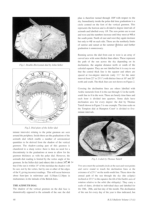
This comprehensive article details the double-horizontal sundial, distinguishing it from William Oughtred's earlier portable instrument. It explains its design, historical prevalence from 1630-1713, and methods for reading its complex graduations. The author also discusses modern examples and the use of stereographic projection in its delineation, providing a list of existing historical and contemporary dials.
Dials: Double Horizontal, Historical Dials, Mathematics of Dialling, Sundial Design & Layout
December 2001
Page 138
Page 138
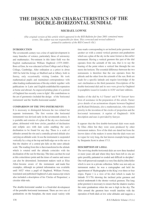
This article examines the double-horizontal sundial, a 17th-century invention by William Oughtred. It features two sets of graduations: one for an inclined polar gnomon and another for a central vertical gnomon, operating from altitude and azimuth. The article details its design, use for time, date, and solar altitude, and discusses its self-setting property and limitations due to orientation error.
Dials: Double Horizontal, Historical Dials, Mathematics of Dialling, Sundial Design & Layout
December 2001
Page 160
Page 160
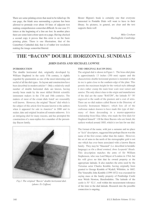
This article investigates the 'Bacon' double horizontal dial, an intriguing 17th or early 18th-century brass instrument of unknown origin. Its unique Equation of Time table and stereographic grid are detailed. Analysis suggests it predates 1752 and aligns with Tompion's calculations. A modern replica, crafted using CAD and photolithography, is also described, featuring updated EoT values and modern heraldry, signed by its maker.
Construction Projects, Dials: Double Horizontal, Equation of Time, Historical Dials
June 2000
Page 88
Page 88
Review of John Heilbron's book detailing cathedral meridian lines and the Catholic Church's role in astronomy.
Book Reviews, Historical Dials
October 2000
Page 120
Page 120
Report on the 11th BSS Annual Conference, with summaries of lectures, site visits, exhibitions, and society updates.
The BSS and Members
February 1998
Page 30
Page 30
Describes novel non-shadow dials using reflectors. Parabolic and cylindrical forms generate bright caustic lines on a screen; hour indication follows motion of the cusp or inner edge. Includes formulae, constructional notes and an aperture version using a sundial curve.
DIY Sundial Projects, Dials: Reflected, How Sundials Work, Mathematics of Dialling
April 1997
Page 11
Page 11
A systematic study of seventy medieval mass dials, analysing their patterns, calibrations, and probable uses, with observations on design variations, dating, and functional purpose.
Historical Dials, Mathematics of Dialling
July 1997
Page 15
Page 15
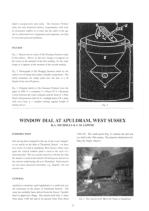
This article investigates a window dial in a church at Apuldram, using a vertical gnomon, thus being accurate on only two days in the year, one of which is the patronal saints day. It discusses the history of the church and the dial, and that the architectural changes to the church mean that the dial is now shaded for half the time.
Dials: Unusual, Historical Dials
October 1997
Page 49
Page 49
Summarises the second Essex Sundial Meeting at Moulsham Mill. Presentations included a history of calendars, the sun's nuclear reactions, and a detailed look at the massive astronomical instruments and sundials at Jaipur, India, built in the early 18th century to determine celestial positions. The meeting concluded with slides of the German sundial safari.
The BSS and Members
February 1996
Page 12
Page 12
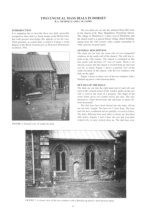
A technical analysis of two rare mass dials found on a Dorset church, discussing their design, orientation, and potential liturgical functions.
Dials: Mass Dials, Historical Dials
October 1996
Page 25
Page 25
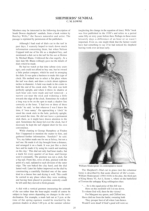
An article about simple portable sundials used by shepherds, exploring their historical use, practicality, and variations in design.
Dials: Portable
February 1992
Page 18
Page 18
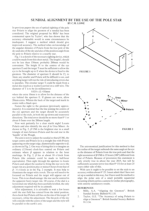
The article proposes an improved method for aligning a sundial gnomon using Polaris, building on previous discussions by Mills and Taylor. It suggests a sighting device made from sheet metal with an eye aperture and a circular target. The method relies on knowing Polaris's angular distance from the true pole and its position relative to the star Beta Ursa Minor (f3 UMi), aiming for an accuracy within 0.25 degrees by aligning Polaris on the target edge opposite f3 UMi.
Construction Projects, Dialling Tools, Mathematics of Dialling