- Home
- /
- Sundial Encyclopaedia
- /
- June 2021
June 2021
The articles link to the specific page in a PDF optimised for speed. If you want the whole issue, you can download it here, but the files from earlier years can be quite large.
June 2021
Page 1
Page 1
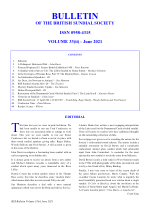
Discusses the cancellation of conferences due to lockdown and the subsequent Zoom event. Previews major articles in the issue, including the Palimpsest Horizontal Dial, the Liffey Sundial, modern dials, and the Drummond Castle Obelisk restoration. Mentions the latest BSS Sundial Awards and the passing of Mario Catamo.
The BSS and Members
June 2021
Page 2
Page 2
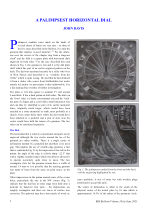
An investigation into a rare horizontal sundial made on a re-used brass plate (a palimpsest). The reverse side reveals an earlier engraving from a memorial brass, identified as a "waster" from the Southwark workshops (c.1600). Metallurgical analysis shows the plate is made of imported high-zinc brass, and the dial's delineation matches the latitude of Southwark.
Dials: Horizontal, Historical Dials, Sundial Design & Layout
June 2021
Page 7
Page 7
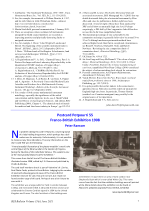
Discusses a specific postcard from the 1908 Franco-British Exhibition in London, featuring a floral sundial in the Garden of Progress. The dial includes a prominent statue of a lady holding the gnomon. The exhibition celebrated the Entente Cordiale.
Dials: Horizontal, Dials: Unusual, Historical Dials
June 2021
Page 8
Page 8
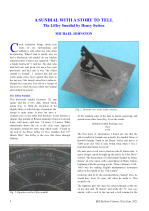
Chronicles the investigation into a horizontal sundial inherited by the author, inscribed as being found in the River Liffey in 1866 and signed "H:Sutton 1654". Analysis confirmed the design latitude matches Dublin (53.35° N), authenticating it as a work by Henry Sutton, a leading 17th-century instrument maker. Explores its provenance and possible link to the Down Survey of Ireland.
Dials: Horizontal, Historical Dials
June 2021
Page 13
Page 13
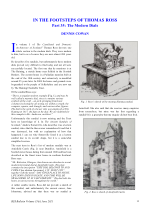
Part 35 of a series tracking dials documented by Thomas Ross, focusing on five "modern dials" (c. 19th century). The article investigates the current status of these Scottish sundials, including the missing dials at The Haining, Amisfield Castle, and Bredisholm, and detailing the surviving, unique designs at Newhall and Grange.
Dials: Multi Faced, Historical Dials, Sundial Design & Layout
June 2021
Page 19
Page 19
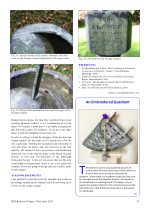
Describes a quadrant made by Iona Isaac as a lockdown project. It is an equal-hour quadrant, embroidered and delineated for Cambridge, based on historical instruments associated with Richard II in the British Museum.
Dials: Portable, DIY Sundial Projects
June 2021
Page 20
Page 20
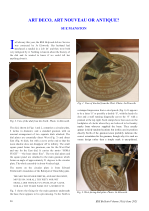
Analyzes a highly unusual circular sundial featuring separate curved direct West and East dials. The investigation, based on numerals and a foundry mark, suggests it might be a custom-made dial by Francis Barker & Son, possibly derived from their 'Antique' model (c. 1907). Concludes the dial incorporates elements of both Art Deco and Art Nouveau styles.
Dials: Vertical, Dials: Unusual, Sundial Design & Layout, Historical Dials
June 2021
Page 24
Page 24
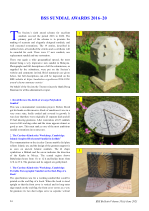
Summary of the British Sundial Society's sixth award scheme entries for 2016–2020, covering 19 submissions focused on accurate design, elegant execution, and restoration. Descriptions of notable projects include David Brown’s polyhedral sundial restoration, Tim Chalk’s sculptural dials, a stained glass replacement, and the highly complex Ta Ha Sundial from Malaysia.
Dials: Multi Faced, Construction Projects, Restoration projects
June 2021
Page 31
Page 31
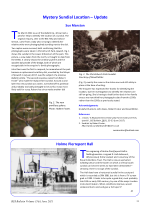
Provides an update identifying the location of a sundial pictured in old family photographs as Christchurch Park, Ipswich. The dial was an armillary sphere. Notes that a 2017 replacement armillary dial was stolen and replaced again by maker Robert Foster.
Restoration projects, Historical Dials, Dials: Armillary Sphere
June 2021
Page 31
Page 31
Discusses an engraving of Holme Pierrepont Hall showing a vertical south sundial on a demolished tower. Mentions a surviving horizontal sundial in the courtyard, likely dating from the late 18th or early 19th century, and requests further investigation.
Dials: Horizontal, Dials: Vertical, Historical Dials
June 2021
Page 32
Page 32
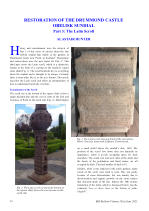
The third part of the restoration series on the 1630 Drummond Castle obelisk sundial, focusing on the unique Latin scroll carving on the shaft. The article provides the corrected transcription and interpretation of the scroll, explaining how it describes the various hour types (Babylonian, Italian, Seasonal, Common) and astronomical markings (Azimuth, Altitude, Declination) found on the dial, often linking them to astrolabe terminology.
Dials: Multi Faced, Historical Dials, Mathematics of Dialling, Restoration projects
June 2021
Page 36
Page 36
Discusses the content related to sundials found in Book IX of De Architectura by the Roman author Vitruvius (c. 80–15 BC). Chapter VII provides a general discussion on dialling, while Chapter VIII credits various ancient figures—including Berosus, Aristarchus, and Apollonius—with inventing different types of early dials like the Hemicyclium, Bowl, and Plinthium.
Book Reviews, Dials: Hemispherical, Historical Dials
June 2021
Page 37
Page 37
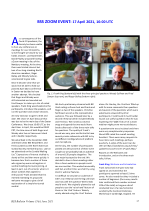
Report on the British Sundial Society's successful virtual conference held via Zoom in April 2021, featuring three noted North American speakers. Talks covered Zarbula and Potey dials in the French Alps, a highly customized ceiling reflection sundial by Woody Sullivan, and Fred Sawyer's theoretical work on Hybrid Peaucellier azimuthal dials designed to eliminate the noon gap.
Dials: Reflected, Mathematics of Dialling, Sundial Design & Layout, The BSS and Members
June 2021
Page 40
Page 40
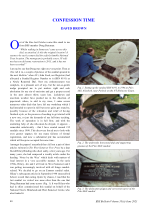
The author recounts his failure to formally register many of the approximately 215 sundials he has created since 1990, prompted by the discovery of an unrecorded dial he made at Piles Mill, Allerford (SRN 8191). Includes the transcription of a 1994 article by Hilary Binding detailing a sundial safari in West Somerset, describing the Piles Mill dial (a double-sided equatorial dial designed to look like a millstone).
Construction Projects, Dials: Equatorial, Historical Dials, The BSS and Members
June 2021
Page 44
Page 44
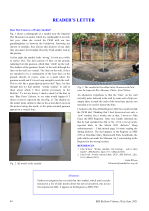
A reader discusses an unusual sundial near the Imperial War Museum, featuring hour lines on the ground that continue vertically up a wall. The author models the dial, hypothesizing that it functions like a giant diptych pocket dial or that the vertical markings are merely endpoints for the hour lines, noting its history in the Fixed Dial Register.
Dials: Portable, Dials: Unusual, How Sundials Work, Sundial Design & Layout