- Home
- /
- Sundial Encyclopaedia
- /
- September 2015
September 2015
The articles link to the specific page in a PDF optimised for speed. If you want the whole issue, you can download it here, but the files from earlier years can be quite large.
September 2015
Page 1
Page 1
Discussion of revised short Check List guidelines for authors, replacing the longer formal guidelines previously published. Notes the continuing welcome for articles on any subject relating to sundials, including short items such as holiday photographs with a line or two of explanation.
September 2015
Page 1
Page 1
A short item reporting that three UK British Sundial Society (BSS) members (Frank King, Doug Bateman, and Jackie Jones) gave talks at the recent North American Sundial Society (NASS) Conference in Canada. Further details regarding the event will be featured in the December Bulletin.
The BSS and Members
September 2015
Page 2
Page 2
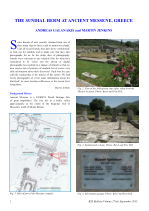
Describes the conceptualisation, design, and installation (2011) of a modern equatorial sundial named 'Sundial Herm' at the ancient UNESCO site of Messene, Greece. It details its unique numbering system, artistic philosophy, orientation challenges, and connection to ancient monumental orientations.
Dials: Equatorial, Sundial Design & Layout, Construction Projects
September 2015
Page 7
Page 7
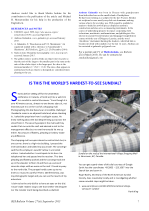
An account of the author's difficult and adventurous attempt to photograph a 40-metre-wide sundial located on the roof of the International Village Shopping Mall in Vancouver, BC, Canada. Few people, including local residents and staff, are aware of the dial's existence.
Dials: Unusual
September 2015
Page 8
Page 8
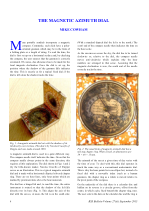
This article explores the design and function of magnetic azimuth dials, where the compass needle indicates the time. Using historical examples by Nicolas Crucefix and Charles Bloud, it details methods for calibration, dealing with magnetic declination, and construction techniques suitable for portable instruments.
Dialling Tools, Dials: Portable, How Sundials Work, Mathematics of Dialling
September 2015
Page 12
Page 12
September 2015
Page 13
Page 13
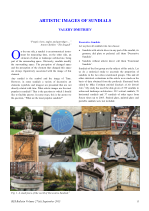
A statistical study analysing the popularity of artistic images (Earth, Sun, Man, God, Water, Air, Fire) used as decorative elements on 339 British sundials. It categorises sundials into 'Decorative' and 'Functional', and discusses trends between 'old' (pre-1900) and 'modern' designs.
Dials: Unusual, Historical Dials, Sundial Design & Layout
September 2015
Page 16
Page 16
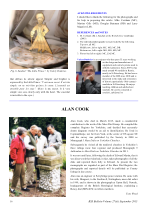
Obituary for Alan Cook, who died in March 2015. He made a considerable contribution to the Mass Dial Group, notably by compiling the complete Register for Yorkshire, which was published as two monographs by the Society.
Dials: Mass Dials, The BSS and Members
September 2015
Page 17
Page 17
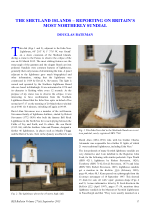
Report on the discovery and registration (SRN 7704) of a lighthouse sundial adjacent to the Esha Ness Lighthouse (60° 29.3′ N). It discusses the dial's distinctive fluted cast iron pedestal and its link to the famous Stevenson family of lighthouse builders.
Dials: Horizontal, Dials: Unusual, Historical Dials
September 2015
Page 19
Page 19
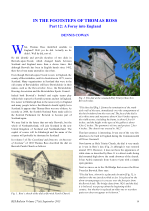
Discusses Thomas Ross's sketches and descriptions of two sundials found in Berwick-upon-Tweed (Holy Trinity Church and the Old Bridge). The article explores the historical ambiguity of Berwick's status between Scotland and England and recent restorations of the dials.
Dials: Horizontal, Dials: Vertical, Historical Dials
September 2015
Page 20
Page 20
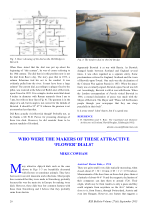
Investigates small ivory diptych dials decorated with flowers or animals, dating to around 1720, possibly originating from Austria (latitude 46.6° N). Details common features, such as the style of the numeral '2', and suggests they were made for ladies due to their size and decoration.
Dials: Portable, Historical Dials, Sundial Design & Layout
September 2015
Page 22
Page 22
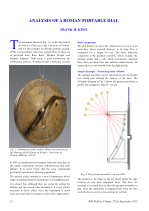
A novel analysis of a Roman portable altitude dial from Oxford’s Museum of the History of Science. It explores how the instrument determines unequal hours from solar altitude, discusses the underlying mathematical model, the use of latitude and declination scales, and provides an error analysis.
Dials: Portable, Historical Dials, How Sundials Work, Mathematics of Dialling
September 2015
Page 30
Page 30
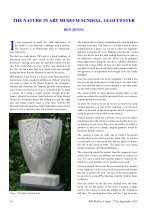
Details the complex design and construction process of a large, conical, declining and reclining sundial made from local Forest of Dean stone for Wallsworth Hall, Gloucester. Describes the challenges of working on an uneven surface and using horizontal dials to establish alignment.
Construction Projects, Dials: Unusual, Sundial Design & Layout
September 2015
Page 33
Page 33
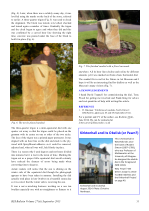
Identifies the obelisk sundial (SRN 1184) located in the foreground of Kirktonhall, West Kilbride. The dial was designed by Robert Simson, who served as Professor of Mathematics at the University of Glasgow in the 18th century.
Dials: Multi Faced, Historical Dials
September 2015
Page 34
Page 34
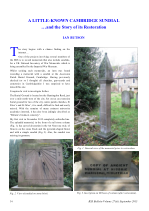
An account of the finding and restoration of the memorial sundial dedicated to Rudolf Cecil Hopkinson (died 1917) at Ascension Parish Burial Ground, Cambridge. It includes the history of the prominent Hopkinson family and details the reconstruction and fitting of the simple scrolled brass replacement gnomon.
Dials: Vertical, Restoration projects, Historical Dials
September 2015
Page 40
Page 40
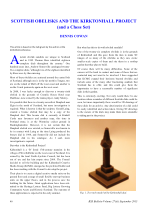
Discusses the Kirktonhall Creative Media Group project to create 3D images and small-scale copies of unique Scottish obelisk sundials for a rooftop garden archive. The author also playfully suggests a sundial-themed chess set using various famous Scottish dials.
Construction Projects, Dials: Multi Faced, Historical Dials, Sundial Design & Layout
September 2015
Page 41
Page 41
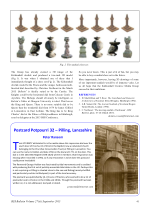
Describes a postcard of the vertical sundial (SRN 1625) above the south door of St John the Baptist Church, Pilling, Lancashire, dated 1766. Notes the motto, "Thus Eternity approacheth" and the historical note that the gnomon was missing when recorded in 1992.
Dials: Vertical, Mottoes
September 2015
Page 42
Page 42
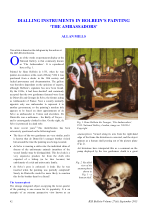
Analysis of the dialling and astronomical instruments depicted in Hans Holbein's 1533 painting, ‘The Ambassadors’. Instruments covered include the torquetum, shepherd’s dial, universal equatorial dial, horary quadrant, and polyhedral dial, noting potential artistic inaccuracies.
Dialling Tools, Dials: Equatorial, Dials: Portable, Historical Dials
September 2015
Page 47
Page 47
Provides historical documentation (recovered notes) confirming written evidence of a dial being purchased and "set on my bruge" (drawbridge) at Little Saxham Hall, Suffolk, in 1505, during the reign of Henry VII, predating Nicolaus Kratzer's popularisation of dials.
Historical Dials
September 2015
Page 48
Page 48
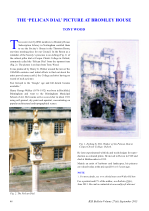
Identifies an etching on loan to the BSS Library at Bromley House as a depiction of the cubical pillar dial, commonly called the ‘Pelican Dial’, at Corpus Christi College, Oxford. The etching was produced by artist Henry G. Walker (1876–1932).
Dials: Multi Faced, Dials: Cube