- Home
- /
- Sundial Encyclopaedia
- /
- Mark Lennox-Boyd
Mark Lennox-Boyd
March 2021
Page 8
Page 8
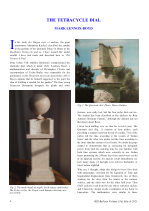
Description of a model sundial inspired by the Meridiana Tetracycla in Rome. It features four niches with analemmas, designed to read GMT throughout the year using corrections for the Equation of Time and longitudinal displacement. The model stands 62 cm high and is made of maple, birch veneer, and bronze.
Construction Projects, Dials: Unusual, Equation of Time, Sundial Design & Layout
December 2020
Page 16
Page 16
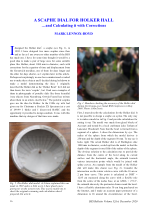
The author details the design and calculation of the Holker Hall scaphe dial (a spherical bowl dial). He explains the trigonometric formulae, derived using his 'y' formula, necessary for plotting points on the curved surface using distance and azimuth. He also proposes making a pair of large scaphe dials incorporating corrections for the Equation of Time (EoT) and longitude displacement.
Construction Projects, Dials: Scaphe, Equation of Time, Mathematics of Dialling
December 2019
Page 12
Page 12
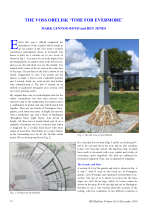
This article details the design and installation of a 3-metre tall obelisk sundial in Cornwall. The obelisk has an equilateral triangular cross-section, featuring two declining/reclining dials engraved on granite and slate, plus a simplified EoT correction table on the north face. Precise GPS alignment and a custom stainless steel turntable were used during installation to achieve high accuracy.
Construction Projects, Dials: Multi Faced, Mathematics of Dialling, Sundial Design & Layout
March 2015
Page 5
Page 5
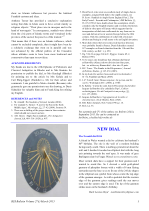
Details the design and construction of a new elliptical vertical dial crafted from grey Burlington slate for a private commission in Wales.
Dials: Vertical, Sundial Design & Layout, Construction Projects
June 2015
Page 30
Page 30
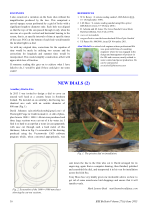
Description of an armillary dial commissioned in 2013 to cover an unused well head at a country house in Southern Ireland. It features two identical arcs, 800 mm in diameter, cut from a phosphor bronze slab using a water jet.
Construction Projects, Dials: Armillary Sphere
December 2015
Page 2
Page 2
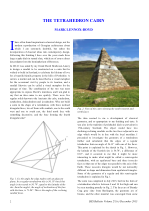
Describes the design and construction of a 9–10 foot high tetrahedron-shaped cairn in Perthshire, Scotland, commissioned by David Heathcoat-Amory. It incorporates two declining reclining sundials and aligns its north edge and gnomons with the Earth's axis.
Construction Projects, Dials: Multi Faced, Dials: Unusual, Sundial Design & Layout
September 2013
Page 2
Page 2
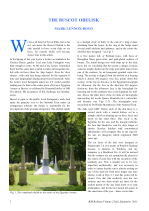
Detailed account of designing and constructing a five-metre tall hexagonal obelisk for Buscot Park to celebrate Queen Elizabeth's Diamond Jubilee. It features seven dials on six slate faces, adjusted for the equation of time and longitudinal displacement, reading GMT, and incorporating Egyptian hieroglyphs.
Construction Projects, Dials: Multi Faced, Sundial Design & Layout
March 2012
Page 23
Page 23
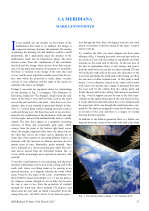
The author describes "La Meridiana," a house in Italy designed with a sundial as its stair tower. This indoor sundial uses projections and reflections onto north, west, and east walls, and the ceiling, to show time and date. The article highlights the mathematics, design, and extensive calibration process.
Construction Projects, How Sundials Work, Mathematics of Dialling, Sundial Design & Layout
June 2002
Page 45
Page 45
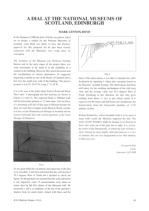
Describes the design and construction of a modern wall-mounted sundial using traditional techniques for the National Museums of Scotland.
Dials: Vertical, Sundial Design & Layout
October 1999
Page 148
Page 148
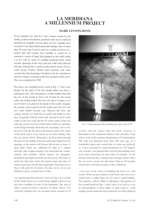
This article describes a millennium project involving the construction of a tower, 'La Meridiana', near Rome, to house a series of internal sundials. The author designed 10 dials for the walls and ceiling, read by sunlight projected through openings or reflected by a mirror. An experimental dial at his family house achieved accuracy within 10 seconds. The project aims to demonstrate precise time and date measurement, zodiac, altitude, and azimuth, using novel methods for declination, horizon, and meridian establishment.
Construction Projects, Dials: Reflected, Dials: Unusual, Sundial Design & Layout
October 1992
Page 37
Page 37
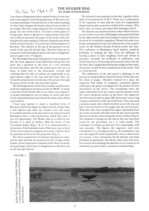
This article describes the Holker Dial, a large shallow bowl sundial made of Burlington slate, sited at Holker Hall. Designed by Mark Lennox-Boyd, it is a projection of Berossos' hemispherium onto a shallow bowl, marked with 15-minute divisions, zodiacal signs, and a combined table for correcting for longitude offset and Equation of Time. The article details the challenging production process by Burlington Slate, involving computer-calculated polar coordinates for engraving and the moving of massive stone objects.
Construction Projects, Dials: Hemispherical, Dials: Scaphe, Mathematics of Dialling, Sundial Design & Layout
July 1991
Page 24
Page 24
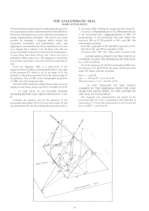
Mark Lennox-Boyd presents a trigonometric proof for the correctness of the equations for laying out an analemmatic dial, aiming to clarify Rene Rohr's complex explanations. Using a diagram relating equatorial, horizontal, and analemmatic dials, he derives three key formulae: one defining the elliptical shape of the dial, and two describing the vertical gnomon's displacement and the hour points angles. The diagram simultaneously provides a proof for the horizontal dial.
Dials: Analemmatic, Mathematics of Dialling