- Home
- /
- Sundial Encyclopaedia
- /
- February 1999
February 1999
The articles link to the specific page in a PDF optimised for speed. If you want the whole issue, you can download it here, but the files from earlier years can be quite large.
February 1999
Page 2
Page 2
This editorial mentions that this issue celebrates the British Sundial Society's tenth anniversary with a colourful display of sundial photographs included in the centre pages, and contributions from early members reflecting on their reasons for joining. It also clarifies the new volume and page numbering system for the Bulletin.
The BSS and Members
February 1999
Page 3
Page 3
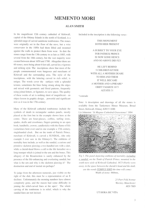
This article describes 17th-century carved sandstone tombstones in Kirkwall Cathedral, Orkney, which feature various symbols of death. One unique tombstone, that of Patrick Prince (1673), depicts a sundial among these emblems of mortality, which the author notes is the only sundial he saw in the Orkneys.
Mottoes
February 1999
Page 4
Page 4
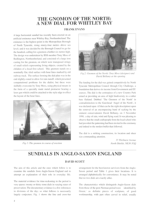
Details the erection of a large horizontal sundial near Whitley Bay, designed by Tony Moss. Named 'The Gnomon of the North', it features a six-metre-high iron gnomon with reliefs created by local schoolchildren, and its hour lines are marked by old railway track on a slightly coned surface.
Dials: Horizontal, Construction Projects
February 1999
Page 4
Page 4
This article explores Anglo-Saxon sundials, using sparse material and documentary evidence to conjecture their role in daily life. It identifies characteristics distinguishing them from post-Norman dials, discusses their introduction by the Roman Church, and their use in regulating canonical hours in monastic communities.
Historical Dials, Dials: Mass Dials
February 1999
Page 8
Page 8
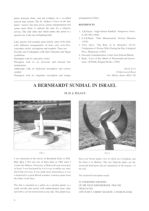
The author recounts discovering a Bernhardt dial at the Hebrew University in Rehovoth, Israel, in 1980. This memorial to Sir Hans Kronberger features special gnomon and dial shapes designed to provide directly read local mean time accurate to within a fraction of a minute.
Dials: Unusual, Equation of Time, Historical Dials
February 1999
Page 9
Page 9
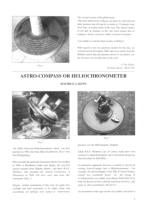
This article references the Gibbs Universal Heliochronometer, patented in 1906, and its presence at the 1998 BSS Conference. It suggests converting existing Astro-Compasses into heliochronometers by adding self-adhesive hour-labels, providing an affordable way to indicate local sun time with reasonable accuracy.
Dialling Tools, DIY Sundial Projects, Dials: Heliochronometer
February 1999
Page 10
Page 10
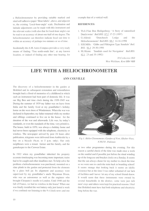
Ann Colville shares memories of growing up with a heliochronometer at Holehird during WWII, where it served as the family's primary timekeeper, for regulating the long case clock. The article highlights its accuracy, the care it received, and its eventual journey to America, now a preserved curiosity.
Historical Dials, Dials: Heliochronometer
February 1999
Page 11
Page 11
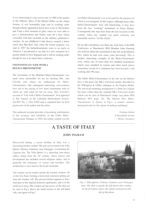
This article describes a utilitarian kitchen sundial found at Villa Quirici in Pedona, Italy, which is accurately delineated from 6 a.m. to 6 p.m. Despite its practicality, its position suggested it was overshadowed until late morning, raising questions about its original function for timing meals.
Dials: Horizontal, Historical Dials
February 1999
Page 12
Page 12
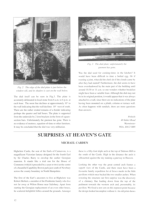
During restoration of the "Heaven's Gate" folly at Highclere Castle, two surprises were uncovered: a chimney flue in the pediment and a sundial engraved on the underside of an urn lid, dated 1737. The author theorizes the sundial was made by masons to regulate their workday.
Dials: Horizontal, Historical Dials
February 1999
Page 14
Page 14
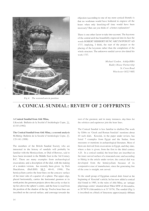
This review discusses two papers on conical sundials, a less familiar type compared to the hemicyclium. It focuses on a conical dial found at Abu Mina, Egypt, dating from the 1st to 3rd century A.D., analyzing its construction, accuracy, and challenging previous interpretations of its markings.
Book Reviews, Sundial Design & Layout, Historical Dials, Dials: Scaphe
February 1999
Page 16
Page 16
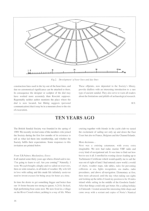
This section compiles responses from early BSS members, including T.B. Palmer, P.D. Briggs, and C.D. Lack, reflecting on their initial motivations for joining and their continued enjoyment of the Society's Bulletin, despite personal challenges or preferences for theoretical over practical involvement.
The BSS and Members
February 1999
Page 18
Page 18
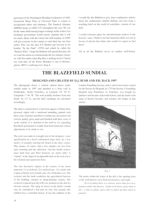
This article describes a vertical, almost direct south, sundial made in 1997 for a barn wall in Nidderdale. Constructed from plywood with a wrought iron style, it features decorative figures symbolizing agricultural life and an equation-of-time correction system via an adjustable disk.
Dials: Vertical, Sundial Design & Layout, Construction Projects
February 1999
Page 19
Page 19
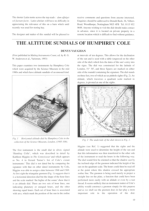
This paper examines two unusual altitude sundials by Humphrey Cole from the Science Museum, one from 1568-1569 and another from 1574. It analyzes their unique gnomon operation for measuring sun height and reading hours, suggesting a new sub-section in sundial classification for Cole's distinctive horizontal plate altitude dials.
Dials: Portable, Sundial Design & Layout, Historical Dials
February 1999
Page 23
Page 23
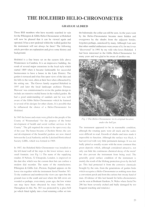
This article details the restoration and reinstallation of the Pilkington & Gibbs Helio-Chronometer at Holehird. It recounts its history, its protection by a glass bell jar, and the innovative security measures implemented for its current display, allowing it to accurately tell time for another century.
Restoration projects, Historical Dials, Dials: Heliochronometer
February 1999
Page 25
Page 25
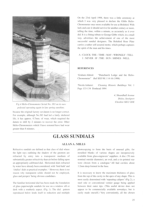
This article introduces refractive sundials made from transparent solids like glass, specifically glass paperweight sundials for window sills. The nodus is an 'aperture' on the top of the paperweight, casting a spot on a dial card on the bottom, with a more compact pattern than in air.
Dials: Horizontal, Dials: Portable, Dials: Unusual, Sundial Design & Layout, DIY Sundial Projects
February 1999
Page 30
Page 30
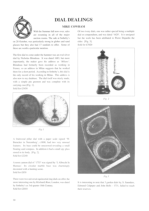
This article reports on recent sundial auctions, highlighting several notable sales, including a silver dial by Nicholas Blondeau (1683), a fruitwood pillar dial with a hidden compass and spyglass, and a rare Cruciform Dial from 1598. It also notes garden dials that failed to reach their reserves.
February 1999
Page 33
Page 33
This section provides updates including the venue for the 1999 Newbury BSS Meeting, the current viewing location of D.G. Rossetti's 'Beata Beatrix' painting, clarifications on 'Italian' hours and a problematic dial from a previous issue, and an apology for a cover photo misattribution.
The BSS and Members
February 1999
Page 33
Page 33
This section contains diverse reader correspondence, including a tribute to Charles Aked, discussions on the Equation of Time and Bernhardt dials, explanations of the Lluc sundial in Mallorca, a comparison of Eureka compass cards, reflections on restoration, and a submission on 'Tipple Times'.
Dials: Unusual, Equation of Time, Dialling Tools, The BSS and Members
February 1999
Page 37
Page 37
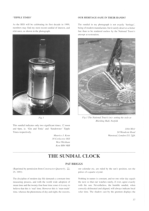
Describes a mechanical clock designed to display local solar time as well as Greenwich Mean Time. It uses two cranks to apply the Equation of Time correction, accurately accounting for the sun's uneven progress throughout the year, making it possible to read solar time even in overcast conditions.
Equation of Time, DIY Sundial Projects
February 1999
Page 38
Page 38
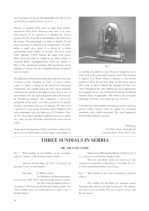
This article describes three wall sundials in Serbia: one in Strpce with historical day lines and a Cyrillic motto; one in Valjevo showing various international noons and birthdays of famous Serbians; and a rhyming motto dial in Lesak.
Dials: Vertical, Mottoes
February 1999
Page 40
Page 40
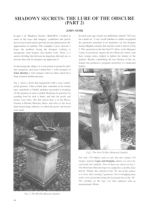
John Moir continues his exploration of hidden meanings and symbolism in sundials, presenting examples of 'false identity' dials like a bowl dial and a cat-shaped memorial. He delves into using logos, Morse code, and snooker ball colour codes, as well as analogies like railway lines and hair-lines, to enrich sundial design.
Dials: Unusual, Sundial Design & Layout, Equation of Time, Mottoes
February 1999
Page 46
Page 46
Frank Coe compares sundial references in Arthur Mee's 1947 "King's England" volume for Northamptonshire with the 1996 BSS Register. He identifies eleven Mee-listed sundials present in the Register, nine others that are now lost or uncatalogued, and 28 'mass' or 'scratch' dials, mostly on churches.
Book Reviews, Historical Dials, Dials: Mass Dials
February 1999
Page 47
Page 47
This review covers two issues of *Compendium*, the NASS journal. It highlights articles on a 'Witch's Sundial', various sundial designs (conical gnomon, Ptolemaic coordinates, cycloid gnomon, split analemma), and 'Sightings' features on notable dials, concluding with a report on the NASS Fourth Annual Conference.
Dials: Equatorial, Book Reviews, Sundial Design & Layout, Equation of Time
February 1999
Page 48
Page 48
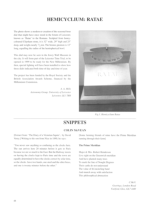
This article describes a modern re-creation of a Roman hemicyclium dial, sculpted from Clipsham stone, now located in Leicester's Jewry Wall Museum. Funded by the Royal Society and British Association Awards Scheme, it will be part of the Leicester Time Trial, set to open in 1999.
Construction Projects, Dials: Scaphe
February 1999
Page 49
Page 49
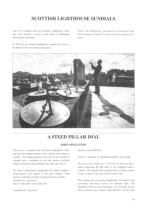
This article describes a fixed pillar dial, a variant of the Shepherd's Dial, which indicates time without requiring cylinder rotation. It features a radial gnomon whose tip's vertical shadow length and position on the cylinder's wrapped surface (calibrated by specific formulas) distinguish morning from afternoon.
Sundial Design & Layout, Dials: Cylindrical