- Home
- /
- Sundial Encyclopaedia
- /
- June 2001
June 2001
The articles link to the specific page in a PDF optimised for speed. If you want the whole issue, you can download it here, but the files from earlier years can be quite large.
June 2001
Page 47
Page 47
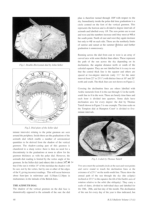
This comprehensive article details the double-horizontal sundial, distinguishing it from William Oughtred's earlier portable instrument. It explains its design, historical prevalence from 1630-1713, and methods for reading its complex graduations. The author also discusses modern examples and the use of stereographic projection in its delineation, providing a list of existing historical and contemporary dials.
Dials: Double Horizontal, Historical Dials, Mathematics of Dialling, Sundial Design & Layout
June 2001
Page 56
Page 56

John Davis introduces his design for a flexible, wallet-sized gnomon protractor, aimed at overcoming difficulties in measuring gnomon angles on buttressed sundials. The device expands the scale for better precision within typical UK angles and can be photocopied by readers to create their own. He details its construction from laminated paper and auxiliary scales.
DIY Sundial Projects, Dialling Tools
June 2001
Page 58
Page 58
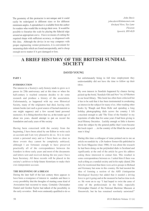
David Young, a founding member, provides a personal account of the British Sundial Society's formation and early years. He traces the resurgence of interest in sundials, early discussions among key figures like Christopher Daniel and Andrew Somerville, and the eventual decision to form an independent society, detailing the initial planning and membership growth.
The BSS and Members
June 2001
Page 60
Page 60
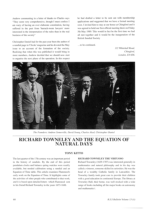
This article discusses the 17th-century work of Richard Towneley and John Flamsteed on the Equation of Time. It highlights their correspondence and experiments aimed at validating the Equation of Time and confirming the Earth's constant rotational speed, discussing earlier publications and the ongoing controversies surrounding this astronomical concept.
Equation of Time, Historical Dials, Mathematics of Dialling
June 2001
Page 65
Page 65
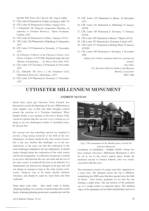
Describes the Uttoxeter Millennium Monument, a large stone disc featuring a solar system theme and an armillary sundial. Conceived to inspire exploration and celebrate the town, it incorporates local craftsmanship, planetary representations, and embedded plaques documenting its creation and sponsors. A time capsule is also concealed within the monument.
Construction Projects, Dials: Equatorial, Dials: Unusual
June 2001
Page 67
Page 67
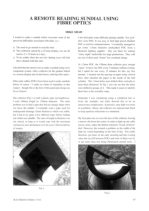
Mike Shaw details his innovative two-component sundial system, comprising an equatorial collector in the garden and a remote display unit indoors, linked by fibre optics. Designed to overcome the need to go outside to read time and simplify the display, the article describes its construction, addressing material challenges and light-gathering techniques.
DIY Sundial Projects, Dials: Unusual
June 2001
Page 73
Page 73
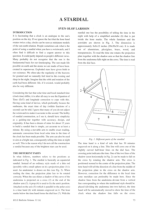
The article presents the Stardial, an innovative device functioning as an equatorial sundial by day and a simplified astrolabe by night. Designed for simplicity, accuracy, and originality, it enables automatic conversion from local solar time to clock time and provides methods for precise time-telling using bright stars and even the moon.
Dials: Equatorial, Dials: Unusual, Dials: Astrolabe, DIY Sundial Projects, Dials: Nocturnals
June 2001
Page 77
Page 77
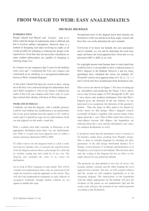
Michael Hickman introduces a non-mathematical method for designing analemmatic sundials using Weir's Azimuth Diagram. He explains how this navigational tool can be adapted to plot hour points and declination scales for dial design without complex trigonometry, making the process accessible to a broader audience.
DIY Sundial Projects, Dials: Analemmatic, Mathematics of Dialling, Sundial Design & Layout
June 2001
Page 79
Page 79
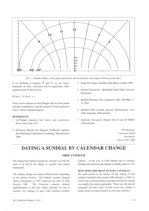
Mike Cowham explains how the historical change from the Julian to Gregorian calendars can serve as a dating aid for sundials. He outlines methods for identifying pre- and post-1752 dials based on calendar scales and Equation of Time tables, providing examples from historical quadrants and portable dials across Europe.
Equation of Time, Historical Dials
June 2001
Page 82
Page 82
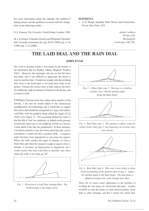
John Foad proposes new categories for sundials designed to prevent rain accumulation: the "Laid Dial," a reclining dial with an "Angle of Lie," and the "Rain Dial", featuring a conical raised centre. He discusses the practical advantages of these forms in preserving dial plates and enhancing readability, and the pleasing play on words.
Dials: Horizontal, Dials: Unusual, Sundial Design & Layout
June 2001
Page 83
Page 83
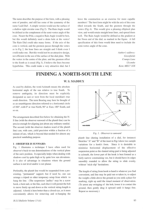
W.S. Maddux describes precise techniques for accurately establishing a true north-south line, essential for sundial installation. He outlines two methods using a plumb line and its shadow: one for general alignment and another for achieving high precision, detailing practical steps for observing and marking the meridian.
Dialling Tools, Sundial Design & Layout