- Home
- /
- Sundial Encyclopaedia
- /
- Tony Belk
Tony Belk
March 2010
Page 48
Page 48
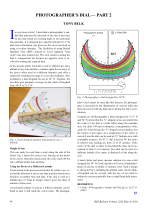
An extension of a previous article on a photographer's sundial. This part adds a scale to indicate the sun's altitude and provides a new design for use at 54° N, which, together with the original 51.5° N dial, covers all of England.
DIY Sundial Projects, How Sundials Work, Sundial Design & Layout
December 2010
Page 45
Page 45
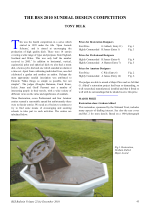
This report covers the fourth BSS Sundial Design Competition, which received 14 entries across restoration, professional, and amateur classes, though no junior entries. Graham Aldred won the Major Prize for his restoration of the Lyme Park dial. Other prizes were awarded for a south-facing vertical dial and highly commended entries for a sun/moon dial, a prototype noon mark dial, and a vertical dial using a 'super ellipse.'
Dials: Unusual, Restoration projects, Sundial Design & Layout, The BSS and Members
June 2009
Page 10
Page 10
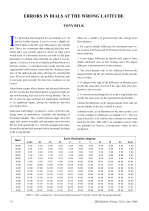
An analysis of the time-telling errors that occur when a horizontal or vertical non-declining sundial is used at a latitude different from its design latitude. The article provides tables and graphs illustrating the magnitude of these errors at different times of day and for different solar declinations.
Dials: Horizontal, Dials: Vertical, How Sundials Work, Mathematics of Dialling
December 2009
Page 26
Page 26
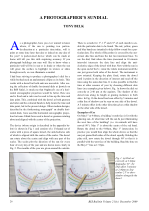
Describes the design and use of a pocket-sized device for photographers to predict the sun's direction at any time of day or year. Based on a horizontal stereographic projection, the instrument uses a rotating dowel aligned with date and time scales to help plan for specific lighting conditions.
DIY Sundial Projects, Dials: Unusual, Sundial Design & Layout
December 2008
Page 169
Page 169
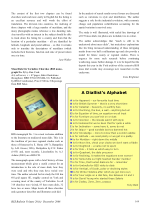
A light-hearted alphabetical list of terms and concepts related to sundials and dialling. It covers various aspects from Apparent time to Zodiac, including types of dials, mathematical concepts, and references to the British Sundial Society and its members.
How Sundials Work, The BSS and Members
December 2008
Page 170
Page 170
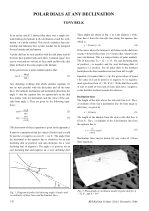
This article presents a method for designing polar sundials for any latitude and declination using four simple formulae. It explains that polar dials have a style parallel with the dial plane and parallel hour lines, and describes how to determine the angle of the equinox line and the sub-style hour angle.
Dials: Polar, How Sundials Work, Mathematics of Dialling, Sundial Design & Layout
September 2007
Page 137
Page 137
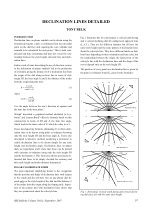
This article offers detailed methods for drawing declination lines on planar sundials using polar and Cartesian coordinates, or a graphical protractor, all based on the dial's style height and nodus distance. It also provides formulas for calculating hour line angles for various dial types and a simple method to check existing dials for accuracy.
Construction Projects, Dialling Tools, Mathematics of Dialling, Sundial Design & Layout
September 2006
Page 142
Page 142
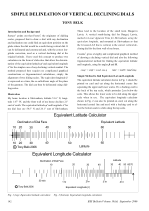
This article introduces a user-friendly method for delineating vertical declining sundials using bespoke slide rule-like calculators. These tools determine equivalent latitude and longitude, simplifying the process by eliminating complex trigonometry. The article explains how to use these calculators with standard dialling scales to accurately plot hour and sub-style lines.
Dialling Tools, Dials: Vertical, Mathematics of Dialling, Sundial Design & Layout
June 2005
Page 47
Page 47
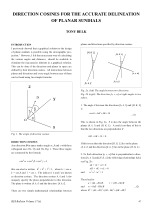
Explains how direction cosines can be used to precisely design planar sundials. The method eliminates inaccuracies of graphical construction by calculating hour lines, declination lines, and style parameters mathematically, with examples for horizontal, vertical, and declining dials, and comparison with conventional calculation methods.
Mathematics of Dialling, Sundial Design & Layout
June 2003
Page 76
Page 76
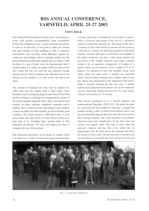
A summary of the British Sundial Society's Annual Conference at Yarnfield. The report covers various talks and workshops, including one on electrochemical hazards to sundials, a presentation on a pilgrim route, and one on unusual sundial designs.
The BSS and Members
December 2002
Page 135
Page 135
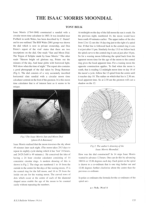
A detailed explanation of a unique 1803 sundial with a moon time calculator by Isaac Morris, exploring its design, mathematics, and possible use for tide prediction.
Historical Dials, Dials: Nocturnals
September 2001
Page 123
Page 123
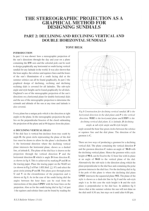
This second part details using stereographic projection for graphical design of declining and reclining vertical, and double horizontal sundials. It explains how to determine sub-style angles and style heights, and how the projection can cover full 24-hour periods. The article also covers William Oughtred"s "Horizontal Instrument" and Blagrave"s "Mathematical Jewel" as related applications.
Dials: Double Horizontal, Dials: Vertical, Mathematics of Dialling, Sundial Design & Layout