- Home
- /
- Sundial Encyclopaedia
- /
- Dials: Analemmatic
Dials: Analemmatic
March 2023
Page 10
Page 10
A summary of the 51 new finds added to the Fixed Dial Register in 2022, increasing the record count to 7,781. Highlights include a Falklands memorial dial, a French Noon Cannon, two Francis Barker instruments, and the largest vertical dial (Piers Nicholson’s in Fleet Street).
Dials: Analemmatic, Dials: Unusual, Historical Dials
December 2021
Page 12
Page 12
Presents the analemmatic human sundial installed around 2012–13 on the north-west lawn of Bodelwyddan Castle, North Wales, made of reconstituted stone with GMT/BST rings. The castle site also hosts an older, 19th-century horizontal dial by Troughton, found and re-erected decades later.
Dials: Analemmatic, Historical Dials
June 2020
Page 18
Page 18
This report outlines 24 sundials newly reported to the BSS Fixed Dial Register in 2019. The entries feature a variety of types, including a Pilkington and Gibbs heliochronometer, several analemmatic dials, and various vertical and horizontal dials located across the UK.
Dials: Analemmatic, Dials: Heliochronometer, Historical Dials, The BSS and Members
September 2020
Page 30
Page 30
Reports on a tour detailing various sundials across New Zealand's North Island, including a memorial dial at Lynfield College. Describes a commemorative dial at the Treaty of Waitangi Grounds and the analemmatic 'Sundial of Human Involvement' in Wellington Botanic Garden.
Dials: Horizontal, Dials: Analemmatic, Historical Dials, Dials: Armillary Sphere
March 2019
Page 18
Page 18
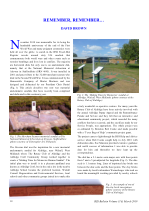
Describes three sundials commemorating war and peace. The first is the Merchant Seamen analemmatic dial at the National Memorial Arboretum. The second and third are new memorial analemmatic sundials in Aldridge (incorporating clay bricks inscribed by schools) and East Stour (made of Portland stone and granite). Also mentions a brass dial commemorating the 1919 Treaty of Versailles.
Construction Projects, Dials: Analemmatic, Historical Dials
March 2019
Page 32
Page 32
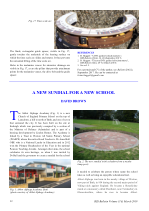
Describes a conventional analemmatic sundial commissioned for the Abbot Alphege Academy in Bath. The Forest of Dean sandstone dial commemorates Abbot Alphege (martyred 1012) and incorporates pointer stones, Bailey points, an Alphege cross, and stones naming personal qualities such as courage and wisdom.
Construction Projects, Dials: Analemmatic
September 2019
Page 7
Page 7
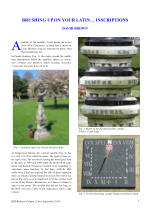
This piece examines Latin mottoes found on sundials visited during the 2019 BSS Conference in Bath. It provides translations for inscriptions on the Parade Gardens armillary sphere, Kingswood School’s vertical and analemmatic dials, and the Pilkington & Gibbs heliochronometer, ending with a challenge regarding the Royal Victoria Park cross dial inscription.
Dials: Analemmatic, Dials: Heliochronometer, Dials: Vertical, Mottoes
June 2017
Page 24
Page 24
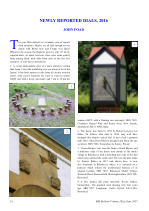
This report lists 47 newly reported dials added to the BSS Register in 2016. Descriptions include an analemmatic dial in New Lanark, a simple vertical dial designed for a Robert Lutyens house, a Dollond dial in London, and a vertical limestone monolith gnomon dial in Lancashire.
Dials: Analemmatic, Dials: Unusual, Dials: Vertical, Historical Dials
September 2017
Page 17
Page 17
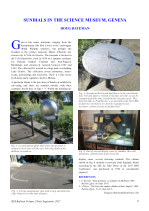
This visits the Geneva Science Museum, which displays instruments related to astronomy and surveying. External exhibits include a conventional globe dial, a large analemmatic dial, and an unusual horizontal altitude dial. Indoor displays feature quadrants, altitude dials, and a navicula portable dial purchased in 1993.
Dials: Analemmatic, Dials: Portable, Dials: Unusual, Historical Dials
September 2017
Page 26
Page 26
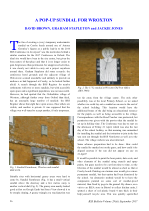
This describes the creation of a temporary analemmatic sundial on the grounds of Wroxton Primary School, intended as an educational resource. Components were made from red plastic board using stencils and spray paint. Alignment relied on Google Earth data, as the sun did not appear. The authors suggest this project, executed before the Oxford Conference, could become a BSS custom.
Construction Projects, DIY Sundial Projects, Dials: Analemmatic, The BSS and Members
March 2016
Page 20
Page 20
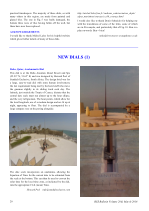
Description of a large, modern, analemmatic dial designed by Howard Peel for the Doha Anantara Island Resort and Spa. The dial's design requires the hotel staff to move the gnomon daily and incorporates an analemma scale for estimating the Equation of Time.
Dials: Analemmatic, Equation of Time, Sundial Design & Layout
September 2016
Page 34
Page 34
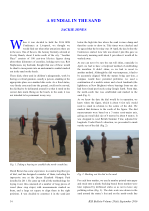
Describes the construction of a large, temporary 6x4 metre analemmatic sundial marked out in the sand at Crosby Beach, Liverpool, utilizing one of Antony Gormley’s cast-iron statues as the gnomon. The team had to use satnav and landmarks to establish the meridian due to the lack of sun.
Construction Projects, Dials: Analemmatic, Sundial Design & Layout, The BSS and Members
December 2016
Page 38
Page 38
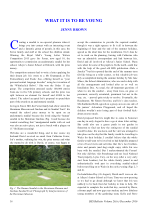
Account of the commission and installation of a Forest of Dean sandstone analemmatic sundial at Alleyn’s Junior School. The project was funded by 10-year-old Iris Ferrar, who won a national writing competition and wanted an active piece amalgamating maths and art. Iris subsequently became the sundial tour guide.
Construction Projects, Dials: Analemmatic
March 2015
Page 10
Page 10
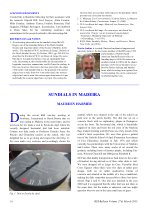
A report surveying several sundials encountered across Madeira. These include David Brown's horizontal slate dial at Escola da Apel, two less impressive dials in Red Cross Square, a horizontal W. Page & Co. dial at Liceu de Jaime Moniz, a large analemmatic dial on the Funchal seafront, a direct south vertical dial by Sampaio E Mello, and a Brookbrae horizontal dial in Palheiro Gardens.
Dials: Analemmatic, Dials: Horizontal, Dials: Vertical, Historical Dials
June 2015
Page 31
Page 31
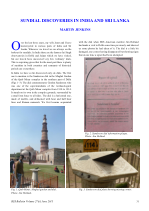
A report on sundials discovered during travels in India and Sri Lanka over three years. Finds include the Sanderson horizontal marble dial in Delhi, a Shimla bronze dial listing railway time, an analemmatic dial in Leh, and an unusual modern dial in Sri Lanka.
Dials: Analemmatic, Dials: Horizontal, Dials: Unusual, Historical Dials
December 2015
Page 14
Page 14
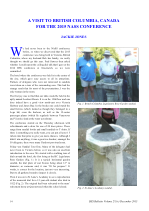
A report on the 2015 NASS Conference in Victoria, BC, Canada, which included presentations on gnomonics and sundial tours. The tour featured several dials, including the Orca totem dial and the impressive Ogden Point analemmatic dial.
Dials: Analemmatic, Dials: Horizontal, Dials: Vertical, The BSS and Members
December 2015
Page 18
Page 18
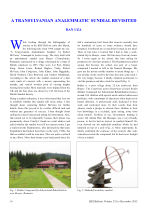
Describes the author's search for an analemmatic sundial near Braşov, Romania, built by British volunteers in 1993. Although wooden posts are gone, the concrete date scale mosaic was found at the Brădet Compound, and the manager intends to restore the dial.
Construction Projects, Dials: Analemmatic, Restoration projects
December 2015
Page 24
Page 24
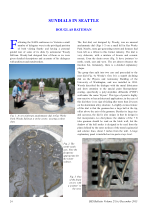
Recounts a guided tour of Seattle dials following the NASS conference, featuring four dials designed by Woody Sullivan. Highlights include an elaborate analemmatic dial in Gas Works Park, a vertical declining dial at UW, and the earliest Seattle dial dating from 1909.
Dials: Analemmatic, Dials: Equatorial, Dials: Vertical, The BSS and Members
March 2014
Page 17
Page 17
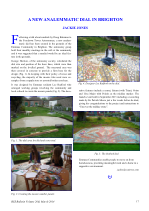
A new analemmatic dial was created in the grounds of the Emmaus Community in Brighton, which supports people moving on from homelessness. Emmaus resident Lee Radford designed the dial, and community members and local schools created the mosaic panels using recycled crockery.
Construction Projects, DIY Sundial Projects, Dials: Analemmatic
September 2014
Page 9
Page 9
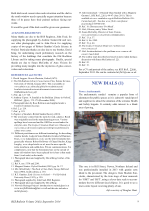
Describes an analemmatic sundial professionally installed in 2013 in Hill Street, Newry, Northern Ireland, featuring twin rings for GMT and BST, designed by Modern Sun-clocks.
Construction Projects, Dials: Analemmatic
June 2013
Page 2
Page 2
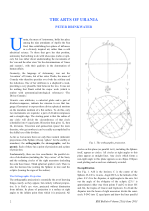
A philosophical and mathematical essay exploring the classical projections of the celestial sphere—orthographic, stereographic, and gnomic—and their relation to sundial design, astronomy, and the history of dialling geometry.
Dials: Analemmatic, Historical Dials, How Sundials Work, Mathematics of Dialling
June 2012
Page 18
Page 18
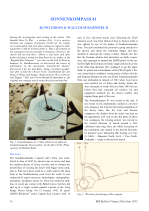
This addendum describes the German Sonnenkompass 41, issued to the Sonderkommando Dora unit in North Africa during WWII. Based on an analemmatic sundial, it featured removable dial plates for different latitudes and seasons, including German Summer Time adjustments. Despite its design, field reports deemed it unsuitable for desert use due to gnomon issues, leading to its obscurity.
Dials: Analemmatic, Dials: Portable, Historical Dials
September 2012
Page 7
Page 7
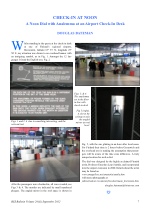
This article describes a unique noon dial with an analemma at Rovaniemi Airport, Finland, designed by Professor Emeritus Lauri Anttila in 2000. An angled mirror in the roof casts sunlight onto the floor to indicate months, with the design assuming passengers are aware of time zone differences.
Construction Projects, Dials: Analemmatic, Dials: Noon Lines, Sundial Design & Layout
September 2012
Page 26
Page 26
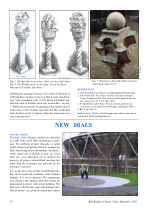
This section introduces several recent sundial projects, including an Olympic sundial by David Brown (an analemmatic dial), a vertical school science centre dial featuring periodic table elements, and the Angel with Sundial at Talaton church by Harriet James, inspired by Chartres Cathedral.
Dials: Vertical, Dials: Analemmatic, Sundial Design & Layout, Construction Projects
December 2012
Page 15
Page 15
This section showcases several contemporary sundials, including a Corian® vertical dial in Pocklington by Stephen Holehan, based on an 1854 design. It also highlights analemmatic dials by Douglas Hunt's Modern Sunclocks for public sites and playgrounds, and a tile-based dial from High Peak Community Arts in Ston, Croatia.
Construction Projects, Dials: Analemmatic, Dials: Vertical, Sundial Design & Layout
June 2011
Page 20
Page 20
This article explores the military use of solar compasses, particularly during World War II, for navigation in unmapped desert terrains. It describes several models, including the Burt, Abrams, Cole Universal, Bagnold, and Union Observatory sun compasses, highlighting their principles and operational advantages.
Dials: Analemmatic, Dials: Portable, Dialling Tools, Historical Dials
March 2010
Page 12
Page 12
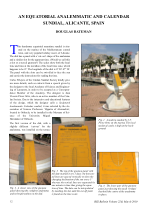
Describes a modern, equatorial meantime sundial on the marina in Alicante, Spain, designed by Juan Vicente Pérez Ortiz. The dial features a 'cut-out' analemma shape and a slot for apparent time, and has scales for both local and time zone time.
Dials: Analemmatic, Dials: Equatorial, Equation of Time
December 2010
Page 44
Page 44
This article describes a walk-on analemmatic sundial designed for Highlands School in North Vancouver, Canada, using 'Alemma' software. It features a double analemma design to provide direct mean time with minimal error, accommodating the equation of time correction. Parent volunteers built the dial, using plywood jigs and bronze survey markers for permanent reference.
Construction Projects, Dials: Analemmatic, Equation of Time, Sundial Design & Layout
March 2009
Page 18
Page 18
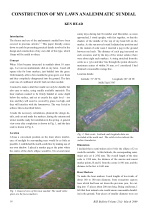
This article provides practical details for designing and constructing a durable lawn analemmatic sundial using readily available materials. It covers establishing the north-south line, calculating dimensions, making hour markers from tree-trunk lengths, crafting a date scale from timber, and ensuring precise installation for accurate solar timekeeping.
Dials: Analemmatic, Sundial Design & Layout, Construction Projects, DIY Sundial Projects
March 2009
Page 28
Page 28
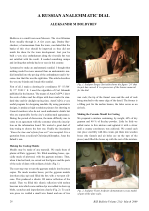
This article details the design and robust construction of an analemmatic sundial installed in the paving of an embankment in Shelkovo, Russia. It covers the use of AutoCAD for design, creating plaster-of-Paris and beeswax models, the ceramic mould casting process for bronze elements, and building substantial concrete foundations to ensure durability against vandalism and weathering.
Dials: Analemmatic, Sundial Design & Layout, Construction Projects
March 2008
Page 13
Page 13
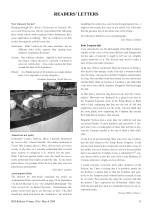
A collection of letters. Graham Stapleton suggests new glossary terms; John Moir corrects a previous 'Almost Sundial' entry; Ken Head clarifies how to use analemmatic dials; George White discusses the Bath Tompion dial and its uncertain link to the Pump Room clock.
Dials: Analemmatic, Dials: Portable, Historical Dials
September 2008
Page 143
Page 143
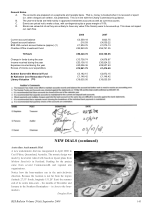
Douglas Hunt reports on a new analemmatic mosaic sundial inaugurated in April 2008 in Cecil Plains, Queensland, Australia. Designed by local artist Alain Colfs with layout plans from Modern Sunclocks, the dial features anti-clockwise hour markers and a date-scale, located near the tropics in the Southern Hemisphere.
Construction Projects, Dials: Analemmatic, Sundial Design & Layout
December 2008
Page 160
Page 160
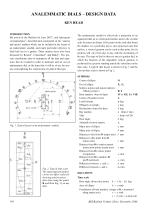
This article provides a summary of data and equations needed to delineate and set out analemmatic sundials. It discusses the projection of an equatorial dial onto a horizontal surface, using a vertical gnomon whose position varies with the sun's declination, and the calculation of sunrise and sunset markers using Lambert circles and Bailey Points.
Dials: Analemmatic, How Sundials Work, Mathematics of Dialling, Sundial Design & Layout
June 2007
Page 78
Page 78
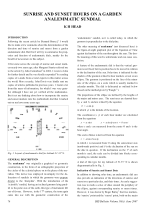
This article discusses the determination of sunrise and sunset directions and times using garden analemmatic sundials. It explains the dial's principles, the Bailey points for seasonal markers, and evaluates the accuracy of these markers, noting discrepancies and suggesting practical applications for garden dials despite minor errors.
Dials: Analemmatic, How Sundials Work, Mathematics of Dialling, Sundial Design & Layout
June 2007
Page 82
Page 82
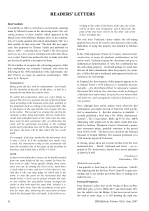
This section contains reader correspondence. Fred Sawyer corrects an article on dual sundials, attributing the self-setting property to Vaulezard (1640) rather than Tuttell (1698). Mike Faraday asks for a website to track the terminator for sunrise times. Tony Wood clarifies the location and movement of the Ross-on-Wye pillar dial.
Dials: Analemmatic, How Sundials Work, Historical Dials
December 2007
Page 161
Page 161
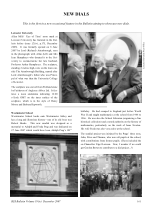
This section showcases several newly completed sundials. It features a memorial dial at Westminster School for Adolph and Freda Prag, an elliptical dial carved in Portland stone, a unique double horizontal dial for the southern hemisphere on Okatjorute Farm in Namibia, a late Saxon memorial sundial for a dog in Macclesfield, and a large analemmatic dial in Pollagh, Co. Galway, Ireland, at Brigit's Garden.
Dials: Horizontal, Dials: Analemmatic, Dials: Double Horizontal
December 2007
Page 173
Page 173
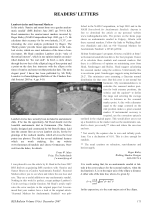
This section contains various letters from readers. Frans W. Maes discusses Lambert circles and seasonal markers on analemmatic sundials. Roger Bailey provides corrections and recommendations for seasonal markers. Frank King confirms a relationship for seasonal marker distance. Ken Head replies to Maes and Bailey. John Lester solves the mystery of a partial sundial motto. Malcolm Barnfield describes the making of a noon cannon sundial.
Dials: Analemmatic, Sundial Design & Layout, DIY Sundial Projects, The BSS and Members
December 2006
Page 146
Page 146
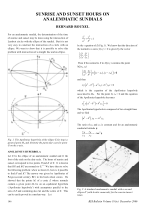
For an analemmatic sundial, the determination of the time of sunrise and sunset may be done using the intersection of Lambert circles with the ellipse of the sundial. However, this is practically difficult and the article explores a simpler solution using the intersection of a straight line and an ellipse.
Dials: Analemmatic, Mathematics of Dialling
March 2004
Page 14
Page 14
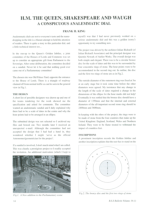
This article details the design and construction of an analemmatic sundial for the Queen's Golden Jubilee, located in Old Palace Yard, opposite the House of Lords. It covers the challenges of designing for a cambered surface, the selection of stone from UK countries, the prominent Shakespearean inscription, and the intricate process of determining the scale of dates for the dial.
Construction Projects, Dials: Analemmatic, Sundial Design & Layout
June 2002
Page 72
Page 72
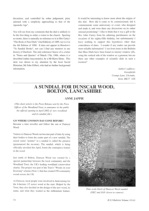
An account of the creation and community involvement in erecting a new sundial in a public woodland area.
Dials: Analemmatic
December 2002
Page 170
Page 170
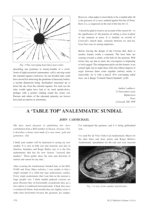
Compact design for a small-scale analemmatic sundial suitable for indoor or portable use, with layout guidance.
DIY Sundial Projects, Dials: Analemmatic
June 2001
Page 77
Page 77
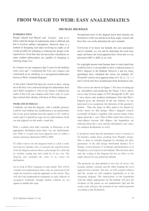
Michael Hickman introduces a non-mathematical method for designing analemmatic sundials using Weir's Azimuth Diagram. He explains how this navigational tool can be adapted to plot hour points and declination scales for dial design without complex trigonometry, making the process accessible to a broader audience.
DIY Sundial Projects, Dials: Analemmatic, Mathematics of Dialling, Sundial Design & Layout
June 2000
Page 103
Page 103
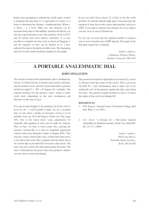
Design and rationale for a moveable analemmatic sundial suitable for demonstration or travel.
DIY Sundial Projects, Dials: Analemmatic
October 2000
Page 125
Page 125
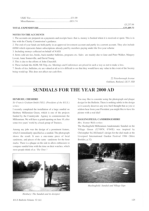
Showcase of sundials commissioned or constructed to commemorate the millennium year.
Dials: Analemmatic, Dials: Equatorial, Dials: Horizontal, Dials: Vertical, The BSS and Members
June 1999
Page 99
Page 99
This tribute remembers Lieut. Commander Richard "Dick" Andrewes, a BSS member known for his wartime naval service, mathematical degree, and enthusiasm for dialling. He designed a unique dial for his home and an analemmatic dial for a conservation centre. He is particularly remembered for delineating a scaphe dial at the Horniman Museum, ingeniously overcoming its organic shape by using a marble to find the bowl's lowest point.
Dials: Analemmatic, Dials: Scaphe, The BSS and Members
February 1998
Page 26
Page 26
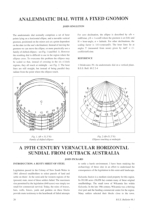
Proposes an analemmatic dial that retains a fixed upright gnomon by drawing a series of ellipses, scaling and shifting them to avoid crossing lines and confusion when reading it.
Dials: Analemmatic, Mathematics of Dialling, Sundial Design & Layout
February 1995
Page 39
Page 39
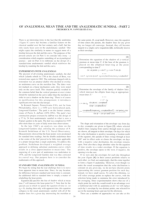
Continued discussion on the analemma and its use in sundials, particularly analemmatic types, including the relation to mean solar time and design techniques.
Dials: Analemmatic, Equation of Time, Mathematics of Dialling
February 1995
Page 44
Page 44
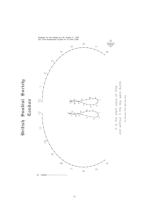
A companion piece offering additional commentary or diagrams for analemmatic sundial design, expanding on the previous article.
Dials: Analemmatic
June 1994
Page 2
Page 2
An in-depth historical and mathematical exploration of the analemma and its application in sundial construction. This first part traces its etymology and use from ancient times through Ptolemy, Vitruvius, and Renaissance scholars, connecting it with the development of the analemmatic sundial. Richly referenced and scholarly, it bridges history and design.
Dials: Analemmatic, Historical Dials, Mathematics of Dialling
June 1994
Page 39
Page 39
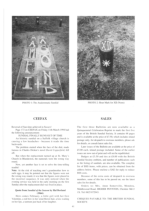
An examination of an analemmatic sundial discovered in Transylvania, analysing its layout, mathematical principles, and probable origin. The author reflects on its preservation and the unique aspects of its design that distinguish it from Western examples.
Dials: Analemmatic, Historical Dials
October 1993
Page 39
Page 39
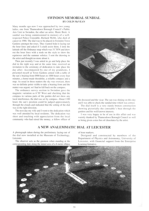
This article describes the design of a horizontal dial commissioned in memory of a police constable and placed in Swindon Town Gardens. The author details the process of laying out hour lines and setting up in the absence of sunshine. It also describes the installation of an analemmatic sundial at Leicester, a photograph shows the preliminary layout, with the observer acting as the gnomon, demonstrating the dial's function in determining time.
Dials: Analemmatic, Dials: Horizontal, Sundial Design & Layout
February 1992
Page 19
Page 19
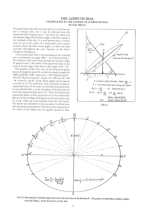
This article describes the azimuth dial, a type of horizontal dial with a vertical style, derived from the equatorial dial formula. It explains that while a vertical style at the center of a horizontal circle cannot show time correctly throughout the year due to declination changes, projecting an equatorial circle onto a horizontal plane forms an ellipse for the hour lines. The article provides the formula for the shadow angle and suggests this as a useful project for understanding geometry and for practical marking in playgrounds or gardens.
DIY Sundial Projects, Dials: Analemmatic, Dials: Equatorial, Dials: Horizontal, Mathematics of Dialling
February 1992
Page 36
Page 36
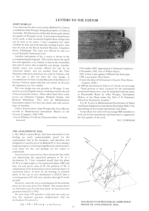
This section contains several letters. H.R. Mills provides mathematical formulae for an analemmatic dial, J.G. Freeman describes the bifilar sundial with two horizontal wires, and Alex Monroe encloses a photograph of his portable equatorial dial. M.J. Cowham contributes notes on John Worgan's work, highlighting a distinctive English Rose design on his instruments.
Dials: Analemmatic, Dials: Bifilar, Dials: Equatorial, Dials: Portable
February 1991
Page 32
Page 32
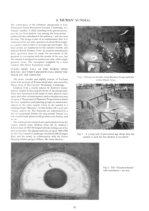
This analemmatic sundial in a Cambridge playground functions by having a child stand on a stone, with their shadow falling onto numbered tiles to indicate the time. The design is intended for summer use and features an inscription on the stone base.
Dials: Analemmatic
July 1991
Page 24
Page 24
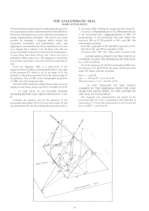
Mark Lennox-Boyd presents a trigonometric proof for the correctness of the equations for laying out an analemmatic dial, aiming to clarify Rene Rohr's complex explanations. Using a diagram relating equatorial, horizontal, and analemmatic dials, he derives three key formulae: one defining the elliptical shape of the dial, and two describing the vertical gnomon's displacement and the hour points angles. The diagram simultaneously provides a proof for the horizontal dial.
Dials: Analemmatic, Mathematics of Dialling
June 1990
Page 17
Page 17
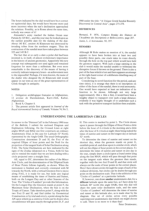
This article explains the construction and practical application of Lambertian Circles in analemmatic dials. These circles, plotted from a specific centre through the foci of the hour point ellipse, determine the times of sunrise and sunset for any given day, applicable across different latitudes.
Dials: Analemmatic, How Sundials Work, Mathematics of Dialling
June 1990
Page 29
Page 29
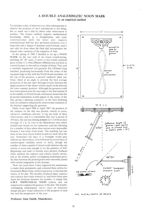
This article describes the empirical method used to construct a double analemmatic noon mark on a south-facing, east-declining wall. Over a year, the author meticulously plotted sunspot positions at noon to permanently engrave the overlapping analemmas, illustrating the dedication required for direct solar observation.
Construction Projects, DIY Sundial Projects, Dials: Analemmatic, Sundial Design & Layout
July 1989
Page 5
Page 5
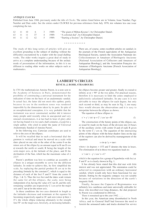
An article by Rene R-J. Rohr discusses Lambert's circles and their relationship to analemmatic sundials. The article discusses how to determine the times of sunrise and sunset using these circles, including their application to the universal dial of Antoine Parent, and how they can be used to create a sun compass.
Dials: Analemmatic, Mathematics of Dialling
November 1989
Page 2
Page 2
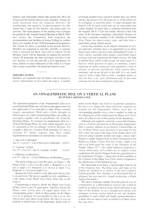
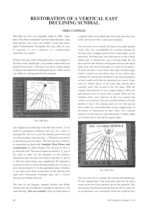
The author explores applying the analemmatic dial principle to vertical planes, contrasting it with the more common horizontal version. The article provides the trigonometric calculations necessary for constructing such a dial on a vertical declining plane, detailing how to find the sub-style to meridian, the dial's "latitude," and the difference of meridians. It describes the layout process involving primary and minor axis circles to generate hour points and arcs for zodiacal signs, explaining why a movable gnomon is impractical for vertical planes and instead a horizontal rod is used. The dial is presented as a philosophical exercise, a functional piece for those interested in the Zodiac, or an aesthetic wall ornament.
Dials: Vertical, Dials: Analemmatic, Mathematics of Dialling