- Home
- /
- Sundial Encyclopaedia
- /
- September 2017
September 2017
The articles link to the specific page in a PDF optimised for speed. If you want the whole issue, you can download it here, but the files from earlier years can be quite large.
September 2017
Page 1
Page 1
This editorial encourages conference speakers and attendees of Newbury meetings to submit articles to the Bulletin for the benefit of all members. It also reminds members that holiday photographs of sundials, such as those featured in 'A Missed Opportunity', can be developed into published articles.
The BSS and Members
September 2017
Page 2
Page 2
This article is based on a 2016 conference talk detailing modern observations of solar transits on Rome's 1702 meridian line. The purpose was to determine the obliquity of the ecliptic, length of the year, and time of vernal equinox. Analysis of 54 data points gathered between 1996 and 2015 confirmed that the obliquity has grown smaller since the line's construction.
Dials: Noon Lines, Historical Dials, How Sundials Work, Mathematics of Dialling
September 2017
Page 12
Page 12
The article examines a 1692/93 query in *The Athenian Mercury* concerning disparate public clock times during a walk across London. Assuming the two sundials mentioned ('Mr. Knib’s Dyal' and the dial near Stocks Market) were accurate, the author uses the measured distance between them to estimate the total elapsed walking time as just over 38 minutes.
Historical Dials
September 2017
Page 14
Page 14
A poem, edited by Kevin Karney, that was read at the 2017 BSS Conference in Oxford. It details how RAF ground staff stationed at Kalyan airfield, India, during 1945, relieved their boredom and homesickness by constructing a makeshift sundial (a 'mound' with a pole gnomon and painted components) outside the Mess.
Construction Projects, DIY Sundial Projects
September 2017
Page 16
Page 16
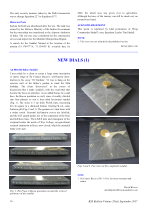
This describes a 40cm square, diamond-format horizontal sundial made of Welsh slate, featuring a brass gnomon with a nodus notch. It includes an EoT graph and declination curves. The inscription uses four phrases from Sir Francis Bacon’s essay ‘Of Gardens’ and was commissioned as an 80th birthday gift.
Dials: Horizontal, Sundial Design & Layout
September 2017
Page 17
Page 17
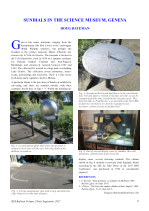
This visits the Geneva Science Museum, which displays instruments related to astronomy and surveying. External exhibits include a conventional globe dial, a large analemmatic dial, and an unusual horizontal altitude dial. Indoor displays feature quadrants, altitude dials, and a navicula portable dial purchased in 1993.
Dials: Analemmatic, Dials: Portable, Dials: Unusual, Historical Dials
September 2017
Page 19
Page 19
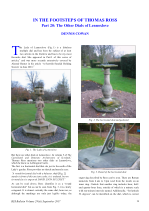
This article examines the other dials at Lennoxlove, Scotland, besides the famous multiple dial. It covers an octagonal horizontal dial engraved by David Lyon (possibly 18th century), a south and east vertical dial (1644), and a similar south and west vertical dial previously unknown to Ross.
Dials: Horizontal, Dials: Multi Faced, Dials: Vertical, Historical Dials
September 2017
Page 21
Page 21
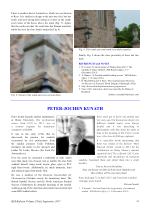
An obituary for Peter-Jochen Kunath (1944–2017), a German enthusiast and BSS member who calculated and built numerous sundials. He collected and translated over 2,000 Latin aphorisms, and won the 2012 Bulletin ‘Most Enjoyed Article’ award for his piece on Henry Moore’s equatorial dial.
The BSS and Members
September 2017
Page 22
Page 22
This article describes a polar sundial constructed by Sundials Australia for the Anzac Centenary Memorial Garden in Darwin (latitude 12.5° N). The gunmetal bronze dial includes a block gnomon and features a dedicated dateline for 25 April, Anzac Day.
Construction Projects, Dials: Polar, Sundial Design & Layout
September 2017
Page 23
Page 23
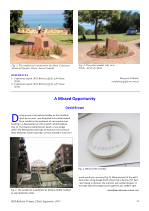
Reporting on a sundial seen on a new building in Dickens Heath, Solihull, the author notes that, despite initial delight, the dial was inaccurate upon closer inspection. The wall declines 59° East, and the author intends to contact the designer to persuade them to correct the inaccuracies.
Dials: Vertical, Sundial Design & Layout
September 2017
Page 24
Page 24
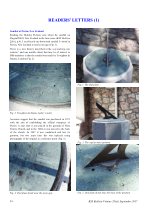
The letter discusses a horizontal sundial in Picton, New Zealand, manufactured by Troughton & Simms in London in 1871. It was restored in 1989 after the gnomon was vandalised. The dial's current placement is unsatisfactory as it is often obscured by shadows from an oak tree and the adjacent building.
Dials: Horizontal, Historical Dials, Restoration projects
September 2017
Page 25
Page 25
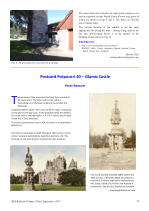
The article shows two postcards, one from 1904 and one from 1967, featuring the Glamis Castle sundial in Scotland. This multi-faceted sandstone dial dates from 1670, stands 6.5 metres high, and contains about 80 individual dials.
Dials: Multi Faced, Historical Dials
September 2017
Page 26
Page 26
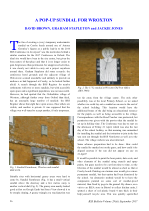
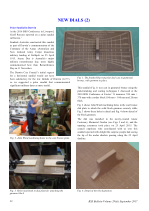
This describes the creation of a temporary analemmatic sundial on the grounds of Wroxton Primary School, intended as an educational resource. Components were made from red plastic board using stencils and spray paint. Alignment relied on Google Earth data, as the sun did not appear. The authors suggest this project, executed before the Oxford Conference, could become a BSS custom.
Construction Projects, DIY Sundial Projects, Dials: Analemmatic, The BSS and Members
September 2017
Page 28
Page 28
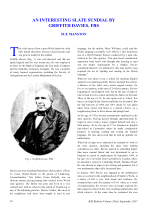
This biography recounts the life of actuary Griffith Davies, FRS, who won a silver medal in 1820 for a complex slate sundial. His 27-inch square horizontal dial, designed for London, displayed 14 different pieces of information, including time in London and Pekin, sun altitude/azimuth, and the Equation of Time.
Dials: Horizontal, Historical Dials
September 2017
Page 32
Page 32
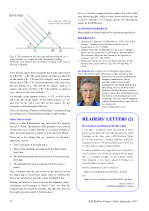
Responding to a previous article on Richard Melville’s slate dial, the author clarifies that Port Jackson refers to Sydney Harbour. She notes that the dial maker made a mistake in showing Port Jackson and Syndney as being an hour apart.
Dials: Horizontal, Historical Dials
September 2017
Page 33
Page 33
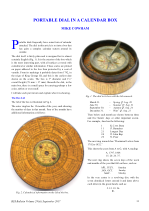
A description of an unsigned portable horizontal dial set in a 3-inch diameter box, likely dating from 1792. The box exterior is covered in detailed printed calendrical information, including Dominical Letters, Easter calculations, and a world time ring listing places and distances from London.
Dials: Portable, Historical Dials
September 2017
Page 36
Page 36
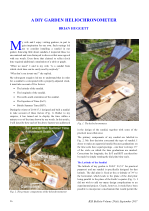
This details the design and construction of a DIY equatorial heliochronometer intended to show clock time easily. It compensates for latitude, longitude, BST, and EoT by allowing the time scale (mounted on a rotating dial plate annulus) to be physically rotated via an acrylic pointer aligned to an EoT graph. The gnomon is a thin, tensioned stainless steel wire.
DIY Sundial Projects, Dials: Equatorial, Dials: Heliochronometer, Sundial Design & Layout
September 2017
Page 41
Page 41
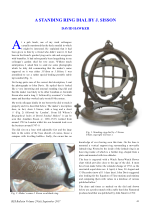
This reports on a rare portable standing ring dial by 'J. Sisson, London', likely Jonathan Sisson (c. 1690–1747). The high-quality brass dial includes latitude and hour rings, alidades, and a Watch Faster/Slower chart on the base. The chart's data matches John Flamsteed's 1702 tables, suggesting the dial was made before the 1730s.
Dials: Portable, Dials: Unusual, Equation of Time, Historical Dials
September 2017
Page 44
Page 44
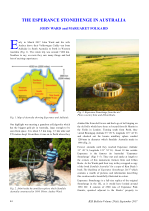
This article details the visit to the Esperance Stonehenge, a full-size replica of the UK original, built in 2011 using 2500 tons of local granite. The massive structure is aligned to the Summer Solstice sunrise and Winter Solstice sunset for its Australian latitude. The authors strongly recommend this construction to BSS visitors.
Construction Projects, Dials: Unusual
September 2017
Page 46
Page 46
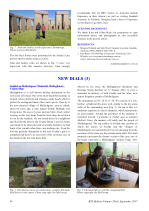
This describes a memorial in Mullaghmore, Ireland, commemorating forgotten villagers, featuring a six-foot sandstone capstone incorporating a limestone sundial. The dial, designed by Christian Meyer, indicates local sun-time and features a stainless steel gnomon with Celtic interlacery. The sundial symbolises the passing of time.
Construction Projects, Dials: Horizontal, Sundial Design & Layout
September 2017
Page 47
Page 47
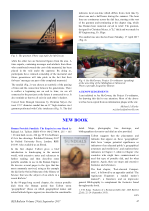
A review of Richard J.A. Talbert’s 2017 book, *Roman Portable Sundials: The Empire in your Hand*. The book describes the 16 known ‘geographical’ portable dials from the Roman period, which feature place names and latitude figures. It discusses their potential significance in understanding the educated public's geographical awareness and worldviews.
Book Reviews, Dials: Portable
September 2017
Page 48
Page 48
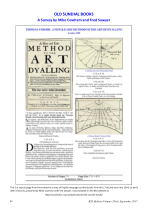
This entry references an extensive survey compiled by Mike Cowham and Fred Sawyer, covering English language sundial books published from the late 16th to the early 20th centuries. The survey is now available for members on the BSS website.
Book Reviews, Mathematics of Dialling, The BSS and Members