- Home
- /
- Sundial Encyclopaedia
- /
- George P. Woodford
George P. Woodford
October 1993
Page 42
Page 42
This section contains letters from readers, including a discussion on "Neolithic Astronomy" and Stonehenge, suggesting early warning systems for climate change. It also features "Errors" pointing out misconceptions in a previous bulletin, and comments on "A Japanese Sundial", "Kircher's Sunflower Clock", and "Kratzer's 'Polyhedral' Sundial", along with a poem about rainbows.
The BSS and Members
July 1991
Page 8
Page 8
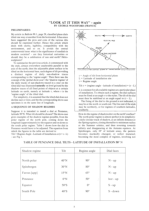
This article re-examines plane dials tilted from the horizontal, focusing on clarity, legibility, and environmental compatibility. It explains 'shadow regimes,' how tilt relates to equivalent latitude, and the impact on sun-shadow patterns. Key considerations include local horizons and the 'night factor'—periods where the dial cannot register time. It highlights the clarity of polar regime dials, despite seasonal limitations, for educational and aesthetic purposes.
Dials: Polar, How Sundials Work, Mathematics of Dialling, Sundial Design & Layout
February 1990
Page 20
Page 20
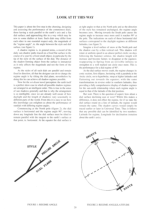
This paper explores the concept of "regime angle" in sundials, defined as the angle between the style and the dial surface. It introduces the idea that the Earth itself acts as a "show case" for various shadow regimes and illustrates how shadow curves change with latitude, showing examples for locations from the North Pole to the South Pole. The article also features Mr. Woodford's "Amundsen" dial
Dials: Unusual, How Sundials Work, Mathematics of Dialling
October 1990
Page 26
Page 26
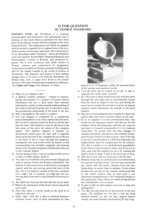
This article, presented in a question-and-answer format, describes a didactic hemispherical sundial that models the Earth's relationship to the sun. It explains how the shadow of a bead indicates date and time, distinguishes it from ancient Greek dials, and clarifies why it needs occasional adjustment about its axis to display clock time.
Dials: Hemispherical, Equation of Time, How Sundials Work