- Home
- /
- Sundial Encyclopaedia
- /
- March 2017
March 2017
The articles link to the specific page in a PDF optimised for speed. If you want the whole issue, you can download it here, but the files from earlier years can be quite large.
March 2017
Page 1
Page 1
The editorial notes that this issue contains three reviews, including a description of the New York 'Time and Cosmos' exhibition. It encourages BSS members to submit articles or short items on sundial themes for publication. The issue also includes the annual Trustees’ Report and Accounts, a requirement due to the Society becoming a Charitable Incorporated Organisation.
March 2017
Page 2
Page 2
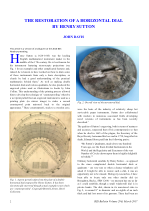
This article details the restoration of a rare, 1652 circular horizontal dial by Henry Sutton, a leading 17th-century instrument maker. Analysis revealed its accuracy but also a beginner’s delineation mistake (wrong centres used for back-hours). The brass plate showed remarkably uniform thickness and bore a unique motto: “As shade doth pass from line to line...”. A replacement gnomon was manufactured.
Dials: Horizontal, Historical Dials, Mathematics of Dialling, Mottoes, Restoration projects
March 2017
Page 8
Page 8
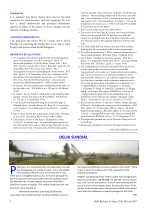
A large sundial in Delhi is reported to be one of the largest scientifically accurate sundials in the world, although the author expresses doubt regarding this claim. Access to the site is difficult due to its location in a complex of flyovers, and poor air quality often means the dial rarely sees the sun.
Dials: Horizontal, Dials: Unusual
March 2017
Page 10
Page 10
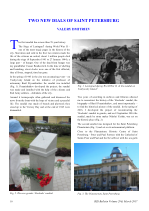
This piece details the history and 2016 granite reconstruction of a 1943 'blockade' sundial, originally made of wood and plywood during the Siege of Leningrad. Additionally, a new horizontal sundial designed with celestial spheres imagery was installed on the astronomical platform of the Saint Petersburg Planetarium.
Construction Projects, Dials: Equatorial, Dials: Horizontal, Historical Dials
March 2017
Page 11
Page 11
Review of *Medieval Graffiti: The Lost Voices of England’s Churches by Matthew Champion. It notes the book's comprehensive approach to church graffiti, including a dedicated chapter on mass dials. The review addresses questions about the utility of mass dials for time-telling and compares the differing height placements observed in British and Spanish corpuses.
Book Reviews, Dials: Mass Dials
March 2017
Page 12
Page 12
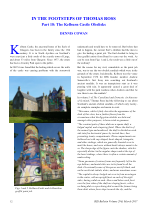
A study of two historical Scottish obelisk sundials at Kelburn Castle. The article describes the typical obelisk structure (shaft, bulged capital, tapering finial, multiple sinkings including scaphe dials). It notes the first dial's 1707 date and wrought-iron vane restoration, and the deteriorated state of the second dial, whose capital and finial have broken off.
Dials: Multi Faced, Dials: Scaphe, Historical Dials
March 2017
Page 15
Page 15
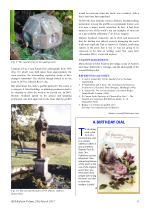
This short item features a 1926 birthday postcard, printed by Raphael Tuck & Sons, which includes a verse using the original word 'dial'. The use of 'dial' rather than the then more common form 'sun-dial' or 'sundial' is highlighted.
March 2017
Page 16
Page 16
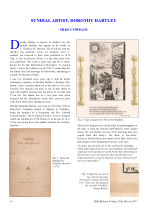
Analysis of Dorothy Hartley (1893–1985), known for her fine sundial illustrations in T. Geoffrey W. Henslow's books (c. 370 sketches). The article discusses her artistic quality, but notes technical errors in her drawings, such as incorrect shadow directions and misdrawn analemmatic components, suggesting a lack of technical gnomonic knowledge when she was young.
March 2017
Page 20
Page 20
A historical survey of five sundial-related sites in the Moorfields district of London. Sites include Sun Dial Court (possibly an inn), Walter Hayes’ instrument-making shop, a vertical dial at Albion Chapel, an Astrological Physician’s house sign with a dial, and a unique 1706 Cross Dial.
Dials: Unusual, Dials: Vertical, Historical Dials
March 2017
Page 22
Page 22
Review of the book *Time and Cosmos in Greco-Roman Antiquity*, resulting from a world-class exhibition at the Institute for the Study of the Ancient World. The book features scholarly papers on ancient time measurement, including sundials, water clocks, and portable sundials, and is considered a core reference source.
Book Reviews, Dials: Portable, Historical Dials
March 2017
Page 24
Page 24
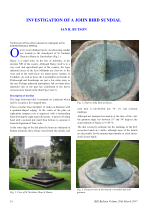
Investigation of a large, corroded horizontal dial by precision instrument maker John Bird (c. 1709–1776) at Haxey, Lincolnshire. By analyzing the division markers, the Equation of Time scale was determined to be applicable to the post-1752 Gregorian calendar era. The dial is likely associated with Dr William Cotton, vicar from 1754 to 1762.
Dials: Horizontal, Equation of Time, Historical Dials
March 2017
Page 28
Page 28
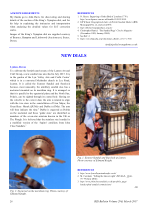
Description of the Exmoor Sundial and Starclock, an armillary sphere unveiled in 2015. Unusually, this stainless steel dial incorporates a nocturnal mounted on its meridian ring, allowing time measurement at night by sighting the North Star and guide stars in Ursa Major (The Plough).
Construction Projects, Dials: Armillary Sphere, Dials: Nocturnals
March 2017
Page 29
Page 29
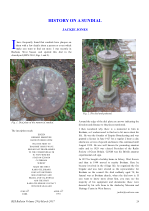
An account of a memorial horizontal dial in Bosham, West Sussex, dedicated to radio pioneer Eugen Gerald Marcuse (1886–1961), G2NM. Marcuse was noted for the first shortwave broadcast programmes to the Commonwealth (1927) and achieving the first radio telephone contact with New Zealand.
Dials: Horizontal, Historical Dials
March 2017
Page 30
Page 30
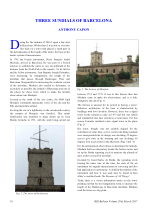
Description of two vertical declining sundials (32° east and 58° west declination) and a modern horizontal dial on the tower of the Montjuïc fortress in Barcelona. The tower was used by Pierre François André Méchain as a trig point for the meridian measurement required in determining the length of the metre in the late 18th century.
Dials: Vertical, Historical Dials
March 2017
Page 32
Page 32
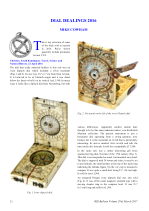
A selection of notable dials sold at auction in 2016. Highlights include a Flemish ivory diptych dial with a silver nocturnal (1590, sold for £17,500), a standing ring dial, a noon gun, an inclining dial by Benjamin Martin, and a silver Butterfield dial featuring Napoleon on the reverse.
Dials: Nocturnals, Dials: Portable, Dials: Unusual, Historical Dials
March 2017
Page 36
Page 36
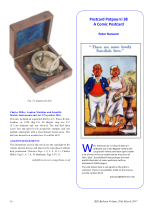
A humorous postcard, artist unknown (number 4513), is described, showing a couple whose sunburnt faces are referred to compared to as 'sun-dials'.
March 2017
Page 37
Page 37
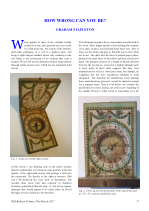
Analysis of wooden diptych sundials (late 18th/early 19th century, Southern Germany) that often only had hour lines delineated for a single latitude (typically 50°). The author calculates the errors (up to 20 minutes) when these dials are used at distant latitudes (e.g., 40° N or 54° N), even if the string gnomon is correctly reset.
Dials: Portable, How Sundials Work, Mathematics of Dialling
March 2017
Page 40
Page 40
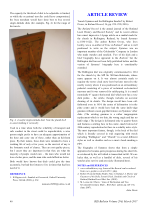
Review of Robert Ovens’ article in the 'Rutland Record' on the Isaack Symmes (c.1580–1622) Ridlington Sundial (1614). Notes the small horizontal dial's old-fashioned design and the detailed biography of Symmes. The dial's back is literally covered in trial engravings, including the words “Ridlington” and “Church”.
Book Reviews, Dials: Horizontal, Historical Dials
March 2017
Page 41
Page 41
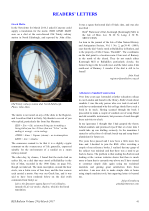
Includes translation and historical context for the Greek motto ‘Zoe Atme skie’ ('Life is smoke, shadow'), previously found on a dial in the Isle of Man and now noted in Edinburgh. Also features a letter discussing a member's return to simple sundial construction using reclaimed materials.
DIY Sundial Projects, Dials: Vertical, Mottoes, The BSS and Members
March 2017
Page 42
Page 42
Report covering BSS activities: membership levels were flat with a small decline, finances saw a surplus, and four quality Bulletins were produced. It highlights the continued success of the website as the main source of new members and the value of the Help and Advice service.
The BSS and Members
March 2017
Page 44
Page 44
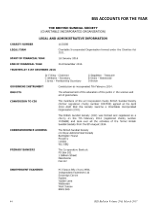
The audited financial statements for the British Sundial Society for the previous calendar year, presented as required by the new Constitution for the Charitable Incorporated Organisation.
The BSS and Members