- Home
- /
- Sundial Encyclopaedia
- /
- December 2011
December 2011
The articles link to the specific page in a PDF optimised for speed. If you want the whole issue, you can download it here, but the files from earlier years can be quite large.
December 2011
Page 1
Page 1
A bumper Christmas edition including plenty of varied reading over this quiet period of the year for dialling, including some continued inputs from overseas writers. It is always interesting to see how different cultures interpret the artistic side of dialling, even if the astronomy remains universal. The responses to the membership survey are continuing to come in and the Secretary will feed back anything relevant to the Bulletin when he sums up.
The BSS and Members
December 2011
Page 2
Page 2
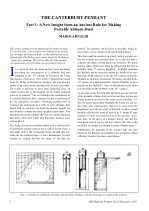
This article summarises the author's attempt to create a clear and correct edition of an ancient text, previously attributed to Bede, on constructing an altitude dial. The findings provide new insight into the famous ‘Canterbury pendant’ and suggest it was made more correctly than previously believed. The text describes a pendant altitude dial, possibly hexagonal, working like a cylinder dial, with specific dimensions and a calendar system.
Construction Projects, Dials: Portable, Historical Dials, Mathematics of Dialling
December 2011
Page 8
Page 8
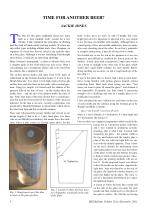
This article details the design and creation of a transparent chalice dial on a 1-pint beer glass, to be read from the outside like a shepherd's dial. The challenge was to make it simple to use, casting a beam of sunlight through a dark circle to indicate time on equal-width month columns. Calculations for sun's altitude were performed for different months and hours, leading to a functional beer-glass sundial.
Dials: Unusual, Sundial Design & Layout, Construction Projects
December 2011
Page 10
Page 10
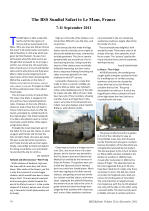
This report covers the British Sundial Society's 2011 safari to the Sarthe and Perche regions of France, based in Le Mans. The group visited various sundials, historical sites, and chateaux, including a specific mean-time dial in Le Mans and other vertical and mass dials in surrounding villages. The trip offered cultural experiences and opportunities to meet fellow enthusiasts.
Dials: Vertical, Dials: Multi Faced, Dials: Equatorial, Historical Dials, The BSS and Members
December 2011
Page 14
Page 14
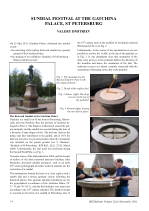
This article reports on a sundial festival at Gatchina Palace, St Petersburg, which included the unveiling of a replica historical sundial and an exhibition. The replica dial indicates true solar time according to 18th-century standards, based on historical photos and other archival material for restoration. The event celebrated the return of the sundial to its historical place after almost 80 years.
Sundial Design & Layout, Restoration projects, Historical Dials, The BSS and Members
December 2011
Page 16
Page 16
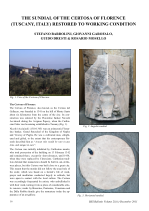
This article details the restoration of a pinhole sundial at the Certosa of Florence. The meridian line served as a calendar and true local noon marker. Investigations revealed inconsistencies, leading to the conclusion that the dial correctly determined the spring equinox, vital for calculating Easter, reflecting its religious institution setting. Historical interventions, possibly by astronomer G.B. Donati, are also discussed.
Dials: Noon Lines, Equation of Time, Historical Dials, Restoration projects
December 2011
Page 22
Page 22
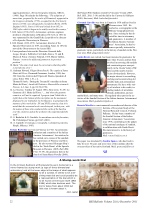
This short piece describes a stump-work mirror frame from about 1650 in Montacute House, Somerset, which features an image appearing to be a declining west sundial. It possibly represents a dial found on the house itself. Little else is known about this embroidered dial, highlighting an unusual artistic representation of a sundial.
Dials: Unusual, Dials: Vertical, Historical Dials
December 2011
Page 23
Page 23
This article describes a newly erected 180 cm high granite sundial in the Irish National Heritage Park, Ferrycarrig, weighing over 2 tonnes. Modelled on ancient monastic sundials, its temporal lines were designed to mark canonical prayer times rather than passing hours. Only twelve such ancient monastic sundials survive, making this reconstruction an important addition.
Construction Projects, Dials: Mass Dials, Dials: Unusual, Historical Dials
December 2011
Page 24
Page 24
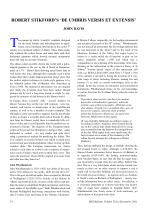
This article discusses Robert Stikford, a 14th-century monk from St Albans, credited in Whethamstede’s Granarium (c.1430) with inventing the equal-hour sundial. His rediscovered extensive Latin treatise, 'De Umbris Versis et Extensis', describes geometric constructions for projecting shadow positions and includes tables for Oxford’s latitude. It showcases detailed designs for various vertical dials, revealing sophisticated early European scientific dialling.
Dials: Vertical, Historical Dials, Mathematics of Dialling, Sundial Design & Layout
December 2011
Page 29
Page 29
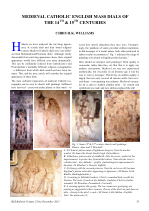
This article explores the original appearance and symbolic meaning of medieval Catholic mass dials, arguing they were vibrantly coloured and rich in symbolism, unlike their current monochrome remnants. It suggests symbolism, such as the sun representing God's light or 360-degree dials signifying day and night, was often more important than time indication, reflecting the deep religious context of the era.
Sundial Design & Layout, Historical Dials, Dials: Mass Dials
December 2011
Page 32
Page 32
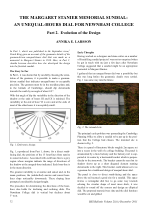
This is Part 2 of an article describing the design evolution of the Margaret Stanier Memorial Sundial, an unequal-hours dial for Newnham College, Cambridge. It details the aesthetic and gnomonic challenges, including discussions with planners, the development of hour-line alignments, and the artistic elements like sun rays and lettering. The article also covers the intricate cutting and gilding process.
Construction Projects, Dials: Vertical, Mathematics of Dialling, Sundial Design & Layout
December 2011
Page 38
Page 38
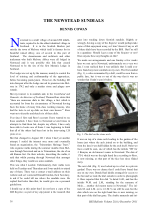
This article describes the author's quest to find and document sundials in Newstead, Scotland, following Thomas Ross's 19th-century account. It details several discoveries, including a cube dial, a semi-cylindrical dial, and other single-faced dials, some in private gardens, highlighting their historical significance and the challenges of locating them. The search continues for missing dials or fragments.
Dials: Horizontal, Dials: Multi Faced, Dials: Vertical, Historical Dials
December 2011
Page 41
Page 41
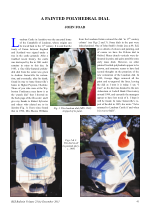
This article discusses a polyhedral dial from Loudoun Castle, Scotland, that was restored and controversially painted in the 1990s using 17th-century colours. The paint was later removed, and the lines re-engraved. The author expresses concern that the dial's current location at Jodrell Bank Observatory is unknown, raising questions about the preservation and tracking of historical sundials.
Dials: Multi Faced, Dials: Unusual, Historical Dials, Restoration projects
December 2011
Page 42
Page 42
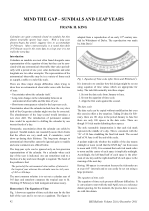
This article addresses the difficulties of accommodating leap years on sundial calendars, particularly when showing the equation of time or solar declination. It explains how to design scales for precise readings despite the difference between tropical and civil years, and discusses the historical debate around which day (24th or 29th February) is the "extra" leap day. Practical design solutions are proposed.
Equation of Time, How Sundials Work, Mathematics of Dialling, Sundial Design & Layout
December 2011
Page 47
Page 47
This section contains letters from readers discussing various sundial topics. These include formulae for horizontal shadow length, a query about the oldest scientific sundial in the British Isles, sundials in family crests, proposed organisational changes within the BSS, and the historical transmission of scratch dials and water-clock functionality. It highlights ongoing member engagement and research interests.
Mathematics of Dialling, Historical Dials, The BSS and Members, Mottoes
December 2011
Page 49
Page 49
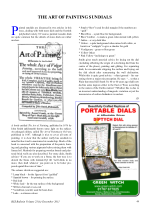
This article, drawing on John Smith's 1676 book 'The Art of Painting', discusses the techniques and colours used for painting sundials, particularly stone dials. It provides practical advice on preparing surfaces, mixing pigments, and laying out dials, including recommendations for repainting and a note on a misconception about earth's motion affecting dial orientation.
Construction Projects, Historical Dials, Restoration projects, Sundial Design & Layout
December 2011
Page 50
Page 50
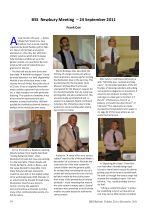
This report details the British Sundial Society's Newbury meeting, featuring talks on topics such as a metal-detected Norfolk horologium, ceiling reflection dials, leap years and calendars, repairing old books, lifting heavy sundials, war memorial dials, and heliochronometers. Exhibits included a cross dial and an equation of time analogue computer, showcasing a diverse range of gnomonic interests.
Dials: Heliochronometer, Dials: Reflected, Historical Dials, The BSS and Members