- Home
- /
- Sundial Encyclopaedia
- /
- Dials: Astrolabe
Dials: Astrolabe
March 2020
Page 21
Page 21
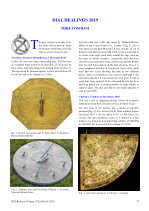
Reviews notable sundials sold at auction in 2019, including an octagonal brass double horizontal dial by Elias Allen (£3,300) and a multiple slate dial by Richard Melvin (£900). The highest price was £731,250 for a medieval astrolabe quadrant. Other items included a silver Butterfield dial, Augsburg dials by Vogler and Müller, and modern reproductions.
Dials: Astrolabe, Dials: Double Horizontal, Dials: Portable, Historical Dials
March 2014
Page 36
Page 36
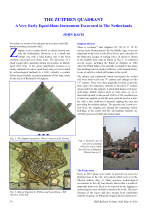
A copper-alloy quadrant excavated in Zutphen is securely dated to c.1300–1320, pushing back the date of known equal-hour quadrants in Europe by nearly a century. The instrument is engraved with an altitude scale, date/declination arcs, and hour lines for equal hours, implying a design latitude of approximately 52.0° N. This find reflects the increasing need for standardised time linked to the spread of tower clocks.
Dials: Astrolabe, Mathematics of Dialling, Dialling Tools, Historical Dials
March 2013
Page 20
Page 20
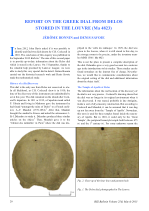
A scholarly report on a fragmentary Greek sundial held in the Louvre. The authors discuss its geometry, probable use, and its place in the evolution of ancient dial types.
Dials: Astrolabe, Dials: Equatorial, Dials: Hemispherical, Historical Dials
March 2013
Page 25
Page 25
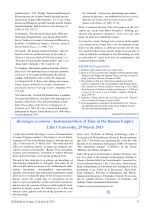
A review of a conference on Roman timekeeping instruments, summarising research on ancient dials, calendars, and astronomical devices.
Dials: Astrolabe, Historical Dials, Mathematics of Dialling
September 2013
Page 5
Page 5
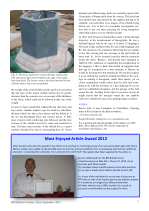
Report on Peter Kunath winning the award for his article on the Henry Moore sundial. He received a certificate and a reproduction astrolabe, which proved useful as he had been asked to explain the operation of a c. 1400 astrolabe at the Cologne City Museum.
Dials: Astrolabe, The BSS and Members
September 2013
Page 32
Page 32
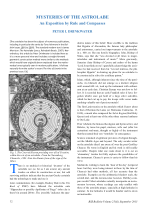
An exposition on the history and components of the astrolabe, including its two faces (sighting bar/calendar and matrix/rete/plates). The article details a geometric construction method using rule and compasses to lay out the template for the rete and the individual plates via stereographic projection.
Dialling Tools, Dials: Astrolabe, How Sundials Work, Mathematics of Dialling
June 2009
Page 18
Page 18
An overview of designing and using sundials in tropical regions. It discusses the suitability and challenges of various dial types, including horizontal, armillary, polar, and vertical, noting issues like noon-line crowding on horizontal dials and the advantages of other formats.
Dials: Horizontal, Dials: Vertical, Dials: Polar, Dials: Astrolabe, Dials: Armillary Sphere
March 2008
Page 17
Page 17
This section reviews 'Biographical Index of British Sundial Makers from the Seventh Century to 1920 (2nd Edition)' by Jill Wilson, praising its enhancements, new names, and comprehensive scope beyond simple indexing. It also reviews 'The Astrolabe' by James E. Morrison, highlighting it as a much-needed, comprehensive guide to astrolabe design, function, and construction.
Dials: Astrolabe, Book Reviews, Historical Dials
March 2008
Page 31
Page 31
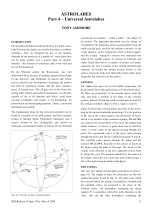
This fourth part of a series describes universal astrolabes, focusing on the Saphea, Rojas, and De la Hire projections. These instruments, developed from the 11th to 17th centuries, could be used at all latitudes, offering flexibility for astronomical and timekeeping purposes, despite the increasing complexity of their design.
Dials: Astrolabe, Historical Dials, How Sundials Work, Mathematics of Dialling
March 2008
Page 41
Page 41
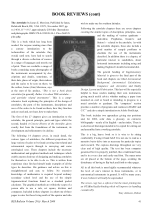
This continuation of book reviews includes an extensive review of 'The Astrolabe' by James E. Morrison, praising its comprehensive coverage of astrolabe types, principles, uses, and construction methods.
Dials: Astrolabe, Book Reviews
September 2008
Page 130
Page 130
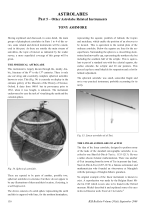
This part of the Astrolabes series covers instruments related to, but distinct from, planispheric astrolabes. It discusses the rare spherical and linear astrolabes, monumental and domestic astrolabe clocks, mariner's astrolabes (not true astrolabes), and various types of quadrants, including horary and astrolabe quadrants, detailing their history and use.
Dials: Astrolabe, Dialling Tools, Historical Dials, How Sundials Work
June 2007
Page 86
Page 86
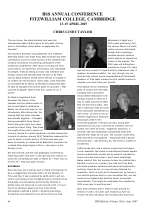
This report summarises the 2007 British Sundial Society Annual Conference in Cambridge. It highlights talks on calendar history, the Equation of Time, analemmatic sundials, astrolabes, and beehive sundialling. It also covers walking tours of Cambridge dials, including Pembroke and Queens' Colleges, and the Andrew Somerville Memorial Lecture on calendar accuracy.
Dials: Astrolabe, Historical Dials, How Sundials Work, The BSS and Members
June 2007
Page 91
Page 91
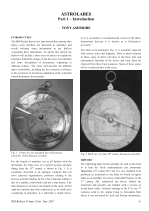
This is the first part of a series introducing astrolabes, describing them as two-dimensional analogue computers for solving spherical trigonometric problems and finding time. It covers their history from Greek origins through Arab development to European decline, and explains the principles of their design including the rete and engraved plates for different latitudes.
Dials: Astrolabe, Historical Dials, How Sundials Work, Mathematics of Dialling
September 2007
Page 107
Page 107
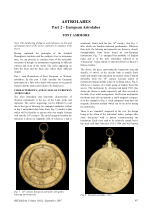
This second part details the characteristics and scales of European astrolabes. It covers the use of Latin script and numerals, simple throne designs (with some Flemish exceptions), and variable rete strapwork. The article also explains the zodiac/calendar scales, shadow squares for surveying, and three methods for determining unequal (planetary) hours found on these instruments.
Dials: Astrolabe, Historical Dials, How Sundials Work
December 2007
Page 156
Page 156
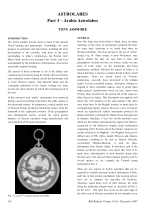
This article, part three of a series, delves into Arabic astrolabes, noting their historical significance in Islamic cultures from before the tenth to the nineteenth century. It describes their general characteristics, such as the use of Arabic scripts, the absence of equal hour scales, and the prominence of astrological scales. It also details specific features like thrones, retes, plates, and scales on the back, including shadow squares and sine/cosine grids.
Dials: Astrolabe, Mathematics of Dialling, Historical Dials
March 2004
Page 27
Page 27
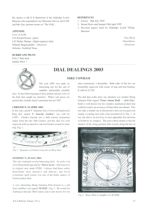
This article reviews notable sundial sales from 2003, highlighting various portable dials sold at auctions like Sotheby's and Christie's. It features different types of dials, including Butterfield dials, Universal Equinoctial Ring dials, String Gnomon dials, Miner's Dials, and a rare Elizabethan compass dial, discussing their features, makers, and sale prices.
Dials: Astrolabe, Dials: Portable, Historical Dials
June 2004
Page 65
Page 65
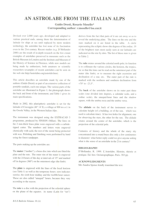
Description of a modern handcrafted brass planispheric astrolabe set for Craveggia’s latitude, with detailed specifications, functions, and star chart data.
Dials: Astrolabe
June 2002
Page 76
Page 76
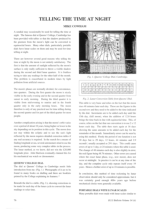
Explores historical and modern approaches to determining time after sunset using nocturnals and other devices.
Dials: Vertical, Dials: Portable, Dials: Astrolabe, Historical Dials, Dials: Nocturnals
June 2001
Page 73
Page 73
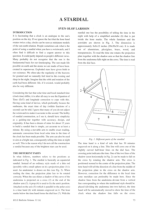
The article presents the Stardial, an innovative device functioning as an equatorial sundial by day and a simplified astrolabe by night. Designed for simplicity, accuracy, and originality, it enables automatic conversion from local solar time to clock time and provides methods for precise time-telling using bright stars and even the moon.
Dials: Equatorial, Dials: Unusual, Dials: Astrolabe, DIY Sundial Projects, Dials: Nocturnals
September 2001
Page 111
Page 111
A review of "The Universe Unveiled. Instruments and Images through History", based on the Adler Planetarium"s collection. The book showcases historical astronomical instruments and illustrations, explaining how they contributed to understanding celestial movements. The reviewer praises the book's stunning visuals and engaging narrative, recommending it as an introduction to the history of post-Copernican astronomy.
Dials: Astrolabe, Book Reviews, Historical Dials
February 1996
Page 36
Page 36
A historical overview of the astrolabe, its design, use in navigation and astronomy, and its gnomonic significance.
Dials: Astrolabe
June 1994
Page 22
Page 22
A scholarly exploration of the design and function of a unique astrolabe developed by the 16th-century English mathematician John Blagrave. The article explains its astronomical foundations, innovative features, and historical context, linking it to broader developments in Renaissance scientific instrumentation.
Dials: Astrolabe, Historical Dials, How Sundials Work
February 1993
Page 2
Page 2
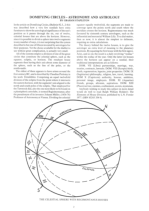
This article discusses the astrological significance of the sun's position in celestial houses as shown on sundials. It details various systems for dividing the celestial sphere into twelve segments, including Regiomontanus. The theory gives additional meaning to planetary positions, mentioning historical texts and further reading on house division.
Dials: Astrolabe, Historical Dials
February 1992
Page 5
Page 5
This article explores Islamic astronomy's role in determining prayer times, particularly the challenge of twilight in higher latitudes like Brussels where true night is absent around summer solstice. It discusses the use of astrolabes and the historical importance of observatories like Maragha and Samarkand, highlighting their monumental instruments and the Koran's influence on precise astronomical observations. It also mentions Maharaja Jai Sing II's five observatories in India, especially the Jaipur Great Samrat Yantra.
Dials: Astrolabe, Mathematics of Dialling