- Home
- /
- Sundial Encyclopaedia
- /
- June 2010
June 2010
The articles link to the specific page in a PDF optimised for speed. If you want the whole issue, you can download it here, but the files from earlier years can be quite large.
June 2010
Page 1
Page 1
When considering the contents of any Bulletin, readers are reminded of the motto of the Royal Society, ‘Nullius in verba’ or, loosely translated, ‘take no-one’s word for it’! This is not to say that we do not try to be authoritative, just that other opinions are always welcome. This issue contains two sets of ‘multiple articles’ where two or more authors have contributed to different aspects of a dialling problem.
June 2010
Page 2
Page 2
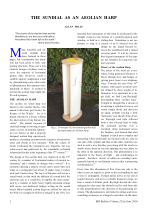
This article explores the concept of integrating an aeolian harp into a sundial's support structure to complement the visual time-telling with ethereal wind-generated music. It details the history and theory of aeolian harps, including the physics of 'aeolian tones' and string resonance. The author describes the construction of a prototype venturi-type aeolian sundial using inexpensive materials, highlighting design considerations for soundboxes, strings, and the integration of a horizontal dial.
Construction Projects, DIY Sundial Projects, Dials: Unusual, Sundial Design & Layout
June 2010
Page 7
Page 7
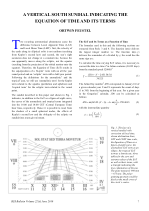
This paper describes a vertical sundial designed to indicate the Equation of Time (EoT) as a figure-of-eight curve, along with its anomalistic and tropical terms. It provides the mathematical formulae for calculating these values and their graphical representations as functions of time and the sun's declination.
Dials: Vertical, Mathematics of Dialling, Construction Projects, Equation of Time
June 2010
Page 10
Page 10
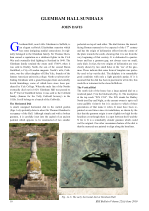
This article explores several sundials associated with Glemham Hall. It details a small, unsigned 17th-century horizontal dial, a large painted vertical dial from 1769, and discusses the 'Elihu Yale's sundial' mounted on a John Nost lead figure, whose current whereabouts are unknown but was possibly seen at Yale University. A modern 'Three Graces' horizontal dial is also mentioned.
Dials: Horizontal, Dials: Vertical, Historical Dials
June 2010
Page 13
Page 13
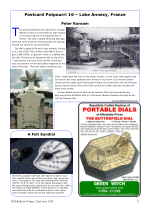
This article features a postcard from 1908 depicting the impressive multiple-dialled structure, L'Unique, on the banks of Lake Annecy, France. Dated 1874 and named in 1876, the dial is credited to Frère Arsène. It features an equatorial dial, multiple gnomons on a 7-pointed star, and various dial plates indicating noon for several European cities and zodiac signs.
Dials: Equatorial, Dials: Multi Faced, Historical Dials
June 2010
Page 14
Page 14
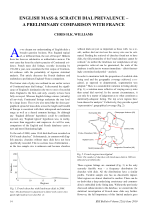
This article presents a preliminary comparison of mass and scratch dial prevalence between England and France, drawing on newly available French mass dial listings. It discusses the 'England different' versus 'England typical' hypotheses and concludes that English findings are of wider European significance at a fundamental and structural level, consistent with the universality and multiplicity of mass dials.
Historical Dials, Dials: Mass Dials
June 2010
Page 16
Page 16
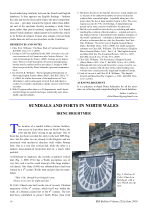
This article explores three instances of sundials located within former fortifications in North Wales. It describes a recently repainted vertical dial on St Cybi’s Church in Holyhead, a modern cast dialplate at St Mary’s churchyard in Caerhun, and a vertical declining dial from 1898 at Fort Belan.
Dials: Horizontal, Dials: Vertical, Historical Dials
June 2010
Page 18
Page 18
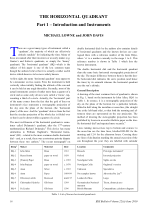
This paper introduces the horizontal quadrant, a less common but useful altitude sundial type, sharing its basic stereographic projection with the double horizontal dial. It discusses its history, including European precursors like Hartmann's compast and Apian's triens, and English developments by Delamain and Oughtred. The article describes the general form and known examples, detailing how it uses the sun's altitude to tell time.
How Sundials Work, Mathematics of Dialling, Historical Dials
June 2010
Page 24
Page 24
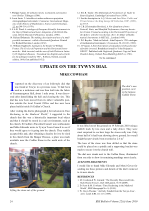
This article provides an update on the Irish-style dial discovered at Towyn. Originally used as a milestone and later built into Ynysmaengwyn Hall, the dial has now been safely moved from outside the local Tourist Office to St Cadfan’s Church. The article details the process of moving the large stone and its new illuminated position next to the Cadfan Stone.
Historical Dials, Restoration projects
June 2010
Page 25
Page 25
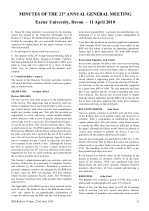
This entry provides the minutes of the British Sundial Society's 21st Annual General Meeting. It covers attendance, approval of previous minutes, and reports from council members, including the Secretary, Bulletin Editor, Registrar, Mass Dial Group, Advertising, Sundial Safaris, Treasurer, Biographical Projects, Membership, Sundial Trail Competition, Conference Organisation, Webmaster, and Sundial Design Competition. Officer elections and other business are also documented.
The BSS and Members
June 2010
Page 26
Page 26
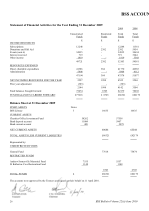
This section presents the British Sundial Society's Statement of Financial Activities and Balance Sheet for the year ending 31 December 2009. It details income resources, expensed resources, net incoming resources, and fund balances.
The BSS and Members
June 2010
Page 31
Page 31
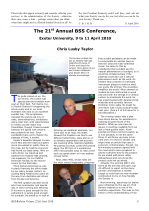
This report summarises the British Sundial Society's 21st annual conference, highlighting the positive weather and successful organisation by Patrick Powers. It details various talks and demonstrations, including stone carving and lettering by Ben Jones, sundials as aeolian harps by Allan Mills, unequal hour lines by Fred Sawyer, and mass dial prevalence by Chris Williams. The conference also featured a sundial tour and dinner.
The BSS and Members
June 2010
Page 36
Page 36
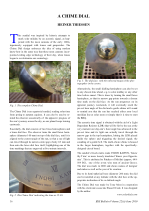
This article introduces the Chime Dial, an equatorial sundial inspired by historic noon cannons, designed to read solar time and provide an acoustic reminder of the sun's journey. It consists of two brass hemispheres and a dial face with five-minute intervals. A Light Dependent Resistor (LDR) inside the sphere triggers a chime when a sunray passes through a narrow gap, marking a pre-set time.
Construction Projects, DIY Sundial Projects, Dials: Equatorial, Sundial Design & Layout
June 2010
Page 37
Page 37
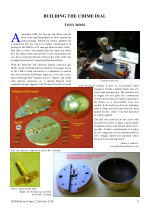
This article details the practical construction challenges and solutions for the Chime Dial. The author describes the difficulties in achieving a sharp sunray cutoff for the Light Dependent Resistor (LDR) due to internal reflections and the need for blackened brass shims.
Sundial Design & Layout, Construction Projects
June 2010
Page 38
Page 38
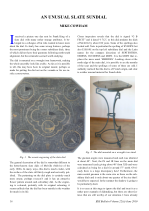
This article examines a unique slate dial from 1712, signed 'G B FECIT'. It notes several unusual features, including incorrect gnomon alignments on subsidiary dials, ornate rococo-like decoration, and French origin due to spellings and slate material. The article also highlights a large discrepancy between calculated latitude and gnomon angle, along with various other intriguing engravings like months, zodiac signs, lunar cycles, epacts, and a crest.
Dials: Multi Faced, Dials: Unusual, Historical Dials
June 2010
Page 40
Page 40
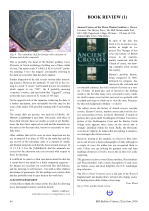
This is a review of Marion Freeman's book, 'Ancient Crosses of the Three Choirs Counties.' The reviewer notes that despite the title, the book covers the history of British crosses broadly, including many converted to carry sundials. It's highlighted as a potential source for finding dials in the West of England, despite some minor picture identification errors.
Book Reviews
June 2010
Page 41
Page 41
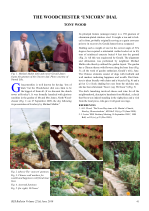
This article describes the formal launch of the 'Unicorn dial' at North Woodchester, Gloucestershire. It features a massive 17ft helical gnomon made of chromium-plated stainless steel, weighing a ton, and held at a 51¾-degree angle. The gnomon was aligned by Michael Maltin, outlining the garden layout which incorporates Chinese themes and floral hour lines.
Construction Projects, Dials: Horizontal, Dials: Unusual, Sundial Design & Layout
June 2010
Page 42
Page 42
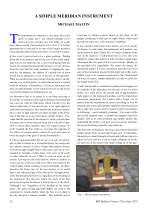
This article describes a DIY instrument for establishing a meridian line, developed for aligning large sundials. It uses two mirrors set at right angles to each other to project a spot of sunlight that remains directly beneath the sun horizontally, regardless of the instrument's heading. The device, a variant of a corner reflector, allows for precise tracking of the sun's path along the horizon.
DIY Sundial Projects, Dialling Tools, Sundial Design & Layout
June 2010
Page 43
Page 43
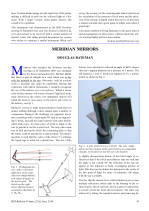
This article presents an alternative construction for Michael Maltin's meridian instrument, which uses two orthogonal mirrors to establish a meridian line. The author describes using an engineering V-block as a ready-made 90-degree angle, adding small mirrors and a spirit level for accurate setup. It discusses refinements like front-silvered mirrors and a hinge for precise spot overlap, highlighting its simplicity and accuracy for determining the sun's azimuth.
DIY Sundial Projects, Dialling Tools, Sundial Design & Layout
June 2010
Page 45
Page 45
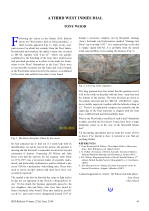
This article introduces a newly discovered West Indies sundial, signed 'DICAS LIVERPOOL' with 'Latt 22°'. The gnomon is missing and the dial is worn, but it is identified as likely from the Turks and Caicos Islands. Research by Jill Wilson and John Davis attributes it to John Dicas (w.1774-1797), a Liverpool scientific instrument maker, or his daughters who ran the business after his death.
Historical Dials, Restoration projects
June 2010
Page 46
Page 46
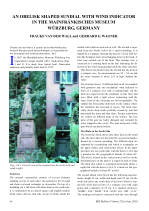
This article describes a unique obelisk-shaped sundial from 1742 in the Mainfränkisches Museum Würzburg. Made of Franconian sandstone, it features 10 sundials and a mechanical wind indicator with a rotating hand connected to a vane by internal gearing. The construction, with dials on inclined surfaces and a Turk's head sculpture, is highly unusual and suggests a learned, wealthy commissioner for an impressive park.
Dials: Multi Faced, Dials: Unusual, Historical Dials, Sundial Design & Layout
June 2010
Page 51
Page 51
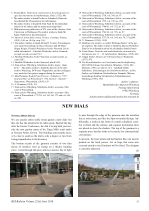
This short note describes a new sundial under construction at Trago Mills retail outlet in Newton Abbot, Devon. The dial, facing close to south, features a gnomon with a slot for a narrow line of light at solar noon and a cylindrical cross-bar nodus to show solstice and equinox declination lines. The hour points and lines are currently painted, with hopes for more durable stainless steel fittings.
Construction Projects, Dials: Vertical, Sundial Design & Layout
June 2010
Page 52
Page 52
This is a review of Catherine Eagleton's book, 'Monks, Manuscripts and Sundials: The Navicula in Medieval England,' which emerged from her doctoral research. The book focuses on the rare medieval navicula, or 'Little ship of Venice,' detailing known examples and newly uncovered 15th-century manuscripts that describe its making and use. It reveals that the navicula was likely more common than previously thought and predates other universal altitude dials.
Book Reviews, Dials: Portable, Historical Dials