- Home
- /
- Sundial Encyclopaedia
- /
- Christine Northeast
Christine Northeast
June 2023
Page 7
Page 7
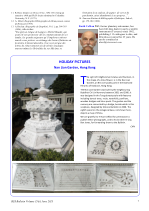
Presents photographs of 'The Light of Enlightenment' statue and fountain located in the Tang dynasty-style Nan Lian Garden in Kowloon, Hong Kong. This sculpture, designed by Simone Bartolini in 2006, is built on an octagonal base, one panel of which depicts a map of China.
Dials: Unusual, The BSS and Members
September 2023
Page 11
Page 11
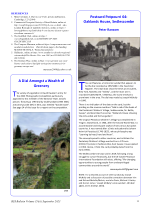
A brief note highlighting an entry in the 2023 Photographic Competition titled “Garden Gate,” which featured a 1790 sundial by Dudley Adams (SRN 3301) at Scotney Castle (NT) in Kent. The variety of vegetation in the image was noted as particularly appealing.
The BSS and Members
December 2023
Page 17
Page 17
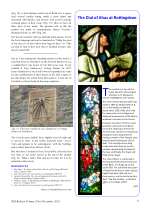
This note examines a stained-glass window in St Margaret’s Church, Rottingdean, designed by Edward Burne-Jones (1897), which depicts King Hezekiah holding the ‘Dial of Ahaz’, referenced in II Kings 20:11 and Isaiah 38:8.
Dials: Unusual, Historical Dials
June 2022
Page 18
Page 18
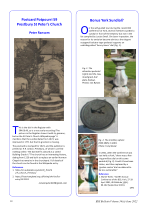
This note records the finding of a previously unlisted sundial on the York Deanery grounds during the BSS conference tour. The current 'Sunny Hours' dial sits on a fine pedestal and appears to be a replacement for a five-ring armillary dial recorded there in 2001.
Dials: Horizontal, Historical Dials, The BSS and Members, Dials: Armillary Sphere
September 2022
Page 20
Page 20
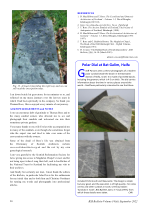
Describes a modern, high-quality polar sundial located beside the beach in Haifa, Israel. The dial is made of polished basalt and carries time information for various global locations, including Portsmouth and Newcastle.
Dials: Polar, Dials: Unusual
September 2022
Page 38
Page 38
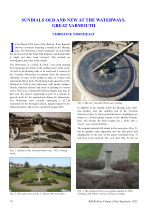
Investigates the sundials at The Waterways in Great Yarmouth after its £2.7 M restoration. Describes the replacement of two historical dials with new horizontal dials, likely made by Brad Dillon, featuring inscriptions related to writers Anna Sewell and Charles Dickens.
Dials: Horizontal, Historical Dials, Restoration projects
March 2021
Page 23
Page 23
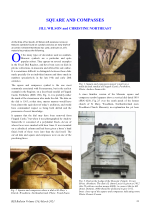
An analysis of various Masonic symbols found decorating sundials, building upon material left by the late Jill Wilson. It describes the use of the square and compasses, the Eye of Providence, pillars, and other emblems on dials, ranging from ancient mason's marks to later 'antique' and custom-made pieces.
Dials: Unusual, Historical Dials, Mottoes, The BSS and Members
December 2021
Page 12
Page 12
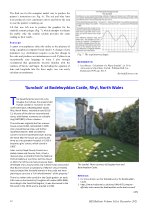
Presents the analemmatic human sundial installed around 2012–13 on the north-west lawn of Bodelwyddan Castle, North Wales, made of reconstituted stone with GMT/BST rings. The castle site also hosts an older, 19th-century horizontal dial by Troughton, found and re-erected decades later.
Dials: Analemmatic, Historical Dials
March 2020
Page 33
Page 33
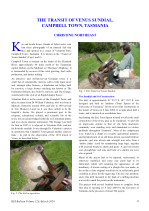
Describes an unusual agricultural-themed sundial designed and built by Anthony Sprent in 2004 to commemorate Campbell Town's role in observing the 1874 transit of Venus. The device, made mostly from old farm machinery parts, is a heliochronometer that uses a nodus (aperture) to project light onto an engraved analemma on a bronze plough disc.
Construction Projects, Dials: Heliochronometer, Dials: Unusual, Equation of Time
March 2020
Page 40
Page 40
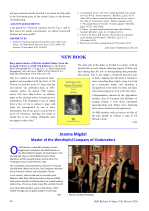
A review of Jill Wilson’s expanded third edition of the Biographical Index of British Sundial Makers, featuring nearly 1900 entries (330 more than the previous edition). The book is divided by century, includes illustrations, useful lists of references, and complementary material on London Guilds and apprenticeships.
Book Reviews, Historical Dials, The BSS and Members
September 2020
Page 6
Page 6
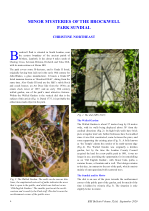
Examines a canted vertical limestone dial in Brockwell Park, dated 1775. The article focuses on translating the cryptic motto, “So Doct Ho In D,” suggesting the elegant interpretation “Sol Ducit Horas in Die” (the sun draws the hours in the day). The dial’s original location is questioned as it was designed for a wall declining approximately 38° west of south.
Dials: Vertical, How Sundials Work, Historical Dials, Mottoes
September 2020
Page 40
Page 40
Explains the Italian terminology for 'Italian hours' (e.g., "ore italiche") and the two historical systems based on sunset. These are "ora italica comune" (geometric sunset) and "ore italiche da campanile" (half an hour after sunset, marked by the Angelus bell).
How Sundials Work, Mathematics of Dialling, Historical Dials
March 2019
Page 13
Page 13
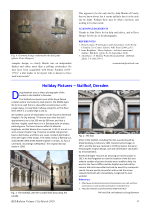
Features photographs of the sundial in the Stallhof courtyard, Dresden, a restored Baroque declining vertical dial destroyed in 1945. It was restored in 1976 and includes a ball nodus, constant-declination lines, Zodiac signs, and the motto *MORS CERTA HORA INCERTA*.
Dials: Vertical, Historical Dials, Mottoes
March 2019
Page 25
Page 25
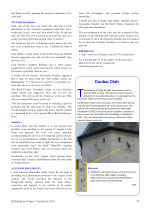
Describes the Category A listed Dunbar Town House, Scotland, which features two renovated wall dials. The dials—one direct-west-facing and one declining south—were originally painted in 1686 and restored in 2011, noting the unusual Roman numerals.
Dials: Vertical, Historical Dials
September 2019
Page 27
Page 27
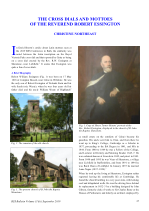
A detailed analysis of the Reverend R.W. Essington (1818–1907) and his enthusiasm for cross dials. It documents the three cross dials he erected at Shenstone and Newquay, discussing their mottoes and inscriptions, and provides strong evidence linking him to the design or erection of the cross dial in the Royal Victoria Park Botanical Gardens in Bath.
Dials: Unusual, Historical Dials, Mottoes
September 2018
Page 32
Page 32
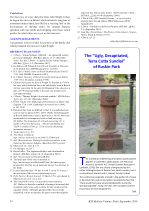
A short piece noting the unflattering description of the Grade II Listed terra cotta sundial in Ruskin Park, South London, quoted from a 1979 historical account. The dial, which is now missing, was originally erected in a Denmark Hill garden to commemorate the house where Mendelssohn wrote the Spring Song in 1842.
Dials: Unusual, Dials: Vertical, Historical Dials
September 2017
Page 47
Page 47
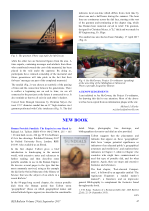
A review of Richard J.A. Talbert’s 2017 book, *Roman Portable Sundials: The Empire in your Hand*. The book describes the 16 known ‘geographical’ portable dials from the Roman period, which feature place names and latitude figures. It discusses their potential significance in understanding the educated public's geographical awareness and worldviews.
Book Reviews, Dials: Portable
September 2016
Page 29
Page 29
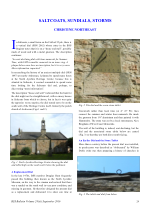
Investigation into a vertical dial (SRN 2062) found on the Heritage Centre wall in Saltcoats. The current dial is a canted, south-facing replacement (by Douglas Hunt) of an older, storm-damaged dial, commemorating the church's turbulent history of being rebuilt multiple times after violent storms.
Dials: Vertical, Historical Dials, Restoration projects
December 2016
Page 21
Page 21
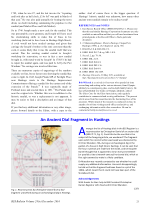
Investigation of a reconstructed sixteenth or seventeenth-century horizontal dial fragment (SRN 7171) found in Hastings. The fragment was recovered from a pit dating to the 1660s, confirming it could not be part of the historic Stonebeach dial discussed elsewhere.
Dials: Horizontal, Historical Dials
March 2015
Page 18
Page 18
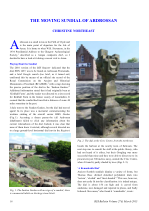
A detailed history and examination of a unique Scottish polyhedral sundial, made by Robert Weir for the Kirkhall estate in 1795. The massive sandstone dial, which originally featured complex adjustable metal apparatus, was moved multiple times by the local council, first to the Sunken Garden and subsequently to the Civic Centre.
Dials: Multi Faced, Dials: Unusual, Historical Dials