- Home
- /
- Sundial Encyclopaedia
- /
- September 2012
September 2012
The articles link to the specific page in a PDF optimised for speed. If you want the whole issue, you can download it here, but the files from earlier years can be quite large.
September 2012
Page 1
Page 1
The editor explains the shortage of material for this issue, so that several articles have been written by the editor. He encourages members to contribute various content, from short pieces to full-blown research studies. This issue features further articles about polyhedral dials.
The BSS and Members
September 2012
Page 2
Page 2
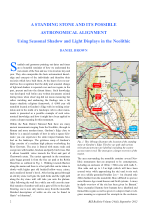
This article examines a 2-metre tall triangular monolith at Gardom’s Edge, Peak District, suggesting it was intentionally erected and astronomically aligned in the late Neolithic/early Bronze Age. It highlights how the stone's north-facing side would be illuminated during the summer, serving as a seasonal marker for ancient communities.
Dials: Unusual, Historical Dials, How Sundials Work, Sundial Design & Layout
September 2012
Page 6
Page 6
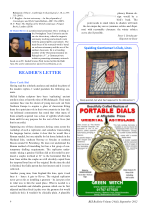
A letter speculating on the origins of the Hever Castle Dial, proposing it was a Sicilian-modelled Roman sundial made for a Northern European patron.
Sundial Design & Layout, Historical Dials
September 2012
Page 7
Page 7
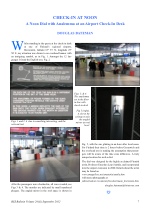
This article describes a unique noon dial with an analemma at Rovaniemi Airport, Finland, designed by Professor Emeritus Lauri Anttila in 2000. An angled mirror in the roof casts sunlight onto the floor to indicate months, with the design assuming passengers are aware of time zone differences.
Construction Projects, Dials: Analemmatic, Dials: Noon Lines, Sundial Design & Layout
September 2012
Page 8
Page 8
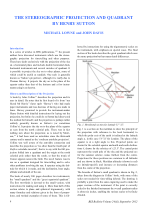
This article explores Henry Sutton's quadrant, which utilises a stereographic projection of the sky onto the equatorial plane, initially conceived by Thomas Harvey. It details the instrument's design, including scales for time-telling and other astronomical problems, and provides instructions for its use, such as finding the time at night using stars.
How Sundials Work, Mathematics of Dialling, Historical Dials
September 2012
Page 15
Page 15
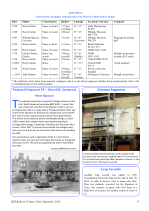
This entry describes a multi-dial sundial located at the Sidney Hill Cottage Homes in Churchill, Somerset, dating from 1907. It notes that the dial is situated within private grounds, making it inaccessible to the public, and speculates on the presence of east, north, and west dials based on an old postcard from 1929.
Dials: Multi Faced, Historical Dials
September 2012
Page 15
Page 15
This brief piece draws attention to an unusual application of a sundial's gnomon in Airanne, Somme, France, where it appears to be providing minimal support to a scaffold tower. The author expresses hope for the sundial's survival following this unconventional use.
Dials: Unusual
September 2012
Page 16
Page 16
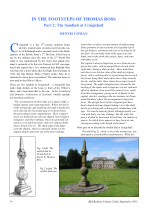
This article details two sundials at Craigiehall: a 4-metre high obelisk dial, restored in 1965 after being found in fragments, and a horizontal brass dial by John England, dating from 1702-1714. The obelisk is unique due to an 18th-century globe base, while the horizontal dial features an Equation of Time table and armorial devices.
Dials: Multi Faced, Equation of Time, Historical Dials, Restoration projects
September 2012
Page 18
Page 18
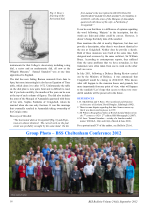
This entry refers to a group photograph taken during the British Sundial Society conference held in Cheltenham in 2012.
The BSS and Members
September 2012
Page 19
Page 19
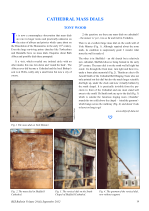
The article discusses the scarcity of mass dials in larger towns and on ruins of abbeys and priories, noting only two found on cathedrals so far, both in Yorkshire: one on York Minster and another inside Sheffield Cathedral. It describes the Sheffield Cathedral's mass dial and a larger, now largely hidden, scientific dial beneath the clock.
Dials: Vertical, Historical Dials, Dials: Mass Dials
September 2012
Page 20
Page 20
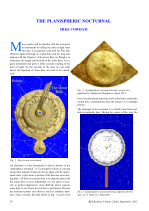
This article describes the planispheric nocturnal, an instrument for telling time at night by aligning a rotating star chart with actual stars. It functions as an alternative to a traditional nocturnal and can be found on the reverse of some quadrants, offering timekeeping to within 15 minutes without requiring Equation of Time correction.
Dialling Tools, How Sundials Work, Dials: Nocturnals
September 2012
Page 21
Page 21
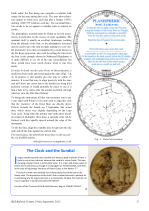
This brief piece features an early Netherlandish image, dating from the late 16th century, which combines a lantern clock and a sundial. It serves as a visual reminder that clocks merely indicate time, whereas sundials actively find time, subtly suggesting the clock's potential inaccuracy compared to the sundial.
Historical Dials, How Sundials Work
September 2012
Page 22
Page 22
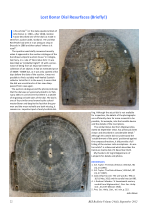
This article reports the brief reappearance of a 1634 slate equatorial dial by John Bonar, originally from Loudon Castle, Scotland, at a German auction. Unsold, it subsequently disappeared from public view. Despite missing its gnomon and moon volvelle, the dial is considered an important artefact of early Scottish dialling, featuring detailed engravings.
Dials: Equatorial, Historical Dials, Restoration projects
September 2012
Page 23
Page 23
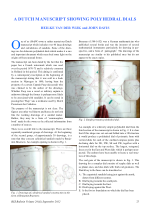
This article describes a mysterious Dutch manuscript from 1670-75 containing over 40 drawings and calculations for sundials, including elaborate polyhedral designs. It features designs attributed to Benjamin Braemers and a complex lectern polyhedral dial similar to Scottish examples, challenging readers to construct a 3D model.
Dials: Multi Faced, Historical Dials, Mathematics of Dialling, Sundial Design & Layout
September 2012
Page 26
Page 26
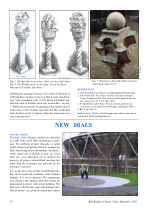
This section introduces several recent sundial projects, including an Olympic sundial by David Brown (an analemmatic dial), a vertical school science centre dial featuring periodic table elements, and the Angel with Sundial at Talaton church by Harriet James, inspired by Chartres Cathedral.
Dials: Vertical, Dials: Analemmatic, Sundial Design & Layout, Construction Projects
September 2012
Page 28
Page 28
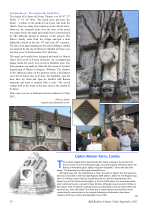
This entry describes a multiple scaphe dial at Upton Manor Farm, tentatively attributed to Edmund Gunter, featuring 29 or 30 individual dials crafted from Ketton stone. Located in an orchard, the property was once owned by Bishop Thomas Dove and is noted for its complex, original delineation.
Dials: Multi Faced, Dials: Scaphe, Historical Dials
September 2012
Page 29
Page 29
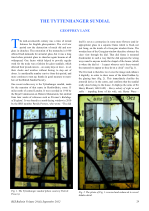
This article details the rediscovery of a mid-17th century glass sundial at Tyttenhanger mansion, Hertfordshire, designed for Sir Henry Blount's arms and a 13-14 degree declination. It bears the motto "Lumen Umbra Dei" and is compared to similar dials by John Oliver, suggesting Oliver as its likely maker despite earlier attributions to Henry Gyles.
Dials: Vertical, Historical Dials, Mottoes
September 2012
Page 32
Page 32
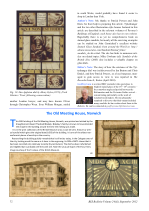
This entry features an 1842 etching of the Old Meeting House, Norwich, depicting a vertical sundial that dates the building to 1693. The sundial, which has undergone refurbishment and regilding, is noted for its unusual hour-line shape and the building's historical significance as one of the country's oldest non-conformist places of worship.
Dials: Vertical, Historical Dials
September 2012
Page 33
Page 33
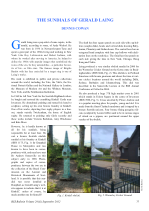
This article highlights the sundial works of pop artist Gerald Laing, known for at least four large sculptural pieces. These include two Scottish obelisk sundials, a 37ft market cross in Inverness, and "Axis Mundi" in Edinburgh, often featuring complex gnomonics and graphical representations of the Equation of Time.
Dials: Multi Faced, Sundial Design & Layout, Equation of Time, Dials: Scaphe
September 2012
Page 34
Page 34
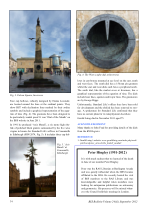
An obituary for Peter Hingley (1951-2012), the RAS Librarian, who played a quiet but influential role in the British Sundial Society's affiliation with the Royal Astronomical Society. He was recognised for his knowledge of antiquarian astronomy and gnomonics, and his absence will be felt at Council meetings.
The BSS and Members
September 2012
Page 35
Page 35
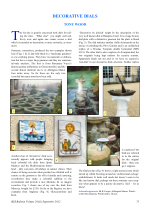
This article discusses sundials designed purely for decorative or ornamental purposes, rather than for time-telling. Examples include two identical large gnomon dials at Barnsley and Ablington Manor, colourful tile dials from the Mediterranean, and an expensive, unfinished replica of a Thomas Tompion double horizontal dial at Hampton Court.
Dials: Vertical, Dials: Unusual, Dials: Double Horizontal
September 2012
Page 36
Page 36
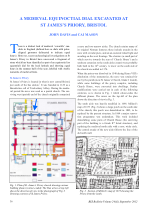
This article describes the excavation of a fragment of a medieval equinoctial (equatorial) dial at St James’s Priory, Bristol. Dated pre-1540 and likely late 14th/15th century due to the use of Arabic numerals, it is a significant find that reinforces awareness of early scientific dials in Europe, and is believed to be one of the oldest in Britain.
Dials: Equatorial, Historical Dials
September 2012
Page 40
Page 40
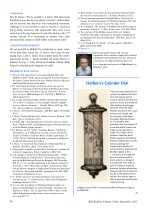
This entry describes a drawing of a cylinder (or shepherd's) dial by Hans Holbein the Younger, dating from 1532-1543. It is speculated that the image depicts a real dial either made by or planned by Nicholas Kratzer, Holbein's contemporary and Henry VIII's horologist. The drawing's cut-out nature and right-to-left month inscription are notable features.
Dials: Portable, Historical Dials, Sundial Design & Layout
September 2012
Page 41
Page 41
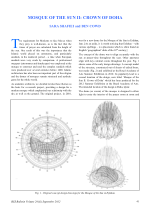
This article presents an architectural study for a solar dome, "Mosque of the Sun II: Crown of Doha" designed to align with the sun for prayer times and celestial events. It uses digital modeling and 3D printing, with the dome's solar orientation differing from the Mecca-aligned prayer room, allowing light to create a clock/calendar on the floor.
Dials: Unusual, How Sundials Work, Sundial Design & Layout, Construction Projects
September 2012
Page 43
Page 43
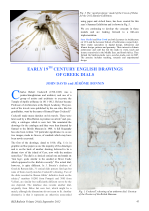
This article details two 19th-century drawings by Charles Robert Cockerell of Greek sundials, possibly newly excavated. One depicts an unknown classical conical dial with "lion legs" and the other illustrates a rare planar, vertical east-facing dial from Delos, which later came to reside in the Louvre, recording significant ancient finds.
Dials: Unusual, Historical Dials
September 2012
Page 45
Page 45
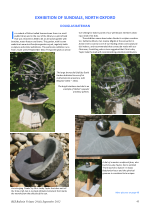
This entry describes a sundial exhibition held from June to September 2012 in the Turrill Sculpture Garden, Summertown, Oxford. It features 11 dials by BSS members, including David Harber's bronze dial and armillary sphere, Chris Lusby Taylor's sculptural "Undial" and "From Sunrise to Sunset" dials, and a cube dial by Harriet James.
Dials: Unusual, The BSS and Members, Dials: Cube, Dials: Armillary Sphere
September 2012
Page 46
Page 46
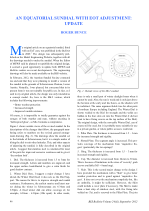
This article provides an update on an equatorial sundial design with Equation of Time adjustment, originally published in 2009. The Mk.2 version incorporates improvements for public use, focusing on weather protection, increased strength, and enhanced vandal resistance, developed in response to the Austrian Sundial Society's plans to install a version.
Dials: Equatorial, Construction Projects, Equation of Time