- Home
- /
- Sundial Encyclopaedia
- /
- John Foad
John Foad
March 2023
Page 10
Page 10
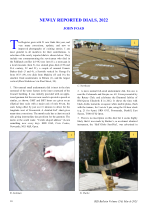
A summary of the 51 new finds added to the Fixed Dial Register in 2022, increasing the record count to 7,781. Highlights include a Falklands memorial dial, a French Noon Cannon, two Francis Barker instruments, and the largest vertical dial (Piers Nicholson’s in Fleet Street).
Dials: Analemmatic, Dials: Unusual, Historical Dials
December 2023
Page 9
Page 9
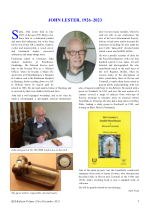
An obituary for John Lester (1926–2023), who was a dedicated sundial and mass dial enthusiast, GP, and instrument maker. He was a prolific recorder for the Fixed Dial Register and contributed frequently to the Bulletin, notably on Mass Dials and the work of Jeanie Crowley.
The BSS and Members
March 2022
Page 32
Page 32
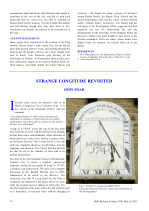
An analysis of the unusual longitude inscription found on the St Mark’s, Longwood dial. By comparison with the Hawkshead dial, it is concluded that the inscription refers to the 'Plane’s Longitude,' which defines the longitude where the dial could be used horizontally, and is numerically equal to the hour angle between the substyle and noon lines.
Dials: Vertical, Historical Dials, Mathematics of Dialling, Sundial Design & Layout
June 2022
Page 26
Page 26
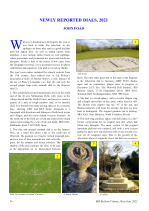
This section presents a selection of over 30 new reports added to the Register in 2021. Noteworthy entries include several 17th-century church verticals, three newly identified makers, a large azimuth dial, and examples featuring advanced concepts like 'Plane’s Longitude' or unusual shapes like sliced spheres.
Dials: Unusual, Historical Dials
March 2021
Page 10
Page 10
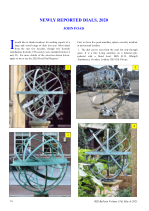
A selection of sundials reported in 2020 and entered into the Fixed Dial Register. The list includes armillary spheres, equatorial dials, various vertical dials (like the one at Staple Inn), several horizontal dials (such as the large Solum dial), and multiple or special dials.
Dials: Armillary Sphere, Dials: Equatorial, Dials: Horizontal, Dials: Vertical
June 2020
Page 18
Page 18
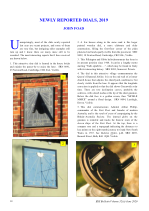
This report outlines 24 sundials newly reported to the BSS Fixed Dial Register in 2019. The entries feature a variety of types, including a Pilkington and Gibbs heliochronometer, several analemmatic dials, and various vertical and horizontal dials located across the UK.
Dials: Analemmatic, Dials: Heliochronometer, Historical Dials, The BSS and Members
September 2020
Page 26
Page 26
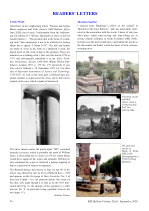
Anthony Turner clarifies that a portable dial signed J Mann 1679 should not be attributed to Joshua Mann. John Foad compares the association of the Thornton sundial with stocks to a similar instance in Ripley, North Yorkshire.
Dials: Portable, Historical Dials
June 2019
Page 30
Page 30
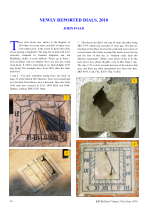
Presents 18 selected entries from the more than 100 dials added to the Fixed Dial Register in 2018. Examples include historical dials by George Adams and Heath and Wing, a Dollond cube dial, a vertical slate dial from 1698, and modern ground-level and wall dials.
Construction Projects, Dials: Equatorial, Dials: Horizontal, Dials: Vertical, Historical Dials
March 2018
Page 15
Page 15
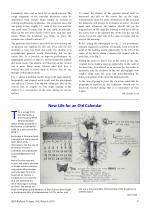
Presents a page from the book Sun-Dial Notes by Nellie Stearns Goodloe, originally published as a calendar for 1894. The calendar is also noted to be correct for 2018, and features illustrations of sundials copied from Gatty, such as the dial on Chartres Cathedral.
Book Reviews
June 2018
Page 13
Page 13
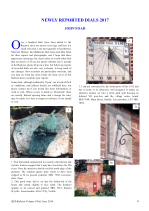
Reports on over one hundred dials added to the Fixed Dial Register in 2017, presenting 18 selected examples. These include a historical horizontal dial, a Francis Barker cross dial, a moon dial, an armillary sphere, and a stained glass millennium dial. Dials by makers Thomas Woodcock and John Bird are highlighted.
Dials: Armillary Sphere, Dials: Horizontal, Dials: Polar, Dials: Stained Glass, Dials: Vertical, Historical Dials
March 2017
Page 41
Page 41
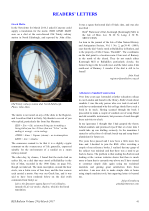
Includes translation and historical context for the Greek motto ‘Zoe Atme skie’ ('Life is smoke, shadow'), previously found on a dial in the Isle of Man and now noted in Edinburgh. Also features a letter discussing a member's return to simple sundial construction using reclaimed materials.
DIY Sundial Projects, Dials: Vertical, Mottoes, The BSS and Members
June 2017
Page 24
Page 24
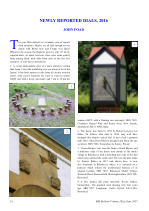
This report lists 47 newly reported dials added to the BSS Register in 2016. Descriptions include an analemmatic dial in New Lanark, a simple vertical dial designed for a Robert Lutyens house, a Dollond dial in London, and a vertical limestone monolith gnomon dial in Lancashire.
Dials: Analemmatic, Dials: Unusual, Dials: Vertical, Historical Dials
December 2017
Page 21
Page 21
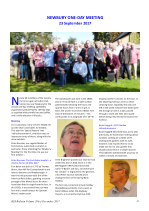
A detailed report on the BSS one-day meeting, summarising talks on topics including the Fort Belan sundial, DIY heliochronometers, multi-centre delineation, promotion via social media, the astronomical Culpeper dial, the Gnomonical Universal Nomograph (GUN), and the mechanical generation of the Equation of Time using equation clocks.
Dials: Heliochronometer, Equation of Time, Historical Dials, The BSS and Members
June 2016
Page 19
Page 19
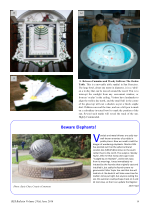
Discusses threats to sundials, including vandals, thieves, and wandering elephants. It reports that the spherical dial at London Zoo is incorrectly inclined because it was "nudged by an elephant" years ago, and the subsequent re-installation failed to correct the orientation.
Dials: Equatorial
June 2016
Page 34
Page 34
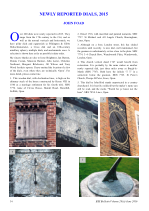
A list of over 200 sundials newly reported to the BSS Register in 2015, ranging from the 17th to 21st centuries. Examples include a 1540 wooden dial, a 1799 horizontal dial by Liverpool clockmaker Thomas Harrison, an exquisite square dial installed for Queen Victoria’s Diamond Jubilee, and a modern spiral analemmatic dial.
Dials: Heliochronometer, Dials: Horizontal, Dials: Multi Faced, Dials: Unusual, Dials: Vertical, Historical Dials, The BSS and Members
September 2016
Page 10
Page 10
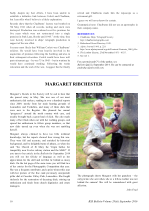
An obituary for Margaret Ribchester, a much-loved, enthusiastic dial seeker who contributed over a hundred accurate and historically rich reports to the BSS Register since 2009, mainly from Lancashire and Yorkshire. She was a frequent contributor to the Photographic Competition, winning a prize this year.
The BSS and Members
June 2015
Page 38
Page 38
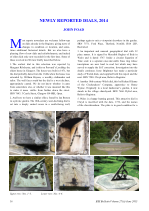
Summarizes new entries to the Register reported in 2014, including historical dials across the UK (Glasgow, Norfolk, Wales, Yorkshire, Scotland), a Campbell–Stokes sunshine recorder in Madeira, and modern commemorative dials.
Dials: Unusual, Historical Dials
December 2015
Page 40
Page 40
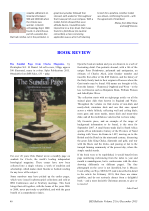
Review of "The Sundial Page from Clocks Magazine" by Christopher St J. H. Daniel. This volume collects over 20 years of monthly essays on sundials, praised for its erudition, comprehensive index, and wide range of content on dials and related history.
Book Reviews, Historical Dials
September 2013
Page 38
Page 38
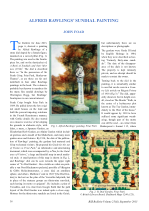
Investigation into a sundial featured in an Alfred Rawlings painting (1914), originally cited as being at Friar Park. The identical-looking dial was photographed at Reigate Priory in 1918, prompting inquiry into whether two versions existed or if the monument was transported between the two sites around the time of the First World War.
Historical Dials, Mottoes
December 2013
Page 18
Page 18
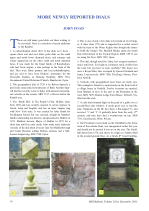
A selection of recent additions to the Sundial Register, including a cuboctahedron (1823), a geographical dial (1720) by Robert Spurrell, the restored 'Smith Dial' (1858), a river bridge dial (1770), and various vertical, cube, and pillar dials across England and Scotland.
Dials: Cube, Dials: Multi Faced, Historical Dials, The BSS and Members
June 2012
Page 17
Page 17
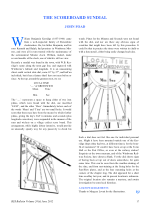
This article describes a unique direct south vertical slate sundial found in Wimborne Minster, made by clockmaker W.B. Kerridge. Its distinguishing feature is a system for displaying the Equation of Time and longitude correction using interchangeable 'FAST'/'SLOW' iron plates and possibly minute/second plates, resembling a cricket scoreboard, for public use.
Dials: Unusual, Dials: Vertical, Equation of Time, Historical Dials
December 2012
Page 26
Page 26
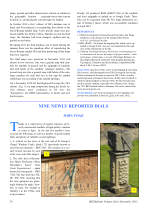
This article reports on nine previously unrecorded or undocumented sundials. Highlights include a 1723 vertical dial at Windsor Castle, a Scottish-style cube dial at Restoration House, a pre-1752 horizontal dial by John Davis of Windsor, and various vertical, geographical, and unusual fixed horizontal analemmatic dials across England.
Dials: Cube, Dials: Horizontal, Dials: Vertical, Historical Dials
June 2011
Page 43
Page 43
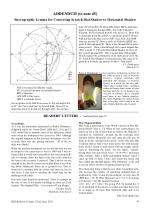
Gordon Taylor describes challenges in orienting the Seven Dials monument. John Foad, the Registrar, corrects the number of war memorial dials in the BSS Register, increasing the total and, consequently, the estimated number of unfound dials using Tony Wood's formula.
Historical Dials, The BSS and Members
December 2011
Page 41
Page 41
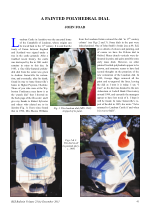
This article discusses a polyhedral dial from Loudoun Castle, Scotland, that was restored and controversially painted in the 1990s using 17th-century colours. The paint was later removed, and the lines re-engraved. The author expresses concern that the dial's current location at Jodrell Bank Observatory is unknown, raising questions about the preservation and tracking of historical sundials.
Dials: Multi Faced, Dials: Unusual, Historical Dials, Restoration projects
December 2011
Page 47
Page 47
This section contains letters from readers discussing various sundial topics. These include formulae for horizontal shadow length, a query about the oldest scientific sundial in the British Isles, sundials in family crests, proposed organisational changes within the BSS, and the historical transmission of scratch dials and water-clock functionality. It highlights ongoing member engagement and research interests.
Mathematics of Dialling, Historical Dials, The BSS and Members, Mottoes
March 2010
Page 42
Page 42
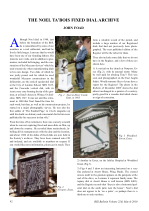
An overview of the photographic archive of Noel Ta'Bois, an early sundial enthusiast. The archive contains around 1,500 slides of fixed dials from the 1980s, which form a valuable record in the Society's collection and have helped identify unrecorded dials.
Historical Dials, The BSS and Members
March 2010
Page 47
Page 47
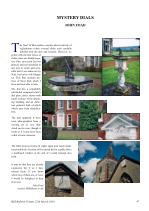
A request for help in identifying three sundials from an unidentified roll of film found in the Noel Ta'Bois archive. The images include a substantial octagonal dial, another photographed from a moving car, and a canted dial in a gable.
Dials: Horizontal, Dials: Vertical
December 2009
Page 6
Page 6
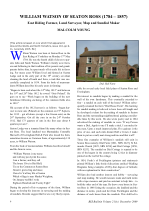
A biography of William Watson, a farmer, surveyor, and self-taught sundial maker from East Yorkshire. The article details his life, his unique 'canted-over gnomon' dial designs, his publication on dialling, and other interests. An addendum discusses the surviving examples of his work.
Dials: Vertical, Historical Dials
March 2008
Page 16
Page 16
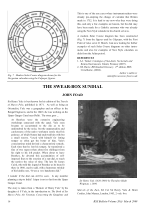
This article recounts the legend of Sir Henry Yule, a Bengal Engineer in the 1840s, who, vexed by his own temper and his native workmen's unpunctuality, fined himself two rupees each time he lost his temper. He used the accumulated money to erect a 'handsome' sundial at Roorkee to teach the locals the value of time.
Dials: Unusual, Historical Dials
March 2008
Page 30
Page 30
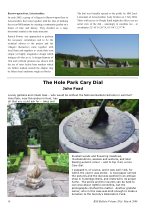
Describes a Cary dial in Hole Park, Kent, which was stolen but later recovered from an antique shop thanks to photographs. The recovery highlights the importance of documentation for proving ownership of valuable sundials.
Historical Dials
June 2008
Page 88
Page 88
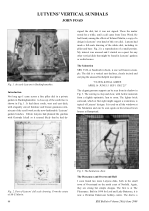
This article explores vertical sundials designed by architect Edwin Lutyens for his gardens and houses, including examples at The Salutation, The Pleasaunce, Overstrand Hall, Tigbourne Court, Hampstead Garden Suburb, Greywalls, and Mothecombe. It highlights his meticulous design, integration with architecture, and use of specific mottoes and materials.
Dials: Vertical, Historical Dials, Mottoes, Sundial Design & Layout
June 2007
Page 96
Page 96
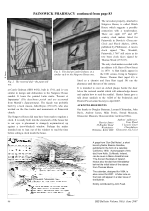
This entry presents a page from Nellie Stearns Goodloe's 1893 Sun-Dial Notes calendar, featuring a sundial from Kells, Co Meath, Ireland. It notes the calendar is correct for 2007 and mentions a fuller note on the book will appear later.
Book Reviews, Historical Dials
March 2005
Page 36
Page 36
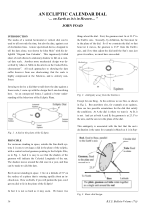
Introduces a novel ecliptic-aligned sundial for direct solar date indication on a linear scale. Describes aligning the dial plane with the ecliptic, date scale calibration, equation of date application, and improved prism-based design. Demonstrates lunar path visualization and usage for sun compass orientation.
Dials: Unusual, Mathematics of Dialling, Sundial Design & Layout
December 2004
Page 172
Page 172
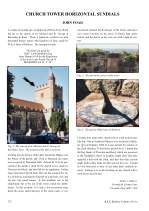
Survey and technical notes on horizontal sundials placed on church towers for regulating the church clock
Dials: Horizontal, Historical Dials
March 2003
Page 33
Page 33
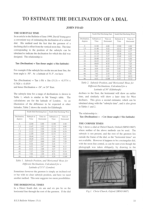
Method for determining the declination of a sundial using shadow observations and calculations, useful for dating or assessing alignment.
How Sundials Work, Mathematics of Dialling
June 2003
Page 85
Page 85
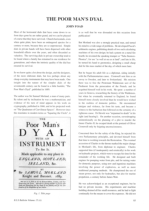
An article based on a historical text about a specific type of portable ring sundial. It provides a detailed account and instructions on how to use it, emphasizing its historical significance and practicality.
Dials: Horizontal, Historical Dials
December 2003
Page 153
Page 153
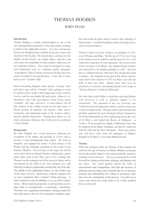
Biographical article about Thomas Hogben, an 18th-century Kent dial maker, exploring his work and its technical and historical context.
Historical Dials
March 2002
Page 17
Page 17
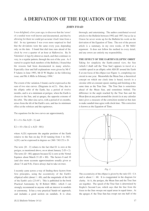
Accessible derivation of the EoT formula using orbital eccentricity and axial tilt, with historical and mathematical context.
Equation of Time, Mathematics of Dialling
June 2002
Page 71
Page 71
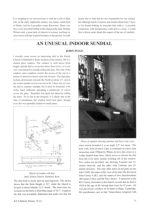
December 2002
Page 156
Page 156
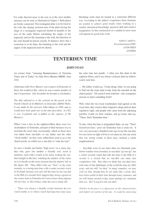
Discussion of a historic vertical dial in Tenterden and its restoration, with background on local timekeeping and recent dial condition.
Historical Dials
June 2001
Page 82
Page 82
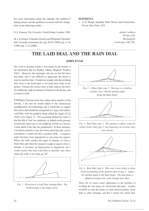
John Foad proposes new categories for sundials designed to prevent rain accumulation: the "Laid Dial," a reclining dial with an "Angle of Lie," and the "Rain Dial", featuring a conical raised centre. He discusses the practical advantages of these forms in preserving dial plates and enhancing readability, and the pleasing play on words.
Dials: Horizontal, Dials: Unusual, Sundial Design & Layout