- Home
- /
- Sundial Encyclopaedia
- /
- Restoration projects
Restoration projects
March 2023
Page 18
Page 18
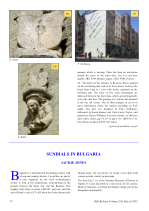
Recounts sightings of four sundials during an archaeological tour. These include an IX–XI century sun clock from Mogila, an ancient sundial of Marcianopolis, a 2nd–3rd century A.D. marble dial in Varna, and a damaged 1878 dial located on the southwest corner of the Dzhumaya Mosque in Plovdiv.
Dials: Vertical, Historical Dials, Restoration projects
March 2023
Page 24
Page 24
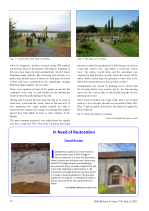
A note identifying a heavily weathered vertical sundial over a doorway at Clarks Village, Street, Somerset. The dial is made of Blue Lias, dated 1811, and the gnomon appears original. The author expresses interest in making a like-for-like replacement.
Dials: Vertical, Historical Dials, Restoration projects
March 2023
Page 26
Page 26
Summary of the Society's 2022 activities, including holding the York conference and Newbury meeting, maintaining strong finances, and detailing public benefit submissions to the Charity Commissioners. Projects included restoration advice, pro bono design work, and the continued growth of the Fixed-Dial Register.
Construction Projects, Restoration projects, The BSS and Members
June 2023
Page 28
Page 28
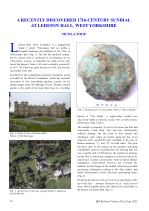
Describes the discovery and subsequent conservation of a damaged octagonal copper-alloy sundial at Ledston Hall. The inscription "Antonius Thompson Fecit" and the Lewis coat of arms indicate it was made by Anthony Thompson between 1653 and 1665, commissioned by Sir John Lewis, then owner of the Hall.
Dials: Horizontal, Historical Dials, Restoration projects
September 2023
Page 15
Page 15
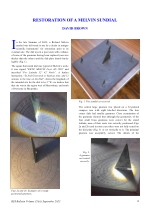
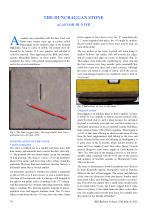
Describes the restoration of a square horizontal slate sundial made by Richard Melvin in 1856 (For Latitude 52° 42ʹ North). The work involved correcting the geometry and seating of the five gnomons, re-incising the details, and finishing the surface by painting the incisions light matt grey enamel and sealing the slate with oil.
Dials: Horizontal, Dials: Multi Faced, Restoration projects
December 2023
Page 2
Page 2
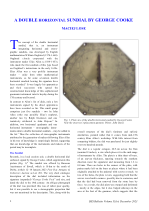
This article analyses and describes the restoration of a rare double horizontal sundial signed by George Cooke, an apprentice of Elias Allen, dating to ca. 1645–47. Geometric analysis determines the design latitude as 53º N, and XRF analysis confirms the use of lower quality brass, suggesting it was possibly a 'master-piece' or early instrument.
Dials: Double Horizontal, Historical Dials, Restoration projects
December 2023
Page 30
Page 30
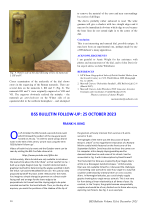
A report on the second BSS Zoom event (renamed 'BSS Bulletin Follow-up'). The event included discussions on the Erfurt Rule and a demonstration of chiselling during the restoration of a Melvin sundial, alongside a theoretical look at converting solar azimuth to solar hour angle for different latitudes.
Dialling Tools, How Sundials Work, Restoration projects, The BSS and Members
March 2022
Page 8
Page 8
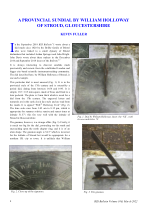
Description of a brass sundial (c. 1658–1693) made by clockmaker William Holloway of Stroud. It is provincial in style, featuring crude engraving and an incorrect replacement gnomon angle of 54.5°. Holloway's workshop location still stands in Stroud.
Dials: Horizontal, Historical Dials, Restoration projects, Sundial Design & Layout
March 2022
Page 14
Page 14
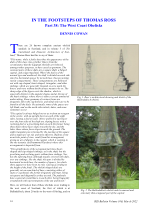
Examination of four ancient obelisk sundials located near the West Coast of Scotland, following descriptions by Thomas Ross. Sites include Ballindalloch, Lochgoilhead, Asknish House, and Mount Stuart. It also reports on the rediscovery of the mutilated Ardgowan lectern sundial and describes a cube dial at Ardgowan.
Dials: Cube, Dials: Multi Faced, Historical Dials, Restoration projects
March 2022
Page 20
Page 20
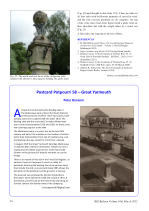
Analysis of a postcard featuring a simple horizontal sundial located next to the Boating Lake in the Great Yarmouth Venetian Waterways. Although the waterways were restored recently, the sundial appears to have vanished or was not repaired, as suggested by earlier photos showing a missing gnomon.
Dials: Horizontal, Historical Dials, Restoration projects
March 2022
Page 24
Page 24
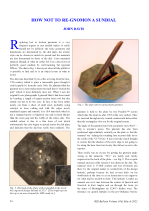
An examination of an old horizontal sundial (c. late 17th/early 18th century) highlighting mistakes made during a poor gnomon replacement. Errors included cutting the angle incorrectly (40.0° instead of the design latitude 52.5° marked on the back), using mild steel that rusted, and using modern Pozidriv screws for attachment.
Dials: Horizontal, Mathematics of Dialling, Restoration projects, Sundial Design & Layout
March 2022
Page 26
Page 26
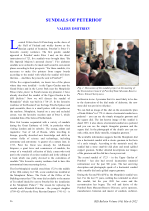
A historical account and description of the 2021 reconstruction project of the horizontal sundial for the Monplaisir Palace at Peterhof, residence of Peter the Great. The new marble dial, with a gilded bronze gnomon, was installed in the location of the lost 18th-century predecessor. The article also touches on Peterhof's museum collection, including a 1715 John Rowley dial.
Construction Projects, Dials: Horizontal, Historical Dials, Restoration projects
June 2022
Page 10
Page 10
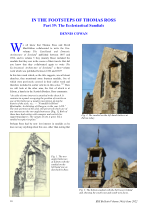
Continuing the series following Thomas Ross, this article examines nine sundials documented in his work on Scottish ecclesiastical architecture. It details the current condition, location, and history of dials found mostly on church walls or associated structures like lych-gates, including cubes and verticals, often noting signs of wear or required restoration.
Dials: Cube, Dials: Multi Faced, Historical Dials, Restoration projects
June 2022
Page 18
Page 18
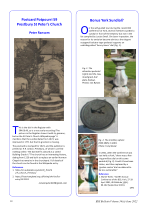
A discussion of the Prestbury St Peter’s Church sundial (SRN 0149), based on a 1923 postcard. The dial, a Grade II Listed Building, originated in 1672 and was improved in 1771, though its gnomon is noted as missing.
Dials: Horizontal, Restoration projects, Historical Dials
June 2022
Page 19
Page 19
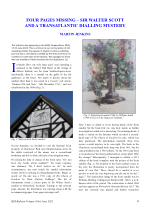
An investigation into the history of Sir Walter Scott’s sundial at Abbotsford and its American replica at Hillside, Menands, NY. The research establishes a probable link through publisher David Douglas and Dean Sage, concluding the replica is likely a copy of a refurbished replacement dial from the mid-19th century, not the original 1812 installation.
Historical Dials, Restoration projects
September 2022
Page 2
Page 2
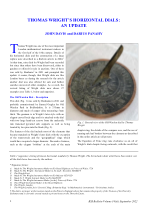
Updates the known catalogue of 18th-century mathematical instrument maker Thomas Wright’s horizontal dials, increasing the count to 27. Provides details, metallurgy, and provenance for recently examined examples, including the Old Warden dial, the Wrexham dial, and the Lisbon College dial (now at Ushaw College).
Dials: Horizontal, Equation of Time, Historical Dials, Restoration projects
September 2022
Page 38
Page 38
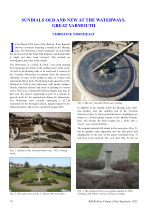
Investigates the sundials at The Waterways in Great Yarmouth after its £2.7 M restoration. Describes the replacement of two historical dials with new horizontal dials, likely made by Brad Dillon, featuring inscriptions related to writers Anna Sewell and Charles Dickens.
Dials: Horizontal, Historical Dials, Restoration projects
December 2022
Page 8
Page 8
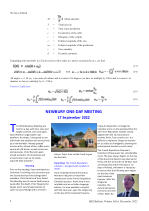
Report on the BSS Newbury meeting held shortly after the Queen's death, covering various talks including the French Republican calendar, Kings Langley Human Sundial, The Wonder Box Sundial, and several sundial restoration and creation projects.
Dials: Portable, Historical Dials, Restoration projects, The BSS and Members
March 2021
Page 2
Page 2
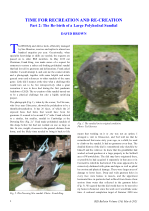
A detailed report on the restoration of a large polyhedral sundial (a rhombicuboctahedron) with 25 faces. The work involved cleaning soft sandstone, making 25 new gnomons, grafting new stone onto the damaged horizontal face, and installing the structure on a new plinth.
Construction Projects, Dials: Multi Faced, Restoration projects
March 2021
Page 18
Page 18
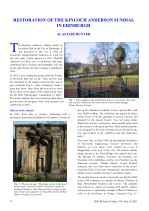
Details the 2018 restoration of the 1890 Kinloch Anderson sundial, a 2.5-metre pillar in Inverleith Park. The work included correcting the sundial's 180° wrong orientation, cleaning the marble dials, simulating lead lines with coloured epoxy, and installing new gilded brass gnomons.
Dials: Multi Faced, Historical Dials, Restoration projects
June 2021
Page 24
Page 24
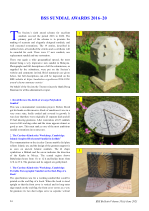
Summary of the British Sundial Society's sixth award scheme entries for 2016–2020, covering 19 submissions focused on accurate design, elegant execution, and restoration. Descriptions of notable projects include David Brown’s polyhedral sundial restoration, Tim Chalk’s sculptural dials, a stained glass replacement, and the highly complex Ta Ha Sundial from Malaysia.
Dials: Multi Faced, Construction Projects, Restoration projects
June 2021
Page 31
Page 31
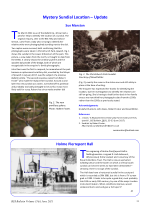
Provides an update identifying the location of a sundial pictured in old family photographs as Christchurch Park, Ipswich. The dial was an armillary sphere. Notes that a 2017 replacement armillary dial was stolen and replaced again by maker Robert Foster.
Restoration projects, Historical Dials, Dials: Armillary Sphere
June 2021
Page 32
Page 32
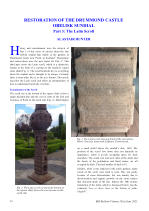
The third part of the restoration series on the 1630 Drummond Castle obelisk sundial, focusing on the unique Latin scroll carving on the shaft. The article provides the corrected transcription and interpretation of the scroll, explaining how it describes the various hour types (Babylonian, Italian, Seasonal, Common) and astronomical markings (Azimuth, Altitude, Declination) found on the dial, often linking them to astrolabe terminology.
Dials: Multi Faced, Historical Dials, Mathematics of Dialling, Restoration projects
December 2021
Page 2
Page 2
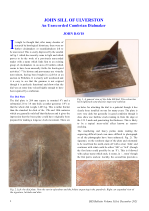
Analyses a newly discovered, unrecorded 17th-century horizontal Cumbrian dial by John Sill, dated 1737. It describes the dial plate specifications, unusual thickness, features (such as oak leaf borders), and XRF materials analysis, identifying copper sources and the controversial use of a selenium-based artificial patina during a past restoration.
Dials: Horizontal, Historical Dials, Restoration projects, Sundial Design & Layout
December 2021
Page 26
Page 26
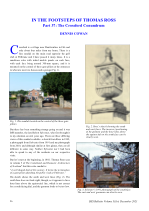
Detailed investigation into the historical changes of a cube sundial at Crossford, Fife, by comparing sketches and photographs from 1892, 1991, and 2010. The study resolved delineation errors, wrong gnomon placements, and incorrect Roman numerals, concluding the errors resulted from a rushed, poor-quality restoration following vehicle damage in the mid-1990s.
Dials: Cube, Historical Dials, Restoration projects
March 2020
Page 2
Page 2
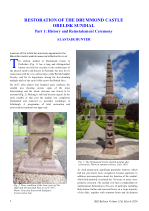
Details the history and recent restoration of the monumental obelisk sundial at Drummond Castle, Perthshire, originally dating from 1630. The article introduces the structure, the discovery of complex gnomonic features, and the reinstatement ceremony in June 2019. The restoration included replacing gnomons and correcting misconceptions about its function.
Dials: Multi Faced, Restoration projects, Historical Dials, The BSS and Members
June 2020
Page 8
Page 8
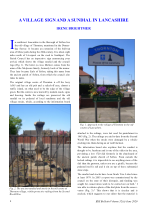
This article describes the ancient, Jacobean sundial in Thornton, Lancashire, which is featured on the village sign and stands near the old village stocks. The dial is Grade Two Listed, but its cracked plate and heavy patina obscure the maker and date. Repairs were undertaken on the stocks, but the sundial itself remains untouched since 1891.
Dials: Horizontal, Historical Dials, Restoration projects
June 2020
Page 10
Page 10
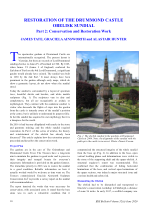
This is the second part detailing the conservation of the 1630 Drummond Castle obelisk sundial. The work involved dismantling the structurally unsound base and shaft, using laser scanning for documentation, and replacing all the gnomons with new, accurately calculated bronze parts, restoring the dial to full working order.
Dials: Multi Faced, How Sundials Work, Restoration projects, Historical Dials
September 2020
Page 2
Page 2
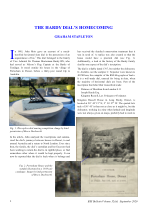
A horizontal slate dial, reliably dated 1767, belonging to Vice Admiral Sir Thomas Masterman Hardy, is tracked through its travels from Dorset to Australia and back to London. The article concludes with the dial's conservation and placement inside Portesham House, alongside a replica placed outside.
Dials: Horizontal, Historical Dials, Restoration projects, The BSS and Members
September 2020
Page 4
Page 4
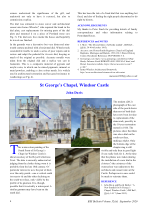
A watercolour painting likely from the late 18th century shows two dials (a vertical south and a declining south-west) on the chapel entry porch. Due to stonework replacement, most of both dials were lost, though evidence suggests there was once a third dial on the south-east face, forming a triplet.
Dials: Vertical, Historical Dials, Restoration projects
September 2020
Page 20
Page 20
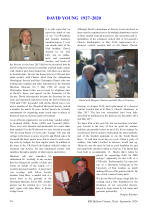
An obituary for David Young, a founder member (no. 3) and Vice-President of the BSS. He served as Secretary for ten years, organised conferences and international ‘sundial safaris,’ and was involved in projects like the Yew Tree Dial and sundial restoration projects.
Restoration projects, The BSS and Members
December 2020
Page 38
Page 38
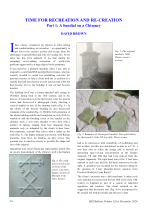
The author describes helping a client re-create a vertical sundial on a 16th-century Wiltshire mill cottage chimney stack, which had been lost around 1900. The design incorporated findings from original fragments, including a unique concatenation of Roman numerals. A separate slate plaque with an Equation of Time correction, featuring a millstone image, was also added.
Construction Projects, Dials: Vertical, Equation of Time, Restoration projects
September 2019
Page 15
Page 15
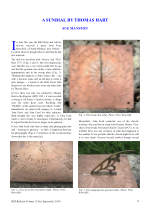
The article details the investigation into a dial inscribed 'Jwade' and 'Thos. Hart 1773', which was found to be the genuine article stolen from All Saints’ Church in Iwade. The investigation concurrently identified eight other similar dials (like one at Wilton House Museum) bearing the 20th-century “Brazen-Faced Old Optimist” motto, believed to be later replicas.
Dials: Horizontal, Historical Dials, Restoration projects
December 2019
Page 2
Page 2
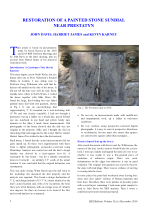
This article details the complex restoration of a large, venerable painted stone sundial near Prestatyn. After initial miscalculations, detailed analysis confirmed its 18th-century origin and correct design latitude. Scientific paint analysis suggested an original smalt blue and gilded finish. The sundial was subsequently restored, repainted, gilded, and reinstalled, canted correctly for its location.
Dials: Vertical, Historical Dials, Restoration projects, Sundial Design & Layout
March 2018
Page 22
Page 22
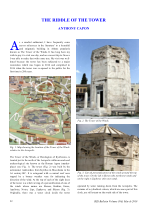
Discusses the newly restored Tower of the Winds (Horologion of Kyrrhestos) in Athens, which features eight exterior sundials and an internal water clock. The main riddle explored is whether the eroded sundials were original to the 1st century BC structure, noting the conflicting evidence of Vitruvius's silence versus the need for sundials to regulate the water clock.
Dials: Multi Faced, Historical Dials, Restoration projects
December 2018
Page 50
Page 50
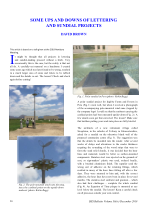
Discusses various challenges in construction projects: ensuring builders are briefed, problems with adhesive on plastic hour lines, and extreme delays (nine years and counting) in installing a replacement dial at St Edmund Hall, Oxford, due to regulatory hurdles.
Construction Projects, Restoration projects
March 2017
Page 2
Page 2
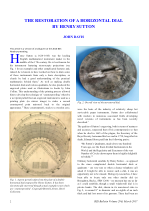
This article details the restoration of a rare, 1652 circular horizontal dial by Henry Sutton, a leading 17th-century instrument maker. Analysis revealed its accuracy but also a beginner’s delineation mistake (wrong centres used for back-hours). The brass plate showed remarkably uniform thickness and bore a unique motto: “As shade doth pass from line to line...”. A replacement gnomon was manufactured.
Dials: Horizontal, Historical Dials, Mathematics of Dialling, Mottoes, Restoration projects
June 2017
Page 32
Page 32
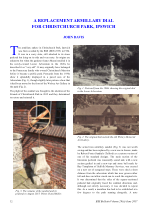
This article reports on the restoration project to replace a heavily rusted, old iron armillary sphere in Ipswich's Christchurch Park. A new bronze dial, custom-made by Robert Foster Sundials, was mounted on a restored pedestal and dedicated to the recently deceased Dr John Blatchly MBE.
Dials: Armillary Sphere, Restoration projects
September 2017
Page 24
Page 24
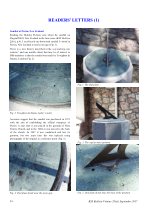
The letter discusses a horizontal sundial in Picton, New Zealand, manufactured by Troughton & Simms in London in 1871. It was restored in 1989 after the gnomon was vandalised. The dial's current placement is unsatisfactory as it is often obscured by shadows from an oak tree and the adjacent building.
Dials: Horizontal, Historical Dials, Restoration projects
December 2017
Page 9
Page 9
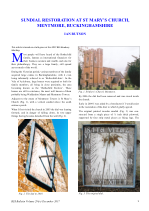
Reports on the protracted restoration of a vertical painted wooden sundial at St Mary’s Church, near the historic Rothschild estates. Due to extensive rot, a new plywood dial was constructed, the gnomon replaced, and the hour lines were corrected based on the wall's measured declination.
Dials: Vertical, Restoration projects
March 2016
Page 1
Page 1
A circa 1913 Francis Barker gnomon, which was severely twisted and bent, required straightening. The author commissioned Mark Clarke, an expert who usually works on historic aircraft components at the Imperial War Museum Duxford, to straighten the piece, finding the task straightforward given his experience.
Historical Dials, Restoration projects
June 2016
Page 16
Page 16
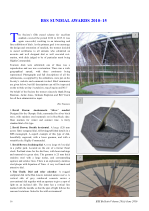
Report on the Society’s fifth award scheme (2010–2015), which resulted in fourteen submissions (including one restoration and one reproduction) from three continents. Certificates were awarded to all accurate and well-designed entrants, with several highly commended. Brief summaries of dials by David Brown, Tim Chalk, Tony Moss, Charles Perry, and others are provided.
Construction Projects, Restoration projects, The BSS and Members
September 2016
Page 17
Page 17
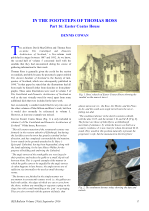
Examines a multi-faceted dial on the south-west angle turret of Easter Coates House (1615), Edinburgh, which Thomas Ross briefly mentioned. The author confirms a horizontal dial face on the upper surface, suggesting the dial is original to the building, despite it possibly containing repurposed stones.
Dials: Multi Faced, Dials: Vertical, Historical Dials, Restoration projects
September 2016
Page 29
Page 29
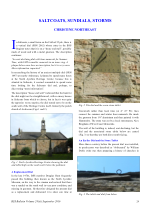
Investigation into a vertical dial (SRN 2062) found on the Heritage Centre wall in Saltcoats. The current dial is a canted, south-facing replacement (by Douglas Hunt) of an older, storm-damaged dial, commemorating the church's turbulent history of being rebuilt multiple times after violent storms.
Dials: Vertical, Historical Dials, Restoration projects
December 2016
Page 29
Page 29
Report covering talks from the 2016 Newbury Meeting. Highlights include John Bird dial investigation, Didsbury stained glass restoration updates, discussions on Wenger and Mojoptix dials, approaches to moon dials, modern sundial challenges, and the Easton Lodge restoration project.
Historical Dials, Restoration projects, Sundial Design & Layout, The BSS and Members
March 2015
Page 33
Page 33
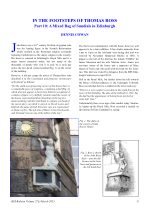
The tenth installment surveying Edinburgh's sundials mentioned by Thomas Ross. Highlights include the restored two-faced vertical dial on John Knox's House and the multi-faceted Huntly House dial (a copy of a 1732 Archibald Handasyde dial). Other dials reviewed are found at West Kirk, Corstorphine Church, Liberton House, Hudson Cottage, and Brighton Park in Portobello.
Dials: Multi Faced, Dials: Vertical, Historical Dials, Restoration projects
June 2015
Page 36
Page 36
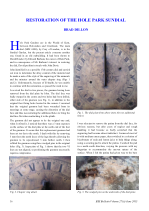
Details the restoration work on a probable 17th-century brass dial found at Hole Park Gardens, Kent, originally identified by John Davis. The work involved straightening the warped plate, realigning the assumed replacement gnomon, cleaning the surface, and applying a mid-brown patina.
Dials: Horizontal, Historical Dials, Restoration projects
June 2015
Page 37
Page 37
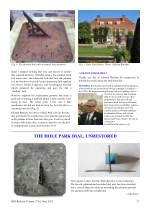
Short descriptive notes accompanying photographs showing the Hole Park dial prior to restoration, highlighting the heavily patinated and scratched dial plate which had been stretched into a convex shape by previous damage.
Historical Dials, Restoration projects
September 2015
Page 34
Page 34
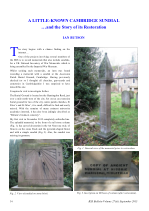
An account of the finding and restoration of the memorial sundial dedicated to Rudolf Cecil Hopkinson (died 1917) at Ascension Parish Burial Ground, Cambridge. It includes the history of the prominent Hopkinson family and details the reconstruction and fitting of the simple scrolled brass replacement gnomon.
Dials: Vertical, Restoration projects, Historical Dials
December 2015
Page 18
Page 18
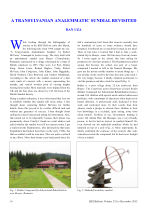
Describes the author's search for an analemmatic sundial near Braşov, Romania, built by British volunteers in 1993. Although wooden posts are gone, the concrete date scale mosaic was found at the Brădet Compound, and the manager intends to restore the dial.
Construction Projects, Dials: Analemmatic, Restoration projects
December 2015
Page 32
Page 32
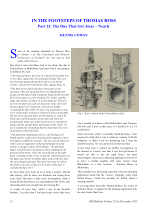
Details the successful search for the missing Polton House dial, originally sketched by Thomas Ross, which had been incorporated into a rockery. Parts of the dial (dating 1685 and 1672) were discovered and re-erected at Arniston House, Midlothian.
Dials: Multi Faced, Historical Dials, Restoration projects
December 2015
Page 41
Page 41
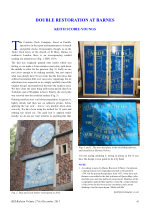
Describes the restoration work on the sundial (and accompanying clock) on the Tudor brick tower of St Mary, Barnes. The deteriorating painted dial was replaced with a 2 mm stainless steel plate, traced from the original design, etched, and traditionally painted and gilded.
Dials: Vertical, Restoration projects
March 2014
Page 46
Page 46
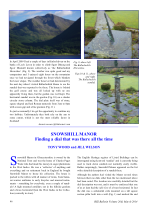
This article describes the unexpected discovery of a substantial cube sundial at Snowshill Manor, Gloucestershire. The dial, constructed of Cotswold limestone and likely dating from 1722, was overlooked because it was built into a wall and had suffered severe erosion, losing its gnomons and delineation, making it resemble an ordinary gatepost.
Dials: Cube, Historical Dials, Restoration projects
June 2014
Page 32
Page 32
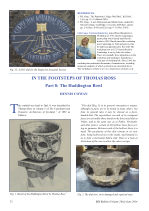
Details the rediscovery of the Haddington Bowl, a unique 17th-century facet-headed dial described by Thomas Ross in 1892. It is a vase-form dial hollowed out to form an internal horizontal dial, featuring cup-hollows (scaphes) and faces acting as gnomons, despite suffering severe damage.
Dials: Scaphe, Dials: Unusual, Historical Dials, Restoration projects
June 2014
Page 44
Page 44
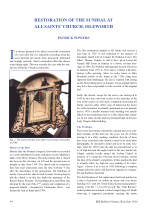
Documents the restoration of a vertical declining dial from All Saints’ Church, Isleworth (originally 1707), which was severely decayed and incorrectly delineated. The restoration included correcting mathematical errors and recreating unique features like solar altitude scales and time arcs for Jamaica, Jerusalem, and Moscow.
Dials: Vertical, Mathematics of Dialling, Restoration projects, Historical Dials
September 2014
Page 2
Page 2
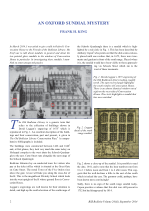
An investigation into two painted glass sundials in the windows of Convocation House at the Old Bodleian Library in Oxford, focusing on their history, appearance, dating, and the discovery that the south dial is incorrectly installed, facing the wrong way.
Dials: Vertical, Historical Dials, Restoration projects, Sundial Design & Layout
September 2014
Page 10
Page 10
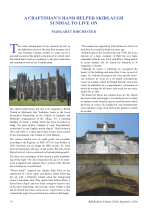
Recounts the personal story of Edward Brown, a Yorkshireman who, after being made redundant, funded his own stonemasonry course and dedicated ten years (1981–1991) to restoring St Augustine’s Parish Church in Skirlaugh, including the repair of its vertical stone sundial.
Dials: Vertical, Historical Dials, Restoration projects, The BSS and Members
September 2014
Page 24
Page 24
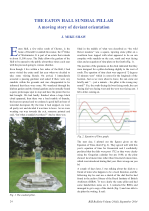
Research into a square, tapering stone pillar sundial at Eaton Hall, designed by Lutyens (1898) with dials by F. Barker & Son. The pillar has been moved multiple times on the estate and currently stands incorrectly orientated (rotated 180 degrees), despite expert advice.
Dials: Multi Faced, Historical Dials, Restoration projects, The BSS and Members
December 2014
Page 20
Page 20
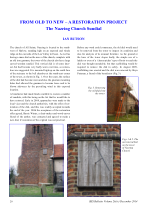
A detailed report on the restoration of a badly worn carved wooden vertical dial, dated 1765, found on Nazeing Church tower. Due to the dial's poor condition, a new chestnut wood replacement was crafted by Barrie Winter. The design analysis confirmed the motto “Meridies Solarium” and the inclusion of solar azimuth lines.
Dials: Vertical, Historical Dials, Restoration projects, Sundial Design & Layout
March 2013
Page 8
Page 8
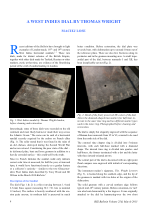
A detailed investigation of a rare eighteenth-century sundial made by Thomas Wright for use in the West Indies. The author compares design features with other known examples and clarifies maker attribution through stylistic and documentary evidence.
Dials: Horizontal, Historical Dials, Restoration projects
March 2013
Page 15
Page 15
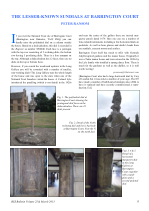
An illustrated survey of several overlooked sundials at Barrington Court. The article documents their styles, inscriptions, and historical setting, adding new information to the site’s known dial heritage.
Dials: Horizontal, Dials: Vertical, Historical Dials, Restoration projects
March 2013
Page 28
Page 28
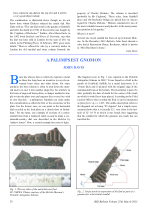
An account of a sundial whose gnomon and markings show evidence of multiple historical restorations. The author describes methods used to reveal earlier engravings and reconstruct its history.
Dials: Horizontal, Historical Dials, Restoration projects
March 2013
Page 30
Page 30
An examination of a carved stone from Scotland believed to be a very early horizontal sundial. The article describes its discovery, measurements, and restoration.
Dials: Horizontal, Historical Dials, Restoration projects
March 2013
Page 39
Page 39
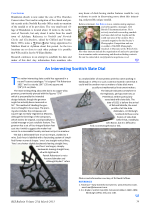
A short report describing a newly found Scottish slate sundial of unknown maker. The author analyses its construction and markings and appeals for comparative examples.
Dials: Horizontal, Historical Dials, Restoration projects
March 2013
Page 45
Page 45
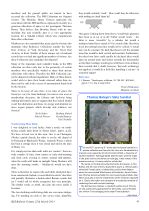
An illustrated study of a sixteenth-century slate sundial connected to the Boleyn family. Davis documents its restoration, symbolism, and stylistic features.
Dials: Horizontal, Historical Dials, Restoration projects
June 2013
Page 5
Page 5
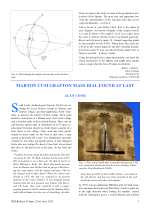
A report on the rediscovery of a medieval mass dial embedded in the vestry wall of Marton cum Grafton church. The article details its design, historical context, and connection to early English ecclesiastical dials.
Dials: Mass Dials, Historical Dials, Restoration projects
June 2013
Page 14
Page 14
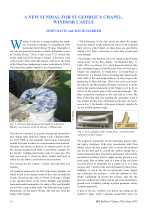
An illustrated account of designing and installing a new bronze vertical sundial at St George’s Chapel, Windsor Castle, featuring the Garter motto and a gnomon based on the Bray family’s heraldic ‘hemp press’.
Dials: Vertical, Historical Dials, Restoration projects, Sundial Design & Layout
June 2013
Page 33
Page 33
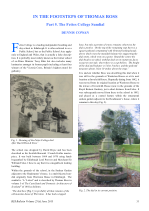
Continuing the series on Thomas Ross, this article documents a restored sundial at Fettes College, Edinburgh, with photographs and analysis of its design and craftsmanship.
Dials: Vertical, Historical Dials, Restoration projects
June 2013
Page 35
Page 35
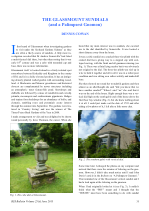
A detailed report on multiple sundials found at Glassmount, including a rare palimpsest gnomon showing evidence of successive historical restorations.
Dials: Multi Faced, Historical Dials, Restoration projects
June 2013
Page 44
Page 44
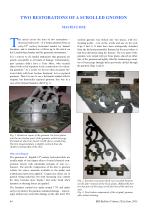
An illustrated technical report on restoring ornate scrolled gnomons from eighteenth-century dials, describing metalwork, conservation, and reinstallation.
Dials: Horizontal, Historical Dials, Restoration projects
September 2013
Page 48
Page 48
Report on the installation of a reproduction horizontal dial at Barrington Court, Somerset, commissioned by the National Trust. The new dial, created by Flowton Dials, replaces an early-19th-century horizontal dial by Cary of London that had been stolen. It is signed “After CARY, LONDON”.
Construction Projects, Dials: Horizontal, Restoration projects
December 2013
Page 12
Page 12
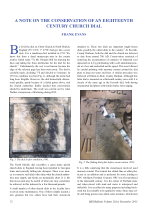
Details the conservation work performed on an 18th-century sandstone dial (1793) at Christ Church in North Shields, which was declining 7°E. The process involved cleaning, removal of cement, consolidation using lime mortar and grout, weatherproofing, and gilding the copper-based gnomon.
Dials: Vertical, Historical Dials, Restoration projects
December 2013
Page 40
Page 40
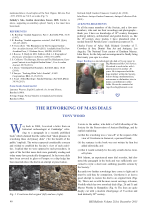
Discusses the controversial practice of reworking or re-cutting old mass dials. The British Sundial Society's policy is against restoration, suggesting a copy dial be carved nearby instead. Examples of reworked dials at Crewkerne, Lamas, and Martyr Worthy are provided.
Dials: Mass Dials, Restoration projects, The BSS and Members
June 2012
Page 31
Page 31
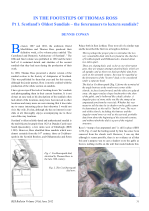
This article is the first part of a quest to track down and photograph sundials identified by Thomas Ross in his late 19th-century work. It focuses on Scotland's oldest dials, specifically three 16th-century examples at Cockburnspath, Oldhamstocks, and Seton Palace, and a fourth at Fogo, all similar in type and potentially forerunners to lectern dials.
Dials: Multi Faced, Dials: Vertical, Historical Dials, Restoration projects
June 2012
Page 44
Page 44
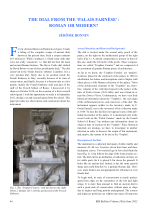
This article investigates a spherical sundial in the 'Palais Farnèse', Rome, questioning its Roman origin due to its perfect state of conservation and lack of gnomon hole. It hypothesises the dial is an 18th or 19th-century copy of a Roman original, potentially with a symbolic rather than functional purpose related to the palace's 'Trophées Farnèse' compositions about Time.
Dials: Scaphe, Dials: Unusual, Historical Dials, Restoration projects
September 2012
Page 16
Page 16
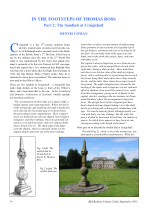
This article details two sundials at Craigiehall: a 4-metre high obelisk dial, restored in 1965 after being found in fragments, and a horizontal brass dial by John England, dating from 1702-1714. The obelisk is unique due to an 18th-century globe base, while the horizontal dial features an Equation of Time table and armorial devices.
Dials: Multi Faced, Equation of Time, Historical Dials, Restoration projects
September 2012
Page 22
Page 22
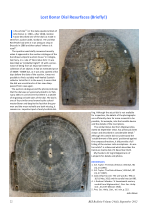
This article reports the brief reappearance of a 1634 slate equatorial dial by John Bonar, originally from Loudon Castle, Scotland, at a German auction. Unsold, it subsequently disappeared from public view. Despite missing its gnomon and moon volvelle, the dial is considered an important artefact of early Scottish dialling, featuring detailed engravings.
Dials: Equatorial, Historical Dials, Restoration projects
December 2012
Page 2
Page 2
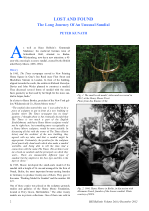
This article details the history and journey of a Henry Moore sundial, from its 1965 commission for The Times in London to its re-alignment in Schwäbisch Hall, Germany. It covers the creation of models, its sale, damage, recovery after theft in 2012, and precise re-installation, highlighting its remarkable travels and survival.
Dials: Unusual, Historical Dials, Restoration projects, Sundial Design & Layout
December 2012
Page 9
Page 9
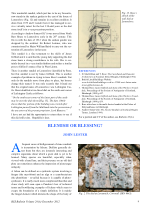
This article discusses lichens on stone sundials, defining them as symbiotic organisms and classifying their external forms. It explores their slow growth, substrate preferences, reproduction, and sensitivity to pollution. The author considers whether lichens enhance antiquity or are a disfigurement, touching on removal methods for restorers.
Historical Dials, Restoration projects
December 2012
Page 34
Page 34
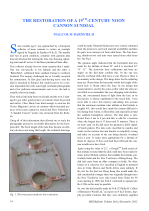
This article describes the restoration of a 19th-century Negretti & Zambra noon cannon sundial. The author recreated missing brass parts, noting design anomalies like incorrect latitude calibration and an inappropriate date scale. The true maker and date remain uncertain, highlighting the common practice of firms selling goods made by others.
Dials: Noon Lines, Historical Dials, Restoration projects, Sundial Design & Layout
December 2012
Page 42
Page 42
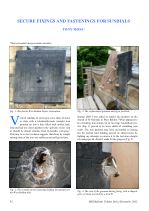
This article addresses methods for securely fixing sundials, focusing on preventing theft and damage. It discusses replacing rusted iron gnomons with stainless steel, using shaped stone blocks with acrylic paste, and cross-bolting for heavy gnomons. For dial plates, methods include recessing them into plinths and using threaded holes with retaining bolts.
Construction Projects, Restoration projects, Sundial Design & Layout
December 2012
Page 47
Page 47
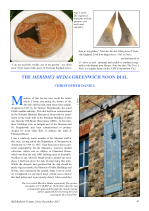
This article details the 2012 reconstruction of the Meridies Media noon mark mean time sundial at the Royal Observatory, Greenwich. Originally designed by Dr Tadeusz Przypkowski in 1967 with a design error, the new Kirkstone slate dial, carved by Ben Jones, was meticulously crafted and unveiled on 10 October 2012.
Restoration projects, The BSS and Members, Dials: Noon Lines
March 2011
Page 2
Page 2
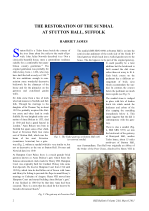
This article details the restoration of a Tudor sundial at Stutton Hall in Suffolk. It covers the history of the house and dial, archaeological findings suggesting its originality, and the methods used for cleaning, realigning the gnomon, and repainting based on known Tudor designs.
Dials: Vertical, Historical Dials, Restoration projects, Sundial Design & Layout
March 2011
Page 12
Page 12
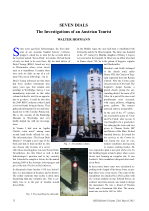
An Austrian tourist investigates the mystery of London's 'Seven Dials' monument. The article details the history of the area, the original Doric pillar with six sundials erected in 1693/94, its removal in 1773, its relocation to Weybridge, and the eventual erection of a new column with seven dials in 1989.
Dials: Multi Faced, Restoration projects, Historical Dials
March 2011
Page 36
Page 36
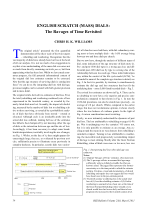
This article revisits previous estimates of scratch dial loss, incorporating dial age structure to provide more precise understanding of historical and future loss dynamics. It analyzes the impact of rebuilding and weathering, noting weathering's increasing dominance over time and the implications for conservation.
Restoration projects, Historical Dials, Dials: Mass Dials
June 2011
Page 25
Page 25
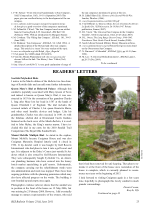
This letter provides additional information on Scottish polyhedral dials, specifically clarifying the history of Queen Mary’s Dial at Holyrood Palace and providing an update on the Mount Melville Multiple Dial's restoration plans after its removal for safekeeping.
Dials: Multi Faced, Restoration projects, Historical Dials
June 2011
Page 26
Page 26
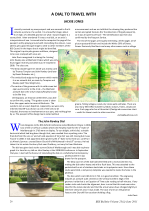
This article details the rediscovery and reinstallation of a lost John Rowley azimuth and equation of time dial from Blenheim Palace. It describes its unique features, including the deep double-ogee rim and specific gnomon design, and its historical significance.
Dials: Unusual, Equation of Time, Historical Dials, Restoration projects
June 2011
Page 48
Page 48
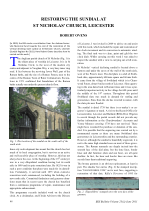
This article describes the restoration of a 1738 vertical declining Swithland slate sundial at St Nicholas’ Church, Leicester. It details the process of in-situ gilding of the numerals and lines, using specific materials and techniques for durability, and notes a previous gnomon replacement in 1896.
Dials: Vertical, Historical Dials, Restoration projects
September 2011
Page 36
Page 36
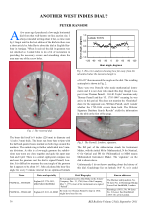
Peter Ransom discusses a 9-inch brass horizontal dial, signed 'Parnell, London,' which he acquired online. The dial, optimized for a latitude of approximately 16.05° N (suggesting a potential link to Guadeloupe), features hours from 6 am to 6 pm, half and quarter-hour marks, and a central compass rose. The gnomon was detached upon acquisition and later restored.
Dials: Horizontal, Restoration projects, Historical Dials
December 2011
Page 14
Page 14
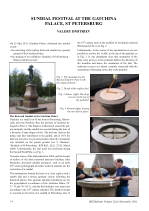
This article reports on a sundial festival at Gatchina Palace, St Petersburg, which included the unveiling of a replica historical sundial and an exhibition. The replica dial indicates true solar time according to 18th-century standards, based on historical photos and other archival material for restoration. The event celebrated the return of the sundial to its historical place after almost 80 years.
Sundial Design & Layout, Restoration projects, Historical Dials, The BSS and Members
December 2011
Page 16
Page 16
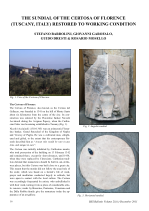
This article details the restoration of a pinhole sundial at the Certosa of Florence. The meridian line served as a calendar and true local noon marker. Investigations revealed inconsistencies, leading to the conclusion that the dial correctly determined the spring equinox, vital for calculating Easter, reflecting its religious institution setting. Historical interventions, possibly by astronomer G.B. Donati, are also discussed.
Dials: Noon Lines, Equation of Time, Historical Dials, Restoration projects
December 2011
Page 41
Page 41
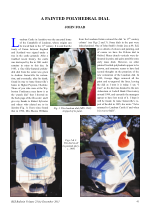
This article discusses a polyhedral dial from Loudoun Castle, Scotland, that was restored and controversially painted in the 1990s using 17th-century colours. The paint was later removed, and the lines re-engraved. The author expresses concern that the dial's current location at Jodrell Bank Observatory is unknown, raising questions about the preservation and tracking of historical sundials.
Dials: Multi Faced, Dials: Unusual, Historical Dials, Restoration projects
December 2011
Page 49
Page 49
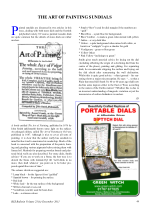
This article, drawing on John Smith's 1676 book 'The Art of Painting', discusses the techniques and colours used for painting sundials, particularly stone dials. It provides practical advice on preparing surfaces, mixing pigments, and laying out dials, including recommendations for repainting and a note on a misconception about earth's motion affecting dial orientation.
Construction Projects, Historical Dials, Restoration projects, Sundial Design & Layout
March 2010
Page 2
Page 2
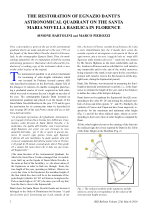
Describes the history and function of Egnazio Danti's 1572 astronomical quadrant in Florence. It details the five systems of time measurement it displayed and outlines the methodology used to re-compute the missing gnomons for a modern restoration and the creation of a working copy.
Dials: Vertical, Historical Dials, Restoration projects, Sundial Design & Layout
June 2010
Page 24
Page 24
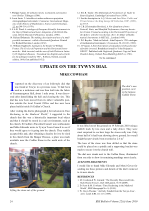
This article provides an update on the Irish-style dial discovered at Towyn. Originally used as a milestone and later built into Ynysmaengwyn Hall, the dial has now been safely moved from outside the local Tourist Office to St Cadfan’s Church. The article details the process of moving the large stone and its new illuminated position next to the Cadfan Stone.
Historical Dials, Restoration projects
June 2010
Page 45
Page 45
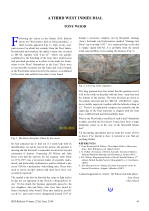
This article introduces a newly discovered West Indies sundial, signed 'DICAS LIVERPOOL' with 'Latt 22°'. The gnomon is missing and the dial is worn, but it is identified as likely from the Turks and Caicos Islands. Research by Jill Wilson and John Davis attributes it to John Dicas (w.1774-1797), a Liverpool scientific instrument maker, or his daughters who ran the business after his death.
Historical Dials, Restoration projects
September 2010
Page 29
Page 29
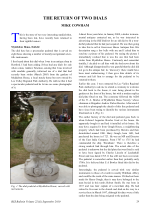
This article recounts the recovery and return of two sundials: a pedestal with carved navigational instruments, stolen from Myddelton House and later reunited with a replica dial plate; and an early Celtic sundial from Tywyn, moved inside its church.
Historical Dials, Restoration projects, The BSS and Members
December 2010
Page 26
Page 26
This historical essay details the Meridies Media sundial designed by Dr Tadeusz Przypkowski for the Old Royal Observatory at Greenwich in 1967. It describes the dial's function using an analemma to indicate standard mean time, true noon, and date. The article recounts the author's involvement in its installation, the initial design error, and the eventual reconstruction of the wooden dial in 1969, which remained until 1991.
Dials: Noon Lines, Equation of Time, Historical Dials, Restoration projects
December 2010
Page 31
Page 31
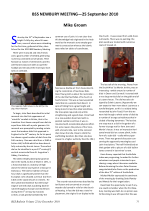
This report summarises the British Sundial Society's Newbury Meeting on 25 September 2010, attended by 36 members. It highlights short talks on scientific sundials in Britain, Essex dial restorations, and Devon/Cornwall dials. Exhibits included devices for determining sun direction, reproductions of historical dials, and modern designs.
Dials: Unusual, Historical Dials, Restoration projects, The BSS and Members
December 2010
Page 45
Page 45
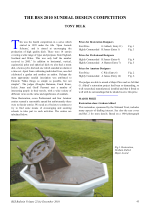
This report covers the fourth BSS Sundial Design Competition, which received 14 entries across restoration, professional, and amateur classes, though no junior entries. Graham Aldred won the Major Prize for his restoration of the Lyme Park dial. Other prizes were awarded for a south-facing vertical dial and highly commended entries for a sun/moon dial, a prototype noon mark dial, and a vertical dial using a 'super ellipse.'
Dials: Unusual, Restoration projects, Sundial Design & Layout, The BSS and Members
June 2009
Page 34
Page 34
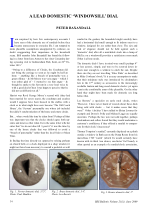
An analysis of a fragmented lead horizontal 'windowsill' sundial found in Dorset. The author reconstructs its likely original octagonal design, discussing its features, numeral conventions, and a possible skewed layout to compensate for magnetic variation, suggesting a date of around 1710.
Dials: Horizontal, Historical Dials, Restoration projects
September 2009
Page 36
Page 36
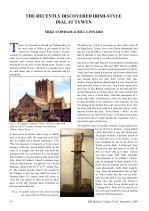
Details the discovery and preservation of an Irish-style pillar dial (c. 700-1000 AD) in Tywyn, Wales. Found in 1986 among rubble, the dial was later used as a milepost. The article describes its features and recounts the successful effort to have the vulnerable stone moved to St Cadfan's Church.
Dials: Mass Dials, Dials: Unusual, Historical Dials, Restoration projects
December 2009
Page 20
Page 20
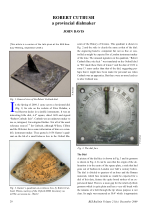
An investigation tracing the history of a 1699 horizontal dial signed by Robert Cutbush. The author identifies the maker as part of a family of Kent clockmakers and discovers that the dial was stolen from Ightham churchyard before 1978. The article concludes with the dial's successful return.
Dials: Horizontal, Historical Dials, Restoration projects
March 2008
Page 3
Page 3
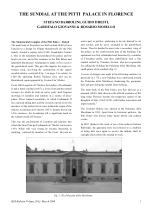
This article details the restoration and description of a 1696 pinhole sundial in Florence's Pitti Palace, designed by Vincenzo Viviani. It served for astronomical observations and calendar functions, notably for determining Easter. The piece also explores its historical context within the Medici court and its allegorical frescoes.
Restoration projects, Historical Dials, Dials: Noon Lines
June 2008
Page 64
Page 64
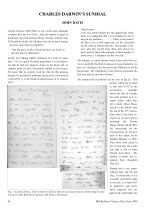
This article details Charles Darwin's horizontal sundial at Down House, used for regulating his clocks. It describes the dial's unpretentious design, its historical context, and recent restoration efforts after two accidents, including the discovery that the gnomon was a replacement.
Dials: Horizontal, Historical Dials, Restoration projects
September 2008
Page 116
Page 116
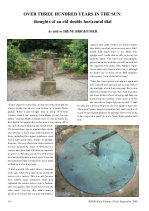
This article, narrated from the perspective of a 17th-century double horizontal dial by John Marke in a North Wales garden, recounts its history. It reflects on its past importance for timekeeping, its relocation, slight misalignment, and a recent renewed interest in its preservation, highlighting its rarity and unique survival.
Dials: Double Horizontal, Historical Dials, Restoration projects
September 2008
Page 144
Page 144
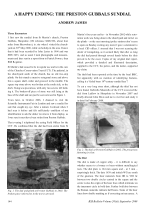
Andrew James recounts the recovery of a stolen 1638 copper alloy sundial from St Martin’s church, Preston Gubbals. He identified the dial for sale, leading to its return. The article details the dial's early 'centred' design and the unique significance of its gnomon supporter being cut from a 15th-16th century memorial brass.
Dials: Horizontal, Restoration projects, Historical Dials
December 2008
Page 163
Page 163
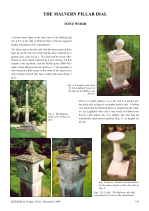
This article reports on the Malvern pillar dial, noting its removal from an old cross shaft and replacement with a gabled cross. The original cube dial has been refurbished or replaced, and is now mounted on a short column in the churchyard. It also mentions a modern cube dial by Liz Leighford based on a similar design.
Dials: Cube, Historical Dials, Restoration projects
March 2007
Page 2
Page 2
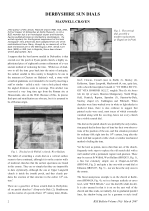
This article provides an overview of sundials found in Derbyshire, from ancient scratch dials on medieval churches to more sophisticated wall and public sundials. It highlights notable examples like the Eyam parish church dial and various works attributed to the Whitehurst family of clockmakers. It also touches on the historical context of timekeeping for ordinary people and the aristocracy.
Dials: Vertical, Restoration projects, Historical Dials, Dials: Cube
March 2007
Page 28
Page 28
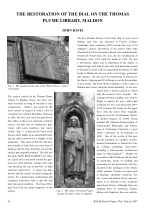
This article details the restoration of a vertical lead sundial on the Thomas Plume Library in Maldon, Essex. It describes the dial's historical context, its construction from lead sheet over oak boards, the damage caused by squirrels, and the repair process including repainting and gilding. The dial is a direct south design and dates from around the turn of the 18th century.
Dials: Vertical, Historical Dials, Restoration projects
March 2007
Page 33
Page 33
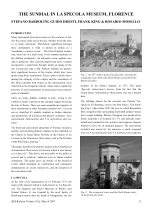
This paper describes the pinhole sundial in the Grand-Ducal Astronomical Observatory (La Specola) in Florence. It covers the observatory's history, the sundial's design as a string-gnomon meridian line, its restoration in 2005, and a comparison of measured zodiac point positions with calculated values. It highlights the instrument's historical importance for astronomical studies and calendar reform.
Dials: Noon Lines, Historical Dials, How Sundials Work, Restoration projects
June 2007
Page 69
Page 69
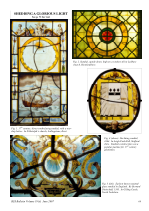
This article, a re-publication, discusses the history and art of painted or stained-glass window sundials in Britain. It covers their construction, fragility, the challenges of preservation, and highlights notable examples and makers like Bernard Dininckoff and Henry Gyles.
Dials: Vertical, Sundial Design & Layout, Restoration projects, Historical Dials, Dials: Stained Glass
June 2007
Page 75
Page 75
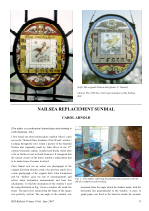
This article describes the process of creating a replica stained-glass sundial for Nailsea Court after the original was stolen. The author explains how window declination was measured and new hour lines calculated, detailing the multi-stage artistic and technical process to recreate the dial, with gnomon fixed to leadwork to prevent glass damage.
Sundial Design & Layout, Construction Projects, Restoration projects
June 2007
Page 83
Page 83
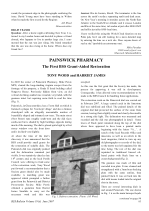
This article describes the restoration of a faded vertical declining sundial at Painswick Pharmacy, the first to receive a British Sundial Society grant. It details the cleaning, stabilisation of a crack, repainting, and strengthening of the iron gnomon. The article also touches on the dial's possible historical connection to local clockmakers and its asymmetrical placement.
Dials: Vertical, Restoration projects
September 2007
Page 111
Page 111
This section features three letters: Robert Scott Simon identifies a dial he made. John Wall comments on a bizarre sundial plot in a TV series, where a pivoted gnomon reveals gold. Graham Aldred discusses corrosion on sundial plates and P&G heliochronometers, suggesting material substitutions and their implications.
Dials: Heliochronometer, Restoration projects, The BSS and Members
December 2007
Page 179
Page 179
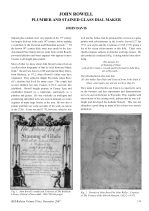
This biography details John Rowell (1689-1756), a provincial plumber and self-taught glass painter who became known for stained glass sundials in the 18th century. It covers his life, business, the influence of his clockmaker father-in-law, and two notable dials: the 'IR 1733' dial at Arbury Hall and the 1734 Purley Hall dial. The latter has undergone restoration, with analysis showing engraving errors and the design of a replacement gnomon.
Dials: Vertical, Sundial Design & Layout, Restoration projects, Historical Dials, Dials: Stained Glass
February 2006
Page 23
Page 23
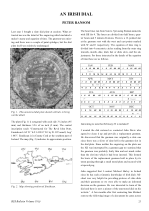
This article documents the restoration and analysis of an octagonal slate sundial plate from 1843, made by D. O’Connell for Revd John Pratt of Enniskean. It details the dial's engraved features, including an equation of time ring, gnomon restoration, and a geometric analysis confirming the remarkable accuracy of its construction for the specified latitude.
Dials: Horizontal, Sundial Design & Layout, Restoration projects, Historical Dials
February 2006
Page 33
Page 33
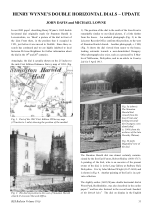
This update provides further information on Henry Wynne’s double horizontal dials, including new historical evidence for the Staunton Harold dial’s position from 19th-century maps and photographs. It also discusses the Wrest Park replica and criticises the National Trust’s decision to preserve a bent gnomon on the Powis Castle dial as part of its history.
Restoration projects, Historical Dials, Dials: Double Horizontal
February 2006
Page 35
Page 35
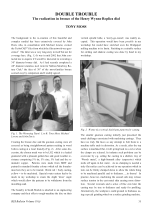
This article details the intricate process of creating a 30-inch bronze replica of the Henry Wynne dial. It covers pattern making, casting, and challenging precision machining operations, including overcoming issues with a gnomon that was initially too short and perfecting a complex knife-edge. The project required meticulous effort and problem-solving.
Construction Projects, Dials: Double Horizontal, Restoration projects, Sundial Design & Layout
June 2006
Page 61
Page 61
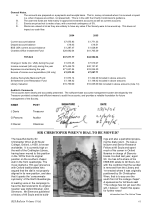
This article discusses the potential relocation of a sundial designed by Sir Christopher Wren at All Souls’ College, Oxford. It details the long-standing grievance of traditionalists about its current misaligned position and the condition in a will left by Oxford librarian John Simmons for its return to its original location.
Historical Dials, Restoration projects
June 2006
Page 96
Page 96
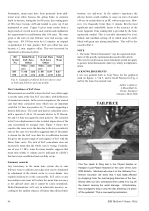
This short note reports that the Heath & Wing dial in the Tiltyard Garden at Hampton Court Palace was badly damaged by contractors who dropped a lopped tree branch onto its pedestal. The dial is now awaiting restoration.
Historical Dials, Restoration projects
September 2006
Page 110
Page 110
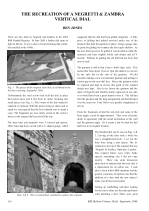
This article describes the challenging recreation of a slate vertical declining dial by Negretti & Zambra after the original was severely damaged. The process involved meticulous replication of the design, adapting features for better readability (without gilding), and installing the new dial with modern, durable fixings while preserving the original gnomon.
Dials: Vertical, Restoration projects, Sundial Design & Layout
September 2006
Page 128
Page 128
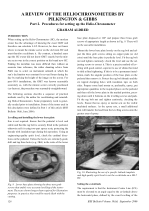
This article provides comprehensive, practical procedures for calibrating and reinstalling Pilkington & Gibbs Helio-Chronometers. It covers essential steps such as precise levelling, accurate co-latitude setting, meridian alignment, and adjustments for the equation of time and longitude, offering detailed guidance for both Northern and Southern Hemisphere models, aimed at owners and restorers.
Dials: Heliochronometer, Equation of Time, Restoration projects, Sundial Design & Layout
September 2006
Page 137
Page 137
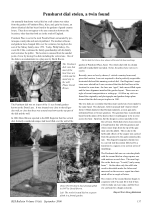
This report details the theft of a distinctive vertical sundial from Penshurst Place in Kent. Coincidentally, an almost identical twin dial was discovered in a private country garden, raising hopes for its potential replication to replace the stolen artifact. The article describes the unique design and features of these large, elegant vertical dials.
Dials: Vertical, Historical Dials, Restoration projects
December 2006
Page 145
Page 145
The editorial summarises the results of a Readership Survey, noting the introduction of solar ephemeris data and ongoing work for new articles. It highlights the importance of BSS members identifying and proposing restoration for old sundials and draws attention to the BSS Grants Policy.
Restoration projects, The BSS and Members
December 2006
Page 172
Page 172
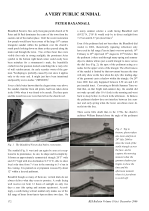
Peter Baxandall details the restoration of the 18th-century triangular sundial on St Peter and St Paul's church in Blandford Forum. The prominent dial, designed by William Bastard, features a unique numerical layout along the base and Aries symbols suggesting an equinoctial line. The restoration, led by Harriet James, preserved its original paintwork and clarified its seasonal indications despite pediment shadows.
Dials: Vertical, Sundial Design & Layout, Restoration projects, Historical Dials
March 2005
Page 15
Page 15
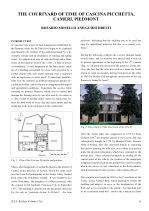
Examines the sundial ensemble in the courtyard of Cascina Picchetta, a 17th-century Italian villa. Analyses six wall-mounted sundials across two façades with varying hour systems (Italian, Babylonian, French, temporary), equatorial orientations, declination corrections, and historical decorative motifs. Explores Jesuit influences and conservation considerations.
Dials: Vertical, Historical Dials, Restoration projects
March 2005
Page 42
Page 42
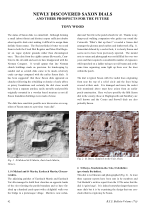
Reports recent identification of likely Anglo-Saxon sundials at English parish churches. Analyses stylistic features such as relief circles, gnomon placement and line patterns. Compares regional examples, explores reuse and church reconstructions, and discusses prospects for future discoveries, preservation strategies and scholarly classification.
Dials: Mass Dials, Historical Dials, Restoration projects
December 2005
Page 160
Page 160
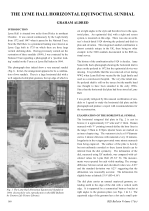
This article details the discovery and reconstruction of a unique 1683 combined horizontal equinoctial sundial at Lyme Hall. The author describes deciphering the inscription "R Legh 1683," examining its robust bronze construction and innovative two-hole sight/screen system. The article also explores the dial's historical context, its owner Richard Legh, and a possible link to George Gibbs's Helio-Chronometer.
Dials: Equatorial, Dials: Horizontal, Dials: Unusual, Historical Dials, Restoration projects, Sundial Design & Layout
September 2004
Page 96
Page 96
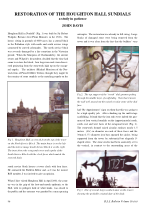
Account of discovering four large vertical dials on an octagonal cupola, surveying gnomon positions, choosing vitreous-enamel steel faces, manufacturing setbacks (overseas enamelling) and the final installation with alignment and conservation choices.
Dials: Multi Faced, Dials: Vertical, Restoration projects
September 2004
Page 105
Page 105
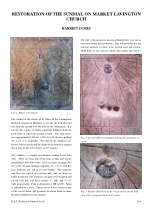
Conservation report for an east-declining carved sandstone dial: cleaning, uncovering original fixing holes, mortar repairs, paint-infill of hour lines and fitting a new brass gnomon; includes measured declination and assessment of layout inaccuracies.
Dials: Vertical, Historical Dials, Restoration projects
December 2004
Page 163
Page 163
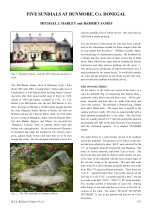
Survey of five McClintock sundials at Dunmore estate, including the 1843 Melville slate dial and its 2003 restoration, the 1936 vertical dial, the 1939 heliochronometer, construction details, inscriptions, and the estate's dial-making history.
Dials: Heliochronometer, Dials: Horizontal, Dials: Multi Faced, Historical Dials, Restoration projects
June 2003
Page 47
Page 47
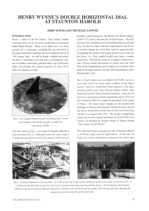
An analysis of one of the most sophisticated 17th-century dials made by Henry Wynne. The article describes the history, features (including its use as a moondial, star dial, and geographical dial), and modern restoration efforts of this large bronze dial.
Dials: Double Horizontal, Historical Dials, Restoration projects
December 2002
Page 167
Page 167
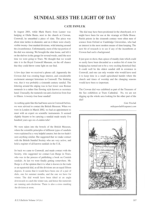
Announcement and brief description of a sundial installed in a school setting, promoting educational and public engagement.
Dials: Horizontal, Restoration projects
September 2001
Page 117
Page 117
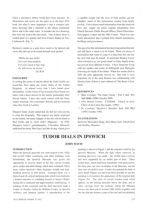
This article details the discovery of an earlier pair of wooden Tudor sundials hidden beneath later ones during demolition at Smart's Wharf in Ipswich. The original dials, dating around 1600, featured a "Protestant work ethic" motto. Analysis revealed the replacement dials were more accurate and likely installed in the mid-1700s, showcasing the efforts made to maintain dial accuracy.
Dials: Vertical, Historical Dials, Restoration projects
December 2001
Page 156
Page 156
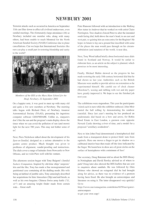
This report covers the well-attended BSS meeting at Newbury. Presentations included astronomy software, 'Spot-on-Sundial' development, and a 'Sundial Seekers Companion' kit. Updates were given on dial restoration. Exhibitions showcased diverse designs, including a rainbow dial, a hemispherical dial made from a bird feeder, and an electronic biscuit box sundial. Various other dials, a nocturnal, and calendars were also displayed.
Dials: Unusual, Restoration projects, Sundial Design & Layout, The BSS and Members
February 2000
Page 32
Page 32
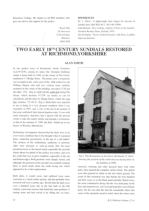
Description of restoration of two historical sundials and their historical and technical features.
Historical Dials, Restoration projects
February 1999
Page 23
Page 23
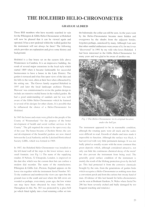
This article details the restoration and reinstallation of the Pilkington & Gibbs Helio-Chronometer at Holehird. It recounts its history, its protection by a glass bell jar, and the innovative security measures implemented for its current display, allowing it to accurately tell time for another century.
Restoration projects, Historical Dials, Dials: Heliochronometer
June 1999
Page 55
Page 55
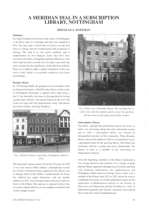
This article describes a rare 1834 meridian dial in Nottingham's Bromley House Subscription Library. It features a brass strip on the first floor, which was covered for 150 years. The dial was used to ascertain Local Apparent Noon and is complemented by two longcase clocks with inscribed time differences. Efforts are underway for its partial restoration, noting its excellent condition in fine surroundings.
Dials: Noon Lines, Historical Dials, Restoration projects
June 1999
Page 98
Page 98
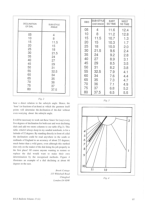
Details the restoration of the author's first vertical east declining sundial, originally made in 1986. It describes the process of stripping old paint, repainting, and redrawing the dial face with hour, equinox, and solstice lines. Challenges in transferring designs and painting fine lines are discussed, along with the decision to use black numerals for better contrast and adding a computer-drawn Equation of Time graph.
DIY Sundial Projects, Dials: Vertical, Restoration projects, Sundial Design & Layout
October 1999
Page 107
Page 107
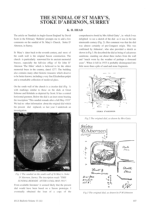
This article discusses the sundial at St Mary's Church, Stoke D'Abernon, a 7th-century Saxon church. It details the 1933 remaking of the dial after a fall, based on pre-Conquest prototypes shown in 19th-century sketches. The current replica is believed to be unique as the only known Saxon dial replica on a church wall in the UK, with markings consistent with an octaval system.
Dials: Mass Dials, Historical Dials, Restoration projects
February 1998
Page 22
Page 22
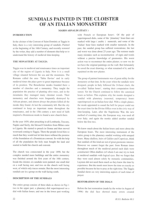
Survey of painted dials in a monastery cloister at Taggia (Imperia), noting multiple faces, canonical hours and decorative treatments, with historical context and observations on preservation.
Dials: Vertical, Historical Dials, Restoration projects
June 1998
Page 2
Page 2
This article discusses the different approaches to problems of conservation and restoration of sundials in Britain and continental Europe. It also touches on the upcoming tenth anniversary of the British Sundial Society and suggests celebrating with colour photographs in the Bulletin.
Restoration projects, The BSS and Members
June 1998
Page 26
Page 26
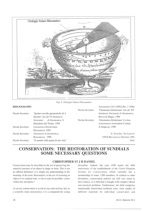
An article that defines conservation and restoration in the context of sundials and highlights the ethical and practical difficulties. It discusses the British Sundial Society's policy on the matter and the cautious approach of conservators.
Restoration projects
June 1998
Page 33
Page 33
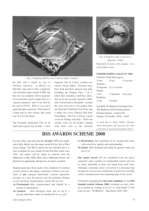
This announcement outlines the new categories for the BSS awards for sundials. It details the classes for professional, amateur, restoration, and junior dials, with an emphasis on the honour of the award itself.
Restoration projects, Sundial Design & Layout, The BSS and Members
October 1998
Page 9
Page 9
This article outlines the British Sundial Society's policy on restoration and conservation of sundials. It defines terms like restoration, conservation, and replacement, and specifies BSS involvement, advising on accurate restoration while avoiding legal liability. The policy discourages restoration of Saxon or Mass Dials, prioritising their conservation and detailed recording.
Restoration projects, The BSS and Members
January 1997
Page 16
Page 16
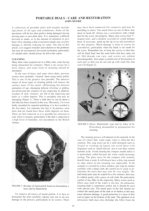
Practical guidance on cleaning, conserving, and restoring portable sundials, including brass, silver, and ivory examples. Covers safe cleaning methods, corrosion prevention, protective coatings, and storage recommendations to preserve both functionality and historical integrity.
Historical Dials, Restoration projects
October 1997
Page 8
Page 8
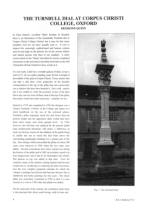
This article describes the Turnbull Dial at Corpus Christi College, Oxford, a 26-foot pillar featuring a total of 27 dials. Designed in 1579-1583 by Charles Turnbull, it includes a principal south-facing dial, a perpetual calendar, tables for planetary years and lunar months, and moon-time corrections. The dials use the old unequal hour system, and the pillar has undergone several restorations.
Dials: Multi Faced, Dials: Scaphe, Historical Dials, Restoration projects
June 1995
Page 36
Page 36
An article about recreating historical sundials using modern methods, reflecting on the balance between authenticity, materials, and function.
Dials: Equatorial, Dials: Portable, Restoration projects
February 1994
Page 2
Page 2
Editorial discussing international sundial publications, restoration challenges, multilingual gnomonic vocabulary, and reports from Roumania and Sarajevo.
Restoration projects, The BSS and Members
February 1994
Page 35
Page 35
Addresses deterioration of stone materials used in sundials and buildings. Covers environmental impacts, stone types, and conservation strategies.
Restoration projects
June 1994
Page 20
Page 20
Describes the reconstruction of a historically inspired sundial, elaborating on how its design was refined for accuracy and visual appeal. The piece combines historical research with practical insights, showing how ancient ideas can be adapted into educational tools and display dials for modern audiences.
Restoration projects
October 1994
Page 10
Page 10
This article details the history and restoration of the Gate of Honour at Gonville and Caius College, Cambridge, which features six sundials. It covers the gate's construction, early repairs and repainting efforts, and its decay over centuries due to porous stone and vandalism. The focus shifts to the 1958-1959 quatercentenary restoration, during which the original painted dials were replaced with expensive bronze plates with enamel fillings. The article also mentions a separate pillar in Caius Court that once housed sixty dials, emphasizing the craftsmanship and decorative nature of these historical timepieces.
Dials: Multi Faced, Historical Dials, Restoration projects
October 1993
Page 2
Page 2
This article details the restoration of a unique astronomical chronogram sundial in Rouffach, France, dating from the early 17th century. It describes the fresco's depiction of planetary orbits based on Ptolemy and Tycho Brahe, highlighting challenges in deciphering faded inscriptions and the astrological significance of a lunar eclipse on the original dial's date in 1617.
Dials: Unusual, Dials: Vertical, Historical Dials, Restoration projects, Sundial Design & Layout
October 1993
Page 24
Page 24
This article tells the story of a sundial from the Neptune Shipyard in Walker, Newcastle-on-Tyne, founded by J. Wigham Richardson in 1860. It traces the dial's history, its motto, and its eventual restoration. The article highlights Richardson's skill as a geometrist and the involvement of his partner, Denham Christie, and describes the dial's characteristics and its journey to the Trinity Maritime Centre.
Dials: Vertical, Historical Dials, Restoration projects
October 1993
Page 32
Page 32
This article explores the rapid deterioration of ancient sundials in the British Isles, attributing decay to factors like stone quality and water-induced damage. It discusses examples like the Bewcastle Cross sundial and the importance of protection and restoration. The article highlights the British Sundial Society's aims in cataloguing and preserving historical artefacts to prevent their complete loss.
Dials: Mass Dials, Historical Dials, Restoration projects, The BSS and Members
June 1992
Page 36
Page 36
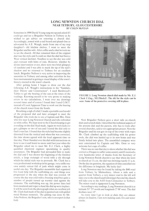
This account describes the restoration of a West vertical decliner church dial at Long Newnton, Gloucestershire, initiated by Brigadier Neilson. Colin McVean assisted in redrawing the dial, correcting for local apparent time, and creating a card model. Mr. E.J. Clark then professionally crafted the painted oak dial with gilded Roman numerals, which was successfully erected and confirmed to be accurate.
Dials: Vertical, Restoration projects
October 1991
Page 5
Page 5
This article, originally by Reverend T.W. Cole, discusses 'incised sundials' (scratch or mass dials) found on church stonework in England from Saxon times to the 18th century. It traces their evolution from small, simple markings to larger, more prominent and scientifically designed dials, and highlights early attempts at accuracy, different time systems, and the preservation efforts for these historical artifacts. It also mentions key figures like Dom Ethelbert Horne and A.R. Green.
Restoration projects, Historical Dials, Dials: Mass Dials
October 1990
Page 4
Page 4
This is a notice for a meeting on 10th November 1990 in Crowthorne, Berkshire. Doug Bateman will speak on the restoration of a vertical declining dial with an analemma at Dial House, and Christopher St. J. Daniel will discuss its original maker, Joseph Alfred Hardcastle.
Dials: Vertical, Historical Dials, Restoration projects