- Home
- /
- Sundial Encyclopaedia
- /
- Irene Brightmer
Irene Brightmer
June 2023
Page 24
Page 24
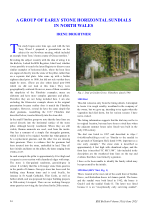
Investigates a distinctive group of early stone horizontal sundials in the former county of Flintshire, North Wales, dating from 1588 to 1637. These dials are characterised by having hour lines carved directly into the surface of the stone pillar (likely Gwespyr stone) and may be derived from cut-down churchyard crosses.
Dials: Horizontal, Dials: Unusual, Historical Dials
March 2022
Page 21
Page 21
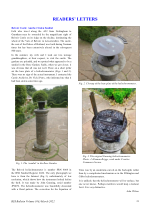
A collection of three letters: John Wilson reports on the theft of a Gunning heliochronometer from Belvoir Castle. Irene Brightmer investigates whether the maker of her 1812 slate dial, Griffith Dafydd, is the same person as Griffith Davies FRS, maker of a prize-winning 1820 dial. Kevin Karney provides a correction on the naming of his 'spider dial'.
Dials: Heliochronometer, Historical Dials, Sundial Design & Layout
December 2022
Page 16
Page 16
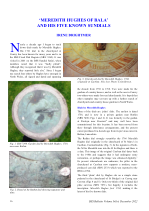
Research into the 18th-century Welsh dial maker, Meredith Hughes, a land surveyor and scientist. Describes his five known dials, including two complex ones incorporating the Equation of Time and geographical features, possibly outsourced for engraving.
Dials: Horizontal, Dials: Unusual, Equation of Time, Historical Dials
September 2021
Page 32
Page 32
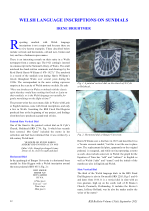
Examines the scarcity of Welsh language inscriptions on sundials, listing and describing nine known examples. Examples include historical vertical and horizontal dials, detailing their locations (Holyhead, Penmorfa, Whitford) and mottoes, such as "Man’s life, though prolonged it may / Draws to its close by night and day".
Historical Dials, Mottoes
September 2021
Page 43
Page 43
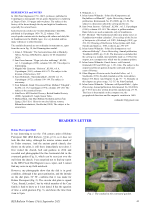
A letter describing a horizontal sundial found in the courtyard garden of Holme Pierrepont Hall. The dial plate is signed "Cary, Strand, London," shows the latitude 52° 58ʹ, and includes the equation of time. The author notes the challenge in dating the dial precisely due to the lack of a date and multiple Cary family makers.
Dials: Horizontal, Equation of Time, Historical Dials
June 2020
Page 8
Page 8
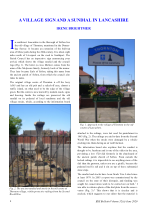
This article describes the ancient, Jacobean sundial in Thornton, Lancashire, which is featured on the village sign and stands near the old village stocks. The dial is Grade Two Listed, but its cracked plate and heavy patina obscure the maker and date. Repairs were undertaken on the stocks, but the sundial itself remains untouched since 1891.
Dials: Horizontal, Historical Dials, Restoration projects
December 2017
Page 21
Page 21
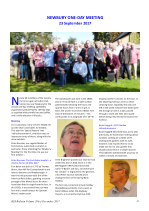
A detailed report on the BSS one-day meeting, summarising talks on topics including the Fort Belan sundial, DIY heliochronometers, multi-centre delineation, promotion via social media, the astronomical Culpeper dial, the Gnomonical Universal Nomograph (GUN), and the mechanical generation of the Equation of Time using equation clocks.
Dials: Heliochronometer, Equation of Time, Historical Dials, The BSS and Members
June 2015
Page 41
Page 41
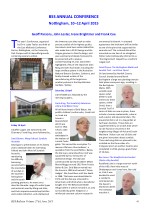
A comprehensive report on the conference sessions, including talks on Australian sundials, the history of Enid Blyton's dial, the Burlingham Sundial Trail, Mike Groom's heliochronometer, and site visits to Bromley House Library and Green's Mill.
Construction Projects, Historical Dials, The BSS and Members
June 2014
Page 15
Page 15
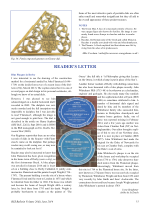
Notes the recent unveiling of blue plaques in Derby commemorating John Flamsteed, the first Astronomer Royal, and John Whitehurst FRS, a renowned clockmaker and sundial maker. It highlights their historical connection, as Whitehurst later occupied a house formerly owned by Flamsteed.
Historical Dials, The BSS and Members
December 2014
Page 27
Page 27
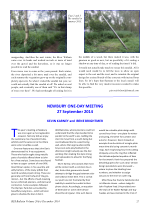
A summary of the Newbury BSS meeting, covering diverse topics including David Brown's talk on commission pitfalls and Kevin Karney's push for mean time dials incorporating the Equation of Time. Frank King reported on historical dials at the Bodleian Library. Attendees viewed the Druid helical mean-time dial at Bayford House Care Home.
Equation of Time, Historical Dials, Sundial Design & Layout, The BSS and Members
June 2010
Page 16
Page 16
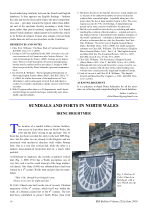
This article explores three instances of sundials located within former fortifications in North Wales. It describes a recently repainted vertical dial on St Cybi’s Church in Holyhead, a modern cast dialplate at St Mary’s churchyard in Caerhun, and a vertical declining dial from 1898 at Fort Belan.
Dials: Horizontal, Dials: Vertical, Historical Dials
September 2010
Page 46
Page 46
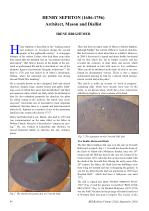
This article examines Henry Sephton, an 18th-century Liverpool architect and mason, as a significant provincial diallist. It describes several dials attributed to him, including signed double horizontal dials at Croxteth Hall and Knowsley Hall, a horizontal dial at Ince Blundell Hall, vertical dials on churches, and two globe dials, highlighting his characteristic transversals and artistic style.
Dials: Horizontal, Construction Projects, Historical Dials, Dials: Double Horizontal
June 2008
Page 60
Page 60
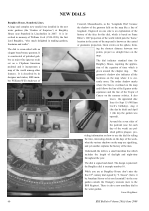
This section introduces new sundials, including the 'Longitude Dial' at Burghley House, designed by William Andrewes, which incorporates a world map and indicates standard time and noon locations. It also describes a brass sundial made by Valery Dmitriev in Russia, designed in a traditional English style using CNC milling.
Dials: Horizontal, Sundial Design & Layout
June 2008
Page 99
Page 99
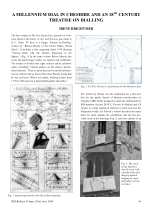
This article links a new millennium sundial at Marbury-cum-Quoisley church in Cheshire, designed by Dr W.E. Flewett and adjusted for longitude and British Summer Time, to an 18th-century treatise by Robert Moody. It also discusses William Emerson, a mathematician and diallist whose work influenced Moody and the millennium dial.
Construction Projects, Historical Dials, Mathematics of Dialling, Sundial Design & Layout
September 2008
Page 116
Page 116
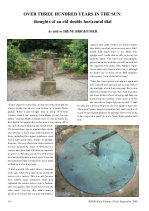
This article, narrated from the perspective of a 17th-century double horizontal dial by John Marke in a North Wales garden, recounts its history. It reflects on its past importance for timekeeping, its relocation, slight misalignment, and a recent renewed interest in its preservation, highlighting its rarity and unique survival.
Dials: Double Horizontal, Historical Dials, Restoration projects
September 2008
Page 118
Page 118
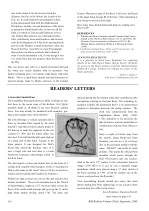
Irene Brightmer shares details of a vertical surrealist sundial by Salvador Dalí in Paris, featuring a blue-eyed female face. She also describes two historic meridians nearby: one in the Church of Saint-Sulpice, commissioned from Henry Sully, and the official Paris meridian marked by over a hundred Arago medallions.
Dials: Noon Lines, Dials: Unusual, Dials: Vertical, Historical Dials
December 2008
Page 168
Page 168
Reviews two books: Les Méridiennes du Monde et Leur Histoire by Andrée Gotteland (2 volumes, 850 meridians in 24 countries, including midday canons and industrial meridians) and Mass Dials On Yorkshire Churches by Alan Cook (monograph on 83 churches with mass dials, discussing variations and survival rates, well-illustrated).
Book Reviews
June 2007
Page 50
Page 50
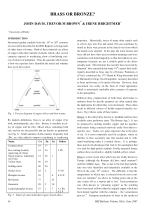
This article explores the material composition of historical horizontal garden sundials, specifically distinguishing between brass and bronze alloys. It discusses the challenges of visual identification due to patination and details an X-ray analysis method used to determine the actual metallic composition of dial samples.
Historical Dials
September 2007
Page 113
Page 113
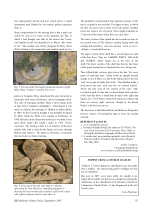
A brief note from a church leaflet describes a medieval churchyard cross in Llanarmon, North Wales, that was converted into a sundial in 1772 for three shillings. Sadly, the sundial has since disappeared, leaving the cut-down cross bare in the churchyard.
Historical Dials