- Home
- /
- Sundial Encyclopaedia
- /
- June 1992
June 1992
The articles link to the specific page in a PDF optimised for speed. If you want the whole issue, you can download it here, but the files from earlier years can be quite large.
June 1992
Page 1
Page 1
This section provides updates from various gnomonic societies including the Catalan Society of Gnomonics, the Austrian Astronomical Association's Sundial Group, the Unione Astrofilo Bresciani, and Der Zonnewijzerkring. It also includes errata for a previous bulletin article, detailing corrections for 'Sundial Alignment by the use of the Pole Star'.
The BSS and Members
June 1992
Page 2
Page 2
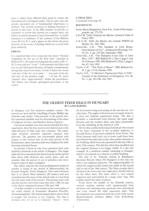
This article outlines the few medieval sundials remaining in Hungary, many destroyed by wars and church rebuilding. It describes early canonical sundials with primitive divisions, including a twelve-division dial at Matraverabely and a Gothic dial at Szentendre. A unique medieval dial not on a church is found in Kaszeg, and St. Nicholas church in Rudabanya has a dial marking prayer times.
Dials: Mass Dials, Historical Dials
June 1992
Page 3
Page 3
This lecture explores the practical aspects of 16th and 17th-century navigation, highlighting the crucial role of sundials and similar instruments for determining time at sea. Mariners used celestial observations for latitude, magnetic compasses for direction, and various tools like traverse boards, sand-glasses, nocturnals, astrolabes, and cross-staves for navigation and timekeeping.
Dialling Tools, Dials: Portable, Historical Dials, Dials: Nocturnals
June 1992
Page 8
Page 8
This entry reflects on the British Sundial Society's Council meetings, emphasising their light-hearted yet serious discussions. It also provides an update on the 1992 Annual General Meeting, welcoming new council members like Mr. R.A. Nicholls (Treasurer) and Mr. Robert Sylvester (Membership Secretary), and thanking retiring members for their significant contributions to the Society.
The BSS and Members
June 1992
Page 9
Page 9
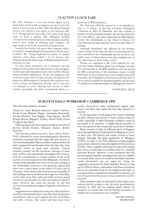
This article reports on the British Sundial Society's participation in the Clacton Clock Fair in May 1992. Mr. D.A. Young and Mr. C.K. Aked displayed items, including sundial cigarette cards and a Singleton helical dial, attracting considerable public interest. The event underscored the general public's limited knowledge about sundials and the need for greater publicity for dialling.
The BSS and Members
June 1992
Page 9
Page 9
This report details a workshop on scratch dials, discussing their origin, enormous variations across regions, and the importance of recording these endangered historical relics. It highlights the need for a specialised recording form and an overall map of existing and known scratch dials across England and Europe due to accelerated damage from atmospheric pollution and vandalism.
Dials: Mass Dials, Historical Dials
June 1992
Page 10
Page 10
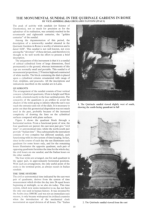
This article describes a unique monumental cubical-cylindrical sundial from 1628 in Rome's Quirinale Gardens, 2.70 meters high, constructed of white marble. It features four concave quadrants indicating both civil/astronomical time and 'Italian time,' reflecting different timekeeping systems. The dial also includes zodiacal curves for calendrical indications and intricate Latin inscriptions from its author Theodosius Rubeus and patron Urbano VIII Barberini.
Dials: Cube, Dials: Multi Faced, Dials: Unusual, Historical Dials
June 1992
Page 17
Page 17
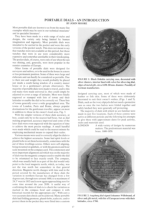
This introduction to portable sundials describes them as early pocket watches, popular in sunnier regions of Europe, offering an affordable alternative to unreliable mechanical watches. It covers various designs, materials, and geographical manufacturing centres like London, Paris, Dieppe, Augsburg, and Nuremburg. The article also discusses their alignment aids, particularly magnetic compasses, and dating by magnetic variation.
Dials: Portable, Historical Dials
June 1992
Page 19
Page 19
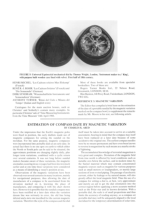
This article explains how magnetic compass deviation, which varies over time and location, can be used to estimate the date of manufacture for portable sundials incorporating compasses. It discusses historical records of magnetic variation and how these can be compared with the deviation marked on a compass bowl. Local conditions affecting magnetic fields, and the need for accurate observations are noted.
Dials: Portable, Historical Dials
June 1992
Page 21
Page 21
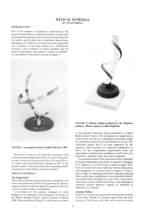
This article introduces helical sundials as a variation of the equatorial dial, where the receiving surface extends axially along the gnomon in a helix. It describes a prototype by John Singleton, a monumental example in Lerida by J. Masuet, and Piet Hein's design at Egeskov Castle. There are two types: the first has a gnomon casting its shadow, the second uses the shadow cast by the other part of the helical strip. The article explains their operation, with the light/dark boundary marking time and hour markings set by the pitch.
Dials: Equatorial, Dials: Unusual, Sundial Design & Layout
June 1992
Page 24
Page 24
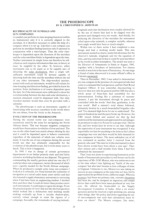
The phoeboscope is presented as a self-sufficient instrument combining time-keeping, meridian-finding, and calendrical functions by detecting solar declination. Designed during WWII as an improvement of the existing sun-compass, its adoption was frustratingly held up in bureaucracy until too late to be useful. It uses a lens to focus sunlight onto a shadow-plate engraved with an analemma, allowing accurate determination of time, meridian, and date anywhere in the world without a watch or almanac.
DIY Sundial Projects, Dials: Heliochronometer, Dials: Unusual, Equation of Time
June 1992
Page 30
Page 30
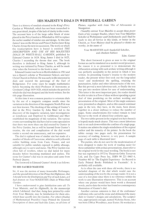
This article details the large cubic sundial erected in Whitehall's Privy Garden in 1622 for King James I, replacing an earlier Caen stone dial. Based on Edmund Gunter's 1624 treatise, it describes the intricate design with multiple dials, including a great horizontal concave. The dial's use led to the discovery of magnetic variation, and its sculptor was Nicholas Stone.
Dials: Cube, Dials: Multi Faced, Historical Dials
June 1992
Page 36
Page 36
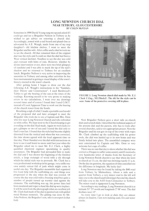
This account describes the restoration of a West vertical decliner church dial at Long Newnton, Gloucestershire, initiated by Brigadier Neilson. Colin McVean assisted in redrawing the dial, correcting for local apparent time, and creating a card model. Mr. E.J. Clark then professionally crafted the painted oak dial with gilded Roman numerals, which was successfully erected and confirmed to be accurate.
Dials: Vertical, Restoration projects
June 1992
Page 37
Page 37
This article describes the development of the 'Make a Sundial' educational book by a British Sundial Society group, initiated in response to the National Curriculum requiring primary children to understand and construct sundials. The book, produced using desktop publishing, offers projects for constructing sundials from common materials, suitable for various educational levels.
How Sundials Work, Book Reviews, DIY Sundial Projects, The BSS and Members
June 1992
Page 38
Page 38
This article explores the concept of a tidal dial for estimating tidal times, acknowledging the moon's primary influence on tides over the sun. It discusses the 'Port Establishment' and 'Lunar Situation,' and how a specially designed watch or optical sight, combined with knowledge of the moon's age, could provide approximate tidal information globally, even correcting for hydrographic board errors.
Dials: Unusual, Dials: Nocturnals
June 1992
Page 41
Page 41
This review evaluates Lawrence N. Price's book on scratch dials in North West Somerset. It criticises the book for adding few new insights to the subject, instead relying on previous works by Horne and Green. The reviewer argues that scratch dials are merely event markers, not precise timekeepers, and stresses the importance of their identification and recording due to modern atmospheric damage.
Book Reviews, Dials: Mass Dials, Historical Dials