- Home
- /
- Sundial Encyclopaedia
- /
- December 2015
December 2015
The articles link to the specific page in a PDF optimised for speed. If you want the whole issue, you can download it here, but the files from earlier years can be quite large.
December 2015
Page 1
Page 1
Discussion of the current issue's mixed content, noting a dominance of Scottish locations, and a reminder to readers to vote for the "most enjoyed article in the four 2015 issues." The result will be announced at the 2016 BSS Conference in Liverpool.
The BSS and Members
December 2015
Page 2
Page 2
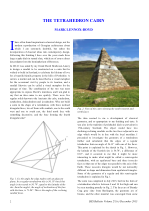
Describes the design and construction of a 9–10 foot high tetrahedron-shaped cairn in Perthshire, Scotland, commissioned by David Heathcoat-Amory. It incorporates two declining reclining sundials and aligns its north edge and gnomons with the Earth's axis.
Construction Projects, Dials: Multi Faced, Dials: Unusual, Sundial Design & Layout
December 2015
Page 5
Page 5
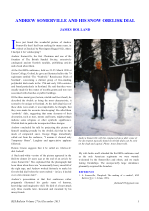
Recounts the life of Andrew Somerville, first Chairman of the BSS, known for cataloguing ancient Scottish polyhedral dials. It describes his talk on "symbolic" dials and the humorous anecdote surrounding the temporary snow obelisk dial he constructed.
Dials: Multi Faced, Dials: Unusual, Historical Dials, The BSS and Members
December 2015
Page 6
Page 6
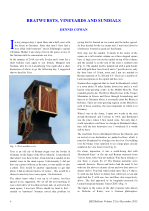
An account of a trip through Germany, specifically Trier and the Moselle wine region, detailing visits to five sundials. Dials included the Trier market cross dial, the Cusanus glass dial in Bernkastel-Kues, and various vertical dials in Wehlen, Zeltingen, and Urzig.
Dials: Horizontal, Dials: Vertical, Historical Dials
December 2015
Page 9
Page 9
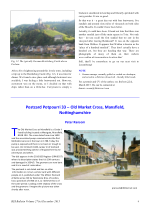
Describes a postcard showing the Old Market Cross at Mansfield, Nottinghamshire, a Grade II listed building dating from circa 1600. It notes the dial's 19th-century origin, damage (bent gnomons), and need for restoration according to the BSS Register.
Dials: Vertical, Dials: Multi Faced, Historical Dials
December 2015
Page 10
Page 10
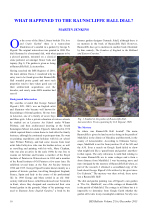
Investigates the horizontal dial shown in a 1908 watercolour by George S. Elgood, supposedly located at Raunscliffe Hall, Leicestershire. The mystery reveals that Elgood intentionally used misleading names for his own garden dial at 'The Cot, Markfield' to secure family privacy.
Dials: Horizontal, Historical Dials
December 2015
Page 12
Page 12
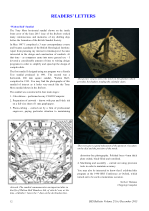
Includes three letters: Norbert Halama discusses his horizontal ‘Walton Hall’ dial; Alison Morrison-Low details James Clark’s horizontal Niddrie Marischal dial, now missing; Dennis Cowan updates on the failed Kirktonhall Project and clarifies the modern Dunphail obelisk dial's origin.
Dials: Horizontal, Construction Projects, Historical Dials
December 2015
Page 14
Page 14
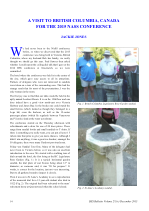
A report on the 2015 NASS Conference in Victoria, BC, Canada, which included presentations on gnomonics and sundial tours. The tour featured several dials, including the Orca totem dial and the impressive Ogden Point analemmatic dial.
Dials: Analemmatic, Dials: Horizontal, Dials: Vertical, The BSS and Members
December 2015
Page 18
Page 18
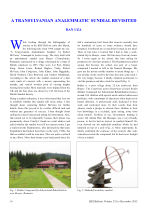
Describes the author's search for an analemmatic sundial near Braşov, Romania, built by British volunteers in 1993. Although wooden posts are gone, the concrete date scale mosaic was found at the Brădet Compound, and the manager intends to restore the dial.
Construction Projects, Dials: Analemmatic, Restoration projects
December 2015
Page 20
Page 20
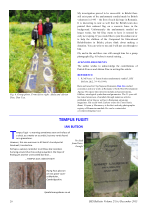
A short conversational piece reflecting on the motto "Tempus Fugit" (Time Flies), which is seen on clocks and sundials. It notes its rare appearance on a gravestone in Greetwell, Lincolnshire, serving as a reminder to dial recorders.
Mottoes
December 2015
Page 21
Page 21
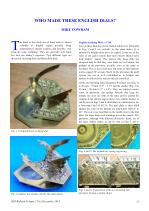
Investigates several unsigned English brass dials, suggesting they might originate from the same provincial workshop around 1740. Discusses similarities between inclining dials and oval Butterfield dials, noting manufacturing irregularities in an octagonal dial.
Dials: Portable, Mathematics of Dialling, Historical Dials
December 2015
Page 23
Page 23
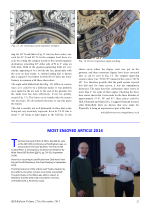
Announcement that Mike Shaw won the Most Enjoyed Article of 2014 award for his piece on ‘The Eaton Hall Sundial Pillar’. It is noted that the pillar, which had been previously misaligned, was finally corrected.
The BSS and Members
December 2015
Page 24
Page 24
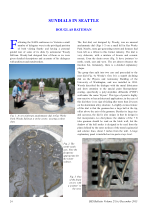
Recounts a guided tour of Seattle dials following the NASS conference, featuring four dials designed by Woody Sullivan. Highlights include an elaborate analemmatic dial in Gas Works Park, a vertical declining dial at UW, and the earliest Seattle dial dating from 1909.
Dials: Analemmatic, Dials: Equatorial, Dials: Vertical, The BSS and Members
December 2015
Page 27
Page 27
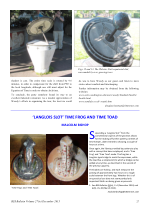
Describes the creation of pottery time-keepers shaped like a frog and a toad. These novel, hollow pieces incorporate a ‘Langlois Slot’ or bridge to mark the equinoxes, measuring the passing of approximately two hours on a rough scale.
DIY Sundial Projects, Dials: Unusual
December 2015
Page 28
Page 28
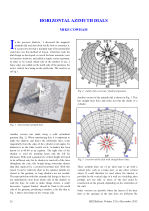
Discusses the construction and layout of horizontal azimuth dials, which use a vertical cylindrical gnomon instead of a polar-aligned one. Various decorative shapes and layouts are explored, noting the complexity of reading the time compared to normal horizontal dials.
Dials: Horizontal, How Sundials Work, Sundial Design & Layout, DIY Sundial Projects
December 2015
Page 32
Page 32
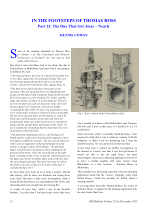
Details the successful search for the missing Polton House dial, originally sketched by Thomas Ross, which had been incorporated into a rockery. Parts of the dial (dating 1685 and 1672) were discovered and re-erected at Arniston House, Midlothian.
Dials: Multi Faced, Historical Dials, Restoration projects
December 2015
Page 35
Page 35
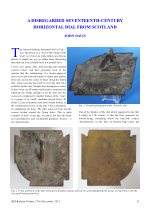
Describes a battered brass horizontal dial acquired via auction, dating to the 17th century based on inward-facing numerals and hammered plate thickness. Discusses its specialized cast gnomon and metallurgy, suggesting a Glasgow–Edinburgh origin.
Dialling Tools, Dials: Horizontal, Historical Dials
December 2015
Page 37
Page 37
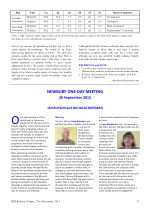
A report on the annual BSS Newbury meeting featuring various talks and exhibits. Highlights include Irene Brightmer’s discovery of a globe dial within a stone sphere, Martin Jenkins' DIY garden projects, and Frank King's demonstration of an umbrella as an astronomical instrument.
DIY Sundial Projects, Dials: Hemispherical, Dials: Unusual, The BSS and Members
December 2015
Page 40
Page 40
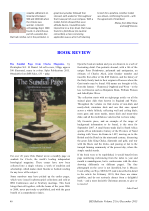
Review of "The Sundial Page from Clocks Magazine" by Christopher St J. H. Daniel. This volume collects over 20 years of monthly essays on sundials, praised for its erudition, comprehensive index, and wide range of content on dials and related history.
Book Reviews, Historical Dials
December 2015
Page 41
Page 41
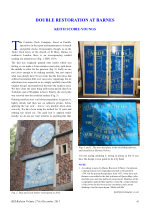
Describes the restoration work on the sundial (and accompanying clock) on the Tudor brick tower of St Mary, Barnes. The deteriorating painted dial was replaced with a 2 mm stainless steel plate, traced from the original design, etched, and traditionally painted and gilded.
Dials: Vertical, Restoration projects
December 2015
Page 42
Page 42
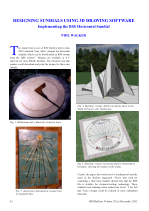
Explains how 3D drawing software (Trimble's Sketchup Make) can be used for sundial design and virtual shadowing. Details the process of creating a physical BSS horizontal dial using a laser-etched plastic plate and a 3D printed gnomon from Shapeways.
DIY Sundial Projects, Dials: Horizontal, Sundial Design & Layout
December 2015
Page 44
Page 44
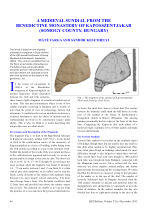
Analysis of a stone fragment found at a Benedictine monastery excavation, identified as a medieval vertical sundial. Its hour lines are nearly equiangular, suggesting monastic or temporal timing, and it is dated to the late 15th or early 16th century, before 1555.
Dials: Vertical, Historical Dials, Mathematics of Dialling
December 2015
Page 48
Page 48
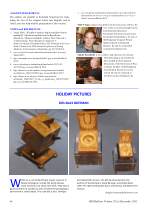
Features photographs of sundials encountered during a visit to the clock museum at La Chaux-de-Fonds in Neufchatel. Specific examples shown include an 18th-century cube dial by D. Beringer and 17th and 18th-century pocket dials.
Dials: Multi Faced, Dials: Portable