- Home
- /
- Sundial Encyclopaedia
- /
- Chris Lusby Taylor
Chris Lusby Taylor
December 2021
Page 13
Page 13
Explores the use of laser scanners and point clouds as a revolutionary method for surveying and designing sundials, accurate to a few millimetres. The technique was used on the Fleet Street dial to determine precise coordinates, declination, and inclination, allowing designers to calculate hour lines and model shadows regardless of surface irregularities.
Construction Projects, Dialling Tools, Mathematics of Dialling, Sundial Design & Layout
December 2020
Page 48
Page 48
Chris Lusby Taylor provides research into Thomas Stringer, the dedicatee of a book referred to in a previous Bulletin. Stringer was steward to the Earl of Shaftesbury and was knowledgeable about sundials, dividing them into Astronomical, Italick, Babilonick, Antient, or Judaick hours.
How Sundials Work, Historical Dials
June 2015
Page 46
Page 46
A report outlining the Society’s activities, including celebrating the Silver Jubilee, improving the website interface (Bridol operational), holding educational workshops at Cheney School, implementing the CIO status change, and acknowledging member participation.
The BSS and Members
June 2012
Page 48
Page 48
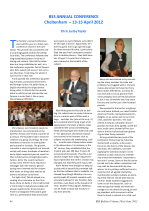
This report summarises the British Sundial Society's annual conference in Cheltenham. It covers various talks including Allan Mills on the Gaocheng Observatory, Kevin Karney on sundial software, Johan Wikander on Norwegian horizontal dials, and presentations by David Brown and Tony Moss on their dial designs. The conference also featured a discussion forum on the Society's future and a tour of local dials.
DIY Sundial Projects, Historical Dials, Sundial Design & Layout, The BSS and Members
June 2010
Page 31
Page 31
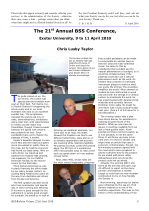
This report summarises the British Sundial Society's 21st annual conference, highlighting the positive weather and successful organisation by Patrick Powers. It details various talks and demonstrations, including stone carving and lettering by Ben Jones, sundials as aeolian harps by Allan Mills, unequal hour lines by Fred Sawyer, and mass dial prevalence by Chris Williams. The conference also featured a sundial tour and dinner.
The BSS and Members
September 2009
Page 21
Page 21
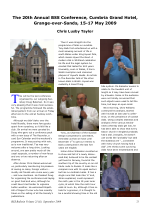
A detailed report on the 20th annual BSS conference. The article summarises the programme of talks, which covered topics such as early Norwegian dials, the prevalence of scratch dials, equant dials, and the Equation of Time. It also describes the conference outing to Holker Hall and Hawkshead, and other social events.
The BSS and Members
September 2009
Page 46
Page 46
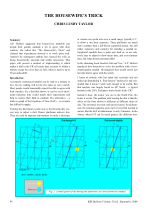
Re-evaluates A.P. Herbert's suggestion of turning a horizontal sundial to make it agree with mean time. While previously dismissed as inaccurate, this article presents a theoretical analysis and a practical implementation showing that, for UK latitudes, the 'trick' can keep the dial accurate to within a minute for most of the year.
Dials: Horizontal, Equation of Time, How Sundials Work, Mathematics of Dialling
June 2008
Page 77
Page 77

This report summarises the 2008 BSS Annual Conference at Latimer, highlighting various talks including Piers Nicholson on Jantar Mantar, Chris Williams on scratch dial statistics, Fred Sawyer on Michnik's bifilar sundial, Celia James on James Richard's dial, Julian Lush on Armenian scallop dials, and John Davis on John Rowley's work.
Dials: Bifilar, Historical Dials, Sundial Design & Layout, The BSS and Members
March 2007
Page 9
Page 9
This section contains correspondence from readers. Chris Lusby Taylor discusses the use of Hooke’s joint for delineating declining and reclining dials, while Allan Mills replies regarding an error in a previous paper. Tony Ashmore suggests an interpretation for the 'Egyptian Face' design on a sundial pillar at Lord Tennyson's home, attributing it to Ptolemy.
Dials: Unusual, How Sundials Work, Mathematics of Dialling
March 2007
Page 24
Page 24
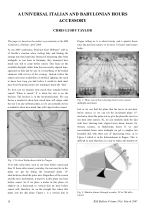
This paper introduces a simple accessory, a three-quarters CD, that can be used with existing horizontal sundials to signify Italian and Babylonian hours. It explains how these hour systems differ from conventional timekeeping and how the accessory allows us to read these hours, using the shadow of the CD.
Dials: Horizontal, How Sundials Work, Dialling Tools, DIY Sundial Projects
June 2007
Page 86
Page 86
This report summarises the 2007 British Sundial Society Annual Conference in Cambridge. It highlights talks on calendar history, the Equation of Time, analemmatic sundials, astrolabes, and beehive sundialling. It also covers walking tours of Cambridge dials, including Pembroke and Queens' Colleges, and the Andrew Somerville Memorial Lecture on calendar accuracy.
Dials: Astrolabe, Historical Dials, How Sundials Work, The BSS and Members