- Home
- /
- Sundial Encyclopaedia
- /
- March 2012
March 2012
The articles link to the specific page in a PDF optimised for speed. If you want the whole issue, you can download it here, but the files from earlier years can be quite large.
March 2012
Page 1
Page 1
This article provides further research on Robert Stikford's manuscript 'De Umbris Versis et Extensis', pushing back its tentative dating from 1396-1401 to potentially the early last third of the fourteenth century based on newly uncovered records of his admission to holy orders.
Historical Dials
March 2012
Page 2
Page 2
This article investigates three London instrument makers named Samuel Saunders from the first half of the 18th century, with no direct family or professional relationships. It focuses on attributing gnomonic instruments to the correct maker through comparative analysis of signatures and engraving styles, and discusses specific horizontal dials.
Dials: Horizontal, Historical Dials
March 2012
Page 7
Page 7
This article describes a new 70 cm diameter stainless steel spherical dial by David Harber, unveiled at Balliol College, Oxford. It celebrates the thirtieth anniversary of women's admission to Balliol and includes features like calendar bands, tropic lines, and moon-dial scales.
Dials: Unusual, Construction Projects, Mottoes
March 2012
Page 8
Page 8
This second part of the article investigates the Canterbury pendant, a 10th-century portable sundial. It compares its graphic layout with the Libellus de mensura horologii and the Roman cylinder dial of Este, exploring the use of two gnomons for different seasons and their relationship to hour curves.
Dials: Portable, Historical Dials, How Sundials Work, Mathematics of Dialling
March 2012
Page 13
Page 13
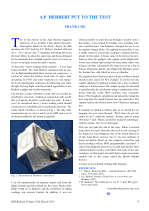
The author tests A.P. Herbert's idea of using a sundial "in reverse" for navigation during a flight to Australia in 1975. He describes making his own "sun clock" and recounts an encounter with a pilot familiar with Francis Chichester's navigation methods, highlighting the practical challenges of such a device.
Dials: Portable, Dials: Unusual, Sundial Design & Layout, DIY Sundial Projects, Historical Dials
March 2012
Page 14
Page 14
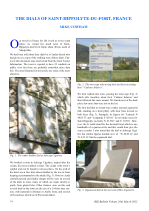
This article describes a walking tour of the 23 (or more) sundials in Saint-Hippolyte-du-Fort, France. It highlights attractive examples, including an equatorial dial, a church dial, and several made by local ceramic artist C. TINGAUD, noting features like 24-hour systems and Provençal mottoes.
Dials: Equatorial, Dials: Vertical, Historical Dials, Mottoes
March 2012
Page 17
Page 17
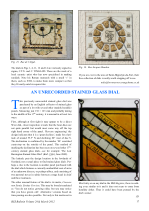
This article details a previously unrecorded 17th-century stained glass sundial. It's unusual for being a "great decliner" made for a latitude in the Scottish lowlands and for its unique motto, which suggests personal authorship rather than a known source.
Dials: Unusual, Historical Dials, Mottoes, Dials: Stained Glass
March 2012
Page 18
Page 18
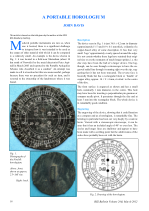
This article examines a medieval copper-based alloy device, found in Norfolk, which functioned as both a compass and a horologium. The fine engraving, including early Gothic lettering and 5° time subdivisions ("mileways"), suggests a 14th-century date and offers insights into medieval timekeeping and connections to local horology.
Dials: Portable, How Sundials Work, Historical Dials
March 2012
Page 23
Page 23
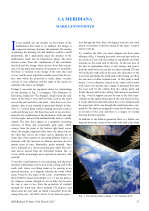
The author describes "La Meridiana," a house in Italy designed with a sundial as its stair tower. This indoor sundial uses projections and reflections onto north, west, and east walls, and the ceiling, to show time and date. The article highlights the mathematics, design, and extensive calibration process.
Construction Projects, How Sundials Work, Mathematics of Dialling, Sundial Design & Layout
March 2012
Page 27
Page 27
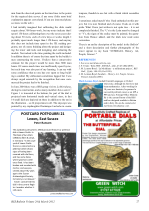
This entry features an undated postcard (c.1930) of a spherical dial at Lewes Castle. It references "The Book of Sun-Dials" (1900) which describes the broken and mended stone ball, noting its unknown history and questioning its current existence.
Dials: Hemispherical, Historical Dials
March 2012
Page 28
Page 28
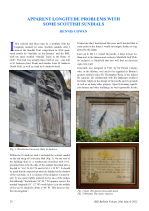
This article investigates "longitude problems" on Scottish sundials from 1877-1913, including those by famous architects. The author discovers that the inscribed "longitude" is actually the time difference from Greenwich, making it more user-friendly for time telling and correcting previous assumptions about design errors.
How Sundials Work, Historical Dials
March 2012
Page 30
Page 30
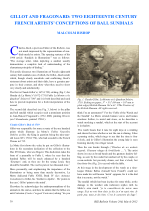
This article discusses two 18th-century French artworks depicting ball sundials: Claude Gillot’s etching for a fable and Jean-Honoré Fragonard’s painting "Rêverie." It argues that while artistically unrealistic, these dials serve a narrative purpose by precisely indicating time to convey moral or emotional messages within their respective contexts.
Dials: Hemispherical, Historical Dials, Sundial Design & Layout
March 2012
Page 34
Page 34
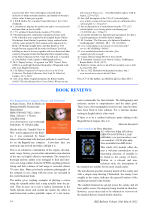
This section contains three book reviews: "The Bagnold Sun-Compass: History and Utilization" by Kuno Gross, "Essex Sundials" by Peter Meadows, and "A Dial in your Poke: A Book of Portable Sundials" by Mike Cowham, offering insights into each publication.
Book Reviews
March 2012
Page 36
Page 36
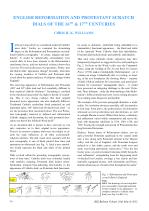
This article examines how English church dials changed during the Reformation, contrasting the colorful, symbolic Catholic 360° dials with the minimalistic, functional Protestant 180° and 90° scratch dials. It uses dial data to inform historical debate on the pace and spread of Protestantism across England.
Dials: Mass Dials, Historical Dials, How Sundials Work
March 2012
Page 38
Page 38
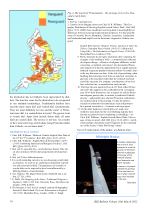
This short piece describes a tradition of local people climbing an artificial hill to view the Silver-link Park sundial at midnight on New Year's Eve to watch firework displays, highlighting a unique, non-gnomonic interaction with the sundial.
The BSS and Members
March 2012
Page 39
Page 39
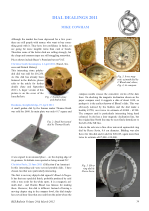
This article reports on sundial sales and auction results from 2011, noting strong sales for higher-quality dials despite a depressed market. It details several interesting pieces, including a stone polyhedral dial, ivory diptych dials, equinoctial ring dials, quadrants, and a double horizontal dial.
Dials: Portable, Historical Dials
March 2012
Page 42
Page 42
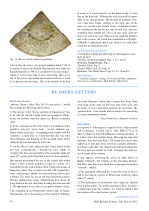
This section features letters from readers discussing various sundial topics. Peter Drinkwater discusses dial transmission and an Islamic scratch dial. Tony Wood offers insights into the progress of "scientific" sundials. John Moir describes "Suburban Reflections" from his front garden.
How Sundials Work, Historical Dials, The BSS and Members
March 2012
Page 43
Page 43
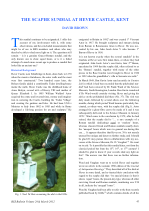
This article details the author’s investigation into the enigmatic scaphe dial at Hever Castle, often called the "Roman" sundial. It discusses its historical background, previous examinations by Ward and Vaughan, and the author's measurements and analysis, concluding it is likely an unworkable dial despite its ancient appearance.
How Sundials Work, Historical Dials, Dials: Scaphe