- Home
- /
- Sundial Encyclopaedia
- /
- Dials: Hemispherical
Dials: Hemispherical
June 2021
Page 36
Page 36
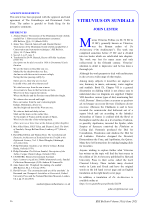
Discusses the content related to sundials found in Book IX of De Architectura by the Roman author Vitruvius (c. 80–15 BC). Chapter VII provides a general discussion on dialling, while Chapter VIII credits various ancient figures—including Berosus, Aristarchus, and Apollonius—with inventing different types of early dials like the Hemicyclium, Bowl, and Plinthium.
Book Reviews, Dials: Hemispherical, Historical Dials
June 2020
Page 44
Page 44
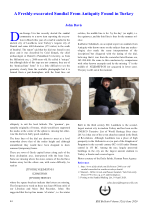
Reports on the March 2020 excavation of a marble "hemicyclium" sundial in the ancient city of Laodikeia, Turkey. The dial features Greek inscriptions for the winter solstice, equinox, and summer solstice, though its exact dating (Hellenistic vs. Roman era) is still debated.
Dials: Hemispherical, How Sundials Work, Historical Dials, Dials: Scaphe
September 2019
Page 22
Page 22
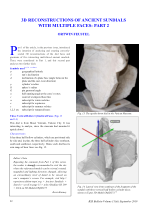
This article continues the analysis of ancient multi-faced sundials using 3D reconstructions. It examines a dial from the Musei Vaticani with three vertical hollow cylindrical faces and a combination dial from Herculaneum featuring vertical hollow cylindrical and spherical faces. Analysis includes calculation based on geographical latitude and declination lines.
Dials: Hemispherical, Dials: Multi Faced, Historical Dials, Mathematics of Dialling
December 2015
Page 37
Page 37
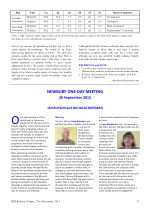
A report on the annual BSS Newbury meeting featuring various talks and exhibits. Highlights include Irene Brightmer’s discovery of a globe dial within a stone sphere, Martin Jenkins' DIY garden projects, and Frank King's demonstration of an umbrella as an astronomical instrument.
DIY Sundial Projects, Dials: Hemispherical, Dials: Unusual, The BSS and Members
March 2013
Page 20
Page 20
A scholarly report on a fragmentary Greek sundial held in the Louvre. The authors discuss its geometry, probable use, and its place in the evolution of ancient dial types.
Dials: Astrolabe, Dials: Equatorial, Dials: Hemispherical, Historical Dials
September 2013
Page 6
Page 6
Detailed description and analysis of a solid white marble globe sundial from antiquity (c. 100 BC) found near Heraion. It uses the terminator (boundary of light and shadow) for time indication and features complex line systems representing hours, seasons, and zodiacal signs.
Dials: Hemispherical, Dials: Unusual, Historical Dials, Mathematics of Dialling
March 2012
Page 27
Page 27
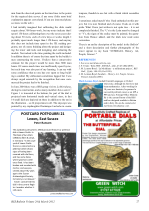
This entry features an undated postcard (c.1930) of a spherical dial at Lewes Castle. It references "The Book of Sun-Dials" (1900) which describes the broken and mended stone ball, noting its unknown history and questioning its current existence.
Dials: Hemispherical, Historical Dials
March 2012
Page 30
Page 30
This article discusses two 18th-century French artworks depicting ball sundials: Claude Gillot’s etching for a fable and Jean-Honoré Fragonard’s painting "Rêverie." It argues that while artistically unrealistic, these dials serve a narrative purpose by precisely indicating time to convey moral or emotional messages within their respective contexts.
Dials: Hemispherical, Historical Dials, Sundial Design & Layout
September 2010
Page 35
Page 35
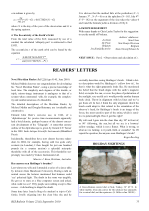
This entry briefly describes a Greco-Roman conical dial at Side, Turkey, made of white marble with day curves for the solstices but unusually lacking those for the equinoxes.
Dials: Hemispherical, Historical Dials
December 2009
Page 2
Page 2
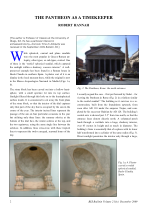
This article argues that the Pantheon in Rome functions as a large-scale timekeeper, similar to a roofed spherical sundial. It examines how sunlight entering through the oculus marks specific times of the year, such as the equinoxes, and compares its astronomical features to those of Nero's Domus Aurea.
Dials: Hemispherical, Dials: Unusual, Historical Dials
June 2006
Page 78
Page 78
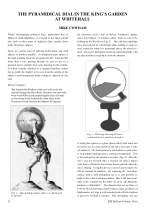
This article reconstructs the spherical dials from the complex 1669 Pyramidical Dial in Whitehall, based on descriptions by William Leybourn. It details various glass sphere dials, including those showing time by heat ("fire"), water, optical alignment ("air"), and terrestrial globes ("earth"), and discusses their delicate construction and short lifespan.
Dials: Hemispherical, Dials: Unusual, Historical Dials
December 2006
Page 184
Page 184
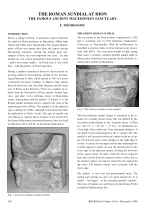
E. Theodossiou describes a unique spherical Greco-Roman sundial discovered at Dion, Macedonia, dating to the 1st century AD. This well-preserved white marble artifact, found in a 'luxurious house', features eleven hour lines and inscriptions dedicating it from I. Granius Felix, a market inspector. It is a significant find for ancient Macedonian archaeology.
Dials: Hemispherical, Historical Dials, Mottoes
June 2002
Page 52
Page 52
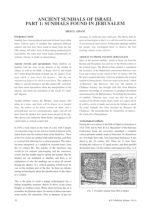
Archaeological survey of ancient sundials discovered in Jerusalem, including conical and hemispherical dials, their contexts, and cultural relevance.
Dials: Hemispherical, Historical Dials
March 2001
Page 41
Page 41
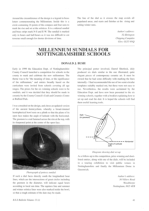
Describes a Nottinghamshire County Council competition for schools to mark the Millennium, with sundials as prizes. The author was consulted on the design, choosing an updated ancient hemicyclium: a hemispherical bowl on a plinth, with a rod gnomon. The ceramic dials, crafted by Danel Sherlock, feature hour, equinox, and solstice lines. A booklet guides setup and reading, hoping the dials will serve as useful learning tools for the winning schools.
Construction Projects, Dials: Hemispherical
February 2000
Page 3
Page 3
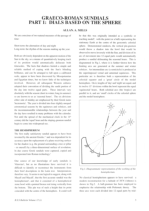
Explores early Greek and Roman hemispherical and hemicyclium sundials, their geometry, historical usage, and accuracy.
Dials: Hemispherical, Historical Dials, How Sundials Work, Mathematics of Dialling
February 2000
Page 12
Page 12
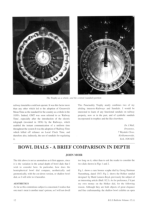
Compares aesthetics and function of deep hemispherical vs shallow bowl sundials, including gnomonic differences and delineation methods.
Dials: Hemispherical, Dials: Scaphe, Sundial Design & Layout
June 1998
Page 40
Page 40
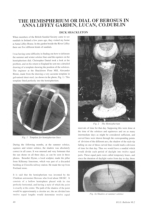
This article describes a hemispherical sundial, or 'hemispherium,' located in the author's garden, reputedly invented by Berosus around 300 BC. It details the successful process of delineating the solstice and equinox lines using a custom-made template and explains the dial's function in dividing daylight into 'temporary hours'.
Construction Projects, Dials: Hemispherical, Dials: Scaphe, Sundial Design & Layout
October 1998
Page 8
Page 8
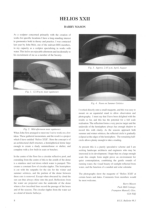
This article introduces an innovative 'Helios XXII' sundial concept, designed as an architectural shell structure or summerhouse. It features a hemispherical dome with a reflective pool at its centre and a stainless steel rod circulating water creating ripples. Reflections from the water, with shadows from the concentric ripples, are projected onto the dome's underside, marking hours and seasons, aiming for a tranquil contemplative environment.
Construction Projects, Dials: Hemispherical, Dials: Unusual, Sundial Design & Layout
July 1997
Page 3
Page 3
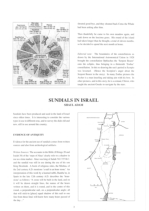
This article provides a historical overview of sundials in Israel, from ancient biblical references and archaeological artifacts to sundial makers of the 20th century. It describes various types of dials, including hemicycliums, portable stone dials, and modern vertical and horizontal dials.
Dials: Hemispherical, Dials: Horizontal, Dials: Vertical, Historical Dials
February 1992
Page 24
Page 24
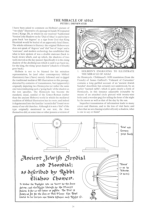
The article clarifies the Biblical account of the "Dial of Ahaz," explaining that the original Hebrew text refers to "steps" and a "staircase" rather than a sundial with "degrees." It discusses how medieval illustrations, like Holbein's, misinterpreted this, depicting a hemicycle-like device. The author also notes an adjustable Jewish hemicycle described in a 1650 translation, which could tell time by both the sun and the moon.
Dials: Hemispherical, Historical Dials
October 1992
Page 37
Page 37
This article describes the Holker Dial, a large shallow bowl sundial made of Burlington slate, sited at Holker Hall. Designed by Mark Lennox-Boyd, it is a projection of Berossos' hemispherium onto a shallow bowl, marked with 15-minute divisions, zodiacal signs, and a combined table for correcting for longitude offset and Equation of Time. The article details the challenging production process by Burlington Slate, involving computer-calculated polar coordinates for engraving and the moving of massive stone objects.
Construction Projects, Dials: Hemispherical, Dials: Scaphe, Mathematics of Dialling, Sundial Design & Layout
February 1991
Page 8
Page 8
The Roman Cylindrical Sundial in the Zemaljski Museum, Sarajevo, Yugoslavia, by Milutin Tadic" discusses a rare cylindrical sundial discovered in Yugoslavia. It highlights the features of ancient sundials, such as being carved in stone and typically concave. The article presents a reconstruction of the Diluntum sundial, explaining its potential mechanism using a horizontal gnomon and projected diurnal arcs to show seasonal hours.
Dials: Hemispherical, Historical Dials
October 1990
Page 12
Page 12
This article discusses various forms of spherical sundials, from simple painted stone spheres to the ancient concave hemisphere (Scaphe or Hemicycle) and the later, less effective, convex hemisphere. It also explores the projection of spherical coordinates onto a plane, linking them to the discovery of the analemmatic dial.
Dials: Hemispherical, Historical Dials, Dials: Scaphe, Dials: Armillary Sphere
October 1990
Page 26
Page 26
This article, presented in a question-and-answer format, describes a didactic hemispherical sundial that models the Earth's relationship to the sun. It explains how the shadow of a bead indicates date and time, distinguishes it from ancient Greek dials, and clarifies why it needs occasional adjustment about its axis to display clock time.
Dials: Hemispherical, Equation of Time, How Sundials Work