- Home
- /
- Sundial Encyclopaedia
- /
- September 2018
September 2018
The articles link to the specific page in a PDF optimised for speed. If you want the whole issue, you can download it here, but the files from earlier years can be quite large.
September 2018
Page 1
Page 1
Notes that this issue is slightly thinner due to fewer article submissions. Mentions Anthony Turner’s article on a glass sundial centre panel and John Wilson’s piece detailing the BSS library in Nottingham. Expresses gratitude to authors, noting the long sunny summer should have encouraged sundial photography.
The BSS and Members
September 2018
Page 2
Page 2
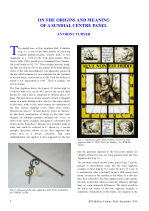
Investigates the history and iconography of the central rectangular image of a putto holding a dial, found on a c. 1670 painted-on-glass window dial by Henry Gyles (York). The source is traced back to a Venetian painting, 'The little tambourine player,' which was transformed into a *memento mori* by engraver Jacob Matham, including symbols of vanity like an hourglass and arrow.
Dials: Stained Glass, Historical Dials, Sundial Design & Layout
September 2018
Page 6
Page 6
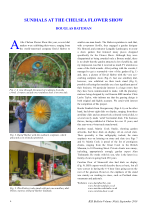
Reports on several dial makers exhibiting at the Chelsea Flower Show. David Harber featured the 'Aeon' sunburst sculpture and an armillary dial. Border Sundials displayed eight pieces, winning a 4-star trade stand award. Martin Cook Studio showed slate dials focusing on calligraphy, and Caroline Dear of Stonecraft displayed dials on Portland stone pedestals.
Dials: Armillary Sphere, Dials: Horizontal, Dials: Vertical
September 2018
Page 8
Page 8
Details an octagonal brass sundial (c. 1651) now in the Armitt Museum, Ambleside. Originally belonging to Gawen Braithwaite, the dial post bears the inscription ‘GB’ and the motto ‘VITA VT HERBA’. Analysis of the punched numerals, hatched segments, and metallurgy suggests it is a very early dial, likely made by a goldsmith or silversmith, G. Hayton.
Dials: Horizontal, Historical Dials
September 2018
Page 12
Page 12
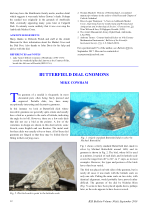
Examines the ornate, hinged gnomons of portable Butterfield dials (usually silver or brass), typically featuring a bird whose bill acts as the latitude pointer. Variations in design are illustrated, including non-bird supporters such as a lion, dolphin, leaf, or swan, spanning French, English, and one Russian example.
Dials: Portable, Historical Dials, Sundial Design & Layout
September 2018
Page 16
Page 16
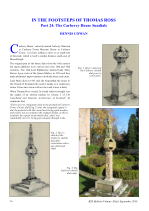
Examines two historical sundials at Carberry House, East Lothian. The first is a hollow obelisk dial capital, restored according to Thomas Ross's sketch. The second, missing for a time but now in the National Museum of Scotland, is a unique 13-dial structure featuring a female bust support, combining upright, reclining, and horizontal dials.
Dials: Horizontal, Dials: Multi Faced, Historical Dials
September 2018
Page 19
Page 19
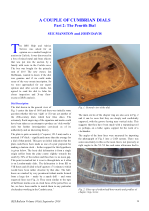
Describes a 1695 brass horizontal dial bought at auction in Carlisle, designed for latitude 54°. The florid motto ‘Ut Hora Sic Vita’ and signature Lawrance Swarbricke, an excise officer in Penrith, suggest he customized a dial commissioned from a clockmaker. Metallurgical analysis reveals a mid-zinc leaded brass composition typical of the period.
Dials: Horizontal, Historical Dials
September 2018
Page 22
Page 22
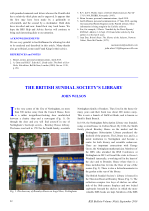
Details the BSS Library, housed in the Thoroton Room of the historic Bromley House Library in Nottingham. The collection is for reference only and includes valuable books kept in locked cupboards. The Library building, which also houses a brass meridian line and a heliochronometer, is currently undergoing a major restoration programme.
The BSS and Members
September 2018
Page 24
Page 24
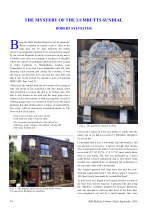
Investigates a vertical stone dial (1864) in Lumbutts, Calderdale, made by schoolmaster James Travis Whittaker MD. Despite accurately engraving the latitude, the hour lines were grossly incorrect. The author discovered Whittaker had mistakenly used the hour line spacings calculated for a *horizontal* dial at that latitude, rather than a vertical one.
Dials: Vertical, Historical Dials, Sundial Design & Layout
September 2018
Page 26
Page 26
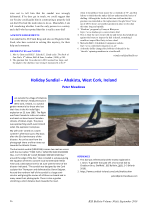
Describes a horizontal sundial (SRN 3936) located in a garden memorial at Ahakista, West Cork, Ireland, dedicated to those who died in the 1985 Air India flight explosion. Designed by Ken Thompson and delineated by Owen Deignan, the dial features the motto 'TIME FLIES...' and a plaque giving the Equation of Time.
Dials: Horizontal, Historical Dials
September 2018
Page 27
Page 27
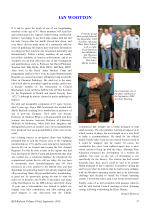
Obituary for Professor Ian David Phimester Wootton, a senior BSS member and respected chemical pathologist who pioneered routine blood tests. A founding member of the Association of Clinical Biochemists, he was BSS membership number 172, serving as the Society's first formal Registrar and introducing the computerised relational database system used today.
The BSS and Members
September 2018
Page 28
Page 28
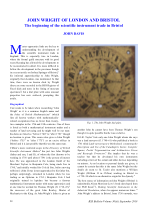
Investigates John Wright, a London-trained instrument maker who initiated Bristol’s scientific instrument trade in 1756. A rare, well-preserved horizontal dial plate signed 'Jo Wright London' is analysed, showing fine engraving and wax infill. The plate features unusual slots around the compass rose whose purpose, possibly related to magnetic variation or EoT, remains an open puzzle.
Dials: Horizontal, Historical Dials, Sundial Design & Layout
September 2018
Page 32
Page 32
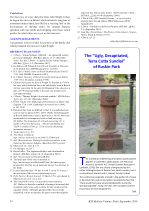
A short piece noting the unflattering description of the Grade II Listed terra cotta sundial in Ruskin Park, South London, quoted from a 1979 historical account. The dial, which is now missing, was originally erected in a Denmark Hill garden to commemorate the house where Mendelssohn wrote the Spring Song in 1842.
Dials: Unusual, Dials: Vertical, Historical Dials
September 2018
Page 33
Page 33
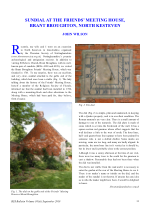
Describes a simple, unadorned stone vertical sundial installed in 1780 on the gable end of the Friends’ Meeting House in Brant Broughton, Lincolnshire. The square-section rod gnomon suggests the wall declines slightly west of south. Although the numerals are clear, the hour lines are poorly painted and the noon line is not vertical, indicating an unskilled diallist.
Dials: Vertical, Historical Dials, Sundial Design & Layout
September 2018
Page 34
Page 34
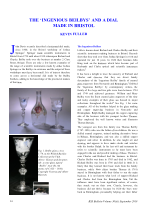
Presents a rare horizontal brass dial signed 'Beilby Bristol,' made by Richard and Charles Beilby who ran the instrument business (1810-1820) after Joshua Springer. The Beilbys are descendants of the famed 'Ingenious Beilby' family of enamel engravers from Newcastle. The dial follows a standard London design but features a unique unpierced gnomon set at 52°.
Dials: Horizontal, Historical Dials
September 2018
Page 36
Page 36
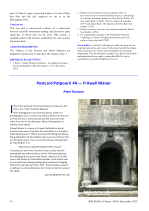
Features a postcard (circa 1930s) showing a sundial at Fritwell Manor, Oxfordshire, which is not currently in the Fixed Dial Register. Enlargement shows the dial declines to the east, as the 6 am line is not horizontal. The manor was once owned by Margaret Boleyn, Anne Boleyn’s grandmother.
Dials: Vertical, Historical Dials