- Home
- /
- Sundial Encyclopaedia
- /
- Doug Bateman
Doug Bateman
March 2023
Page 8
Page 8
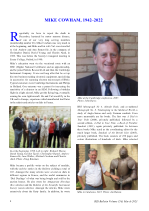
An obituary for Mike Cowham (membership number 26), a BSS founder-member known for his extensive contributions, including 103 articles for the Bulletin and his regular 'Dial Dealings' reports until 2020. He was the coordinating editor for Sundials of the British Isles and authored the monograph Altitude Dials.
The BSS and Members
March 2021
Page 7
Page 7
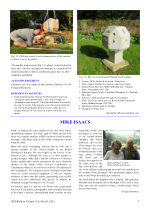
Obituary for Mike Isaacs (membership number 126), a Chartered Chemist and founder member of the Oxford Branch of the British Horological Institute. He had interests in electrical clocks and sundials, and his son David, a photographer, captured many sundial images used by the Society.
The BSS and Members
September 2020
Page 20
Page 20
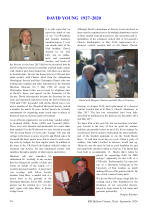
An obituary for David Young, a founder member (no. 3) and Vice-President of the BSS. He served as Secretary for ten years, organised conferences and international ‘sundial safaris,’ and was involved in projects like the Yew Tree Dial and sundial restoration projects.
Restoration projects, The BSS and Members
September 2020
Page 30
Page 30
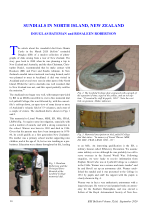
Reports on a tour detailing various sundials across New Zealand's North Island, including a memorial dial at Lynfield College. Describes a commemorative dial at the Treaty of Waitangi Grounds and the analemmatic 'Sundial of Human Involvement' in Wellington Botanic Garden.
Dials: Horizontal, Dials: Analemmatic, Historical Dials, Dials: Armillary Sphere
December 2020
Page 22
Page 22
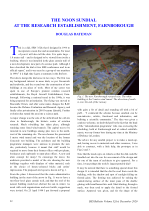
Description of a large aperture nodus noon dial designed by the author and installed in a glass curtain wall at the Farnborough research site in 1996. The 1.8-metre tall dial declines 13.5° west of south and incorporates a gilded analemma calculated for 1999, which allows it to show both the date and mean time noon.
Construction Projects, Dials: Noon Lines, Dials: Vertical, Equation of Time
March 2019
Page 17
Page 17
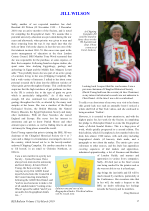
Obituary for Rosalind Jill Wilson (1929–2018), a highly respected BSS member known for compiling the monumental Biographical Index of British Sundial Makers. Her diverse interests included geology, Egyptology, astronomy, and her work on the Index lists almost 1,900 names. She also left a bequest to the BSS.
The BSS and Members
March 2019
Page 35
Page 35
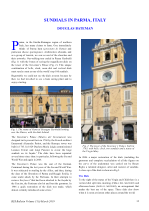
Describes the magnificent dials on the tower of the Governor’s Palace in Parma, Italy, restored in 2006. The combination includes a vertical dial split into morning/afternoon hours and a noon dial, both featuring an analemma with constant-declination lines and zodiac symbols. The dials were damaged during WWII when partisans attempted to remove Fascist symbols.
Dials: Noon Lines, Dials: Vertical, Historical Dials
June 2019
Page 20
Page 20
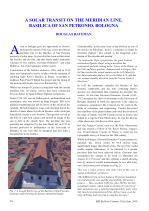
Details the history and functioning of the 66.8-metre meridian line constructed by Giovanni Domenico Cassini in 1655 at San Petronio Basilica. Discusses the earlier Danti line, restorations, the use of Cassini units and Italian hours, and how the line helped confirm Kepler's elliptical orbit theory.
Dials: Noon Lines, Historical Dials
September 2019
Page 2
Page 2
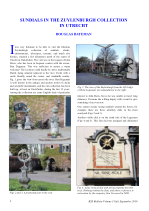
This article details a visit to the privately owned Zuylenburgh collection in Oud-Zuilen, Utrecht, which includes sundials, clocks, and scientific instruments. Highlights include a vertical dial by Pieter de Ruiter, several armillary dials, and portable dials by notable makers such as J. Smith, W. & S. Jones, Elias Allen, Thomas Wright, and Humfrey Cole.
Dials: Vertical, Dials: Portable, Historical Dials, Dials: Armillary Sphere
September 2018
Page 6
Page 6
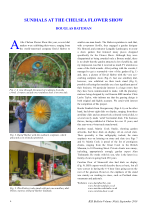
Reports on several dial makers exhibiting at the Chelsea Flower Show. David Harber featured the 'Aeon' sunburst sculpture and an armillary dial. Border Sundials displayed eight pieces, winning a 4-star trade stand award. Martin Cook Studio showed slate dials focusing on calligraphy, and Caroline Dear of Stonecraft displayed dials on Portland stone pedestals.
Dials: Armillary Sphere, Dials: Horizontal, Dials: Vertical
September 2018
Page 27
Page 27
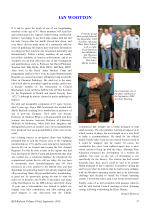
Obituary for Professor Ian David Phimester Wootton, a senior BSS member and respected chemical pathologist who pioneered routine blood tests. A founding member of the Association of Clinical Biochemists, he was BSS membership number 172, serving as the Society's first formal Registrar and introducing the computerised relational database system used today.
The BSS and Members
September 2017
Page 17
Page 17
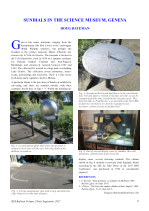
This visits the Geneva Science Museum, which displays instruments related to astronomy and surveying. External exhibits include a conventional globe dial, a large analemmatic dial, and an unusual horizontal altitude dial. Indoor displays feature quadrants, altitude dials, and a navicula portable dial purchased in 1993.
Dials: Analemmatic, Dials: Portable, Dials: Unusual, Historical Dials
September 2016
Page 7
Page 7
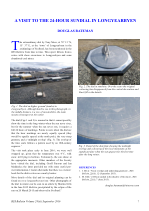
A report on a visit to the unusual 24-hour sundial designed by Tony Moss in Longyearbyen, Svalbard (78° N). Key features noted include the steep gnomon, nearly equally spaced hour lines, and a ‘midnight overlap’.
Dials: Horizontal, Dials: Unusual, Historical Dials
September 2016
Page 22
Page 22
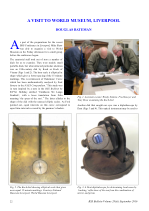
A report on a BSS visit to World Museum, Liverpool, to view their collection of dials. Highlights included an 18th-century Koch dial from Vienna featuring an elliptical scale for better spacing of 15-minute markings, and a Dent dipleidoscope, an instrument used for precisely determining apparent noon.
Dialling Tools, Dials: Portable, Historical Dials, How Sundials Work
September 2016
Page 32
Page 32
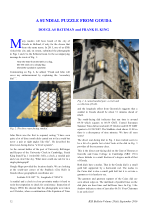
Analysis of a pair of canted vertical dials on the Stadhuis in Gouda, Holland, focusing on a direct east-facing nodus dial. Although the direct south-facing dial shows minor discrepancies with the clock time, the east-facing dial's parallel lines meant to be constant-declination curves are considered seriously suspect and likely the result of bad restoration.
Dials: Vertical, Historical Dials
December 2016
Page 16
Page 16
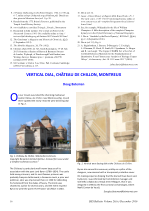
Description of a restored west-declining vertical dial found at the Château de Chillon. Though the castle is associated with Lord Byron, enquiries confirmed the dial was designed much later in 1905 by cantonal archaeologist Albert Naef.
Dials: Vertical, Historical Dials
March 2015
Page 13
Page 13
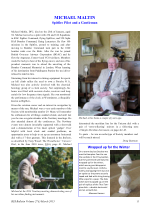
An obituary for Michael Maltin, DFC (1920–2014), a retired RAF pilot (Spitfires and Lancasters) and a very early member of the BSS (Membership No. 29). His interests included accurate timekeeping, navigation by the sun, and electrical horology. He actively assisted with gnomonic projects, including determining the meridian for the enormous Woodchester ‘Unicorn’ Dial.
The BSS and Members
June 2015
Page 7
Page 7
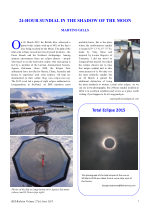
A photograph of the total solar eclipse of 20 March 2015 is presented, taken from a cruise ship positioned east of the Faroe Islands.
June 2015
Page 22
Page 22
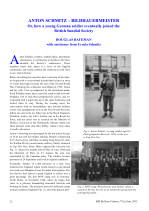
A biographical account of Anton Schmitz (b. 1926), a German sculptor and master stonemason (Bildhauermeister), who became a POW in England after D-Day. He studied under Heinz Schumacher and later became renowned for making over 100 sundials, specializing in globe dials.
Dials: Multi Faced, Dials: Unusual, Construction Projects
September 2015
Page 17
Page 17
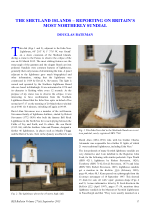
Report on the discovery and registration (SRN 7704) of a lighthouse sundial adjacent to the Esha Ness Lighthouse (60° 29.3′ N). It discusses the dial's distinctive fluted cast iron pedestal and its link to the famous Stevenson family of lighthouse builders.
Dials: Horizontal, Dials: Unusual, Historical Dials
December 2015
Page 24
Page 24
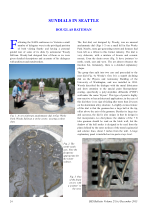
Recounts a guided tour of Seattle dials following the NASS conference, featuring four dials designed by Woody Sullivan. Highlights include an elaborate analemmatic dial in Gas Works Park, a vertical declining dial at UW, and the earliest Seattle dial dating from 1909.
Dials: Analemmatic, Dials: Equatorial, Dials: Vertical, The BSS and Members
December 2015
Page 37
Page 37
A report on the annual BSS Newbury meeting featuring various talks and exhibits. Highlights include Irene Brightmer’s discovery of a globe dial within a stone sphere, Martin Jenkins' DIY garden projects, and Frank King's demonstration of an umbrella as an astronomical instrument.
DIY Sundial Projects, Dials: Hemispherical, Dials: Unusual, The BSS and Members
December 2015
Page 48
Page 48
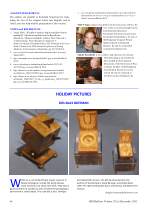
Features photographs of sundials encountered during a visit to the clock museum at La Chaux-de-Fonds in Neufchatel. Specific examples shown include an 18th-century cube dial by D. Beringer and 17th and 18th-century pocket dials.
Dials: Multi Faced, Dials: Portable
March 2014
Page 10
Page 10
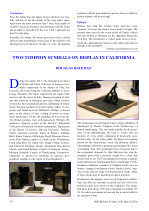
This report discusses two of Thomas Tompion’s rare horizontal sundials displayed at a symposium in California. Only ten Tompion dials are recorded; these included a square dial (c. 1705, latitude 50° 54') and the large circular former Wrest Park dial (c. 1700, adjustable for two latitudes).
Dials: Horizontal, Equation of Time, Historical Dials
March 2014
Page 43
Page 43
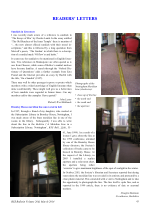
John Lester inquires about further references to sundials in English literature beyond those by Lamb, Marvell, and Chaucer. Douglas Bateman reports that the brass meridian line at Bromley House, Nottingham, mentioned in a 1999 article, has been fully revealed during recent renovations.
Dials: Noon Lines, Historical Dials
June 2014
Page 16
Page 16
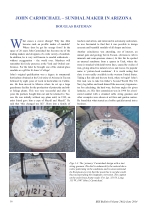
Profiles John Carmichael, detailing his career shift from horticulture to becoming a leading sundial maker in Tucson. It describes his primary design using a stranded cable gnomon, his use of modern software for complex dials (like heliochronometers), and his artistic stained glass dials and durable vitreous enamel finishes.
Construction Projects, Dials: Heliochronometer, Dials: Vertical, Sundial Design & Layout
September 2014
Page 17
Page 17
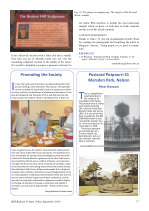
Describes efforts to promote the British Sundial Society at the annual meeting of south-east astronomy societies at the Chichester Planetarium, featuring talks by members (Doug Bateman on the Greenwich time ball) and a display of dials and books.
The BSS and Members
December 2014
Page 11
Page 11
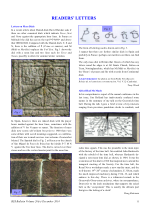
Tony Wood discusses canonical dials found in France and Spain that explicitly mark the prayer hours of Prime, Terce, Midi, Nones, and Vespers. Doug Bateman clarifies an error in a previous conference report, confirming that E. J. Dent made the improved machinery for the Greenwich time ball, while John Hardcastle designed a rare mean time dial.
Dials: Mass Dials, Equation of Time, Historical Dials
June 2013
Page 11
Page 11
A collection of correspondence from members discussing topics such as the BSS library, dial design conventions, and Society matters.
The BSS and Members
June 2013
Page 12
Page 12
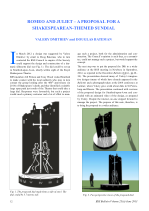
An artistic proposal for a monumental sundial inspired by *Romeo and Juliet*, designed for Stratford-upon-Avon. The article describes its symbolism, geometry, and design for public installation.
Dials: Horizontal, Dials: Vertical, Sundial Design & Layout, The BSS and Members
December 2013
Page 32
Page 32
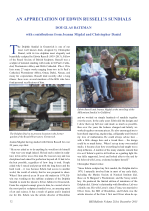
An appreciation of the late sculptor Edwin Russell (1939–2013), Fellow of the Royal Society of British Sculptors and Artistic Director of Brookbrae Ltd. It highlights his collaborations, notably the Dolphin Sundial in Greenwich (1978), and his dedication to perfection, inspiring his student Joanna Migdal.
Sundial Design & Layout, The BSS and Members, Dials: Armillary Sphere
September 2012
Page 7
Page 7
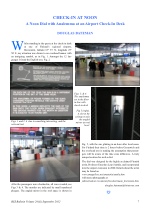
This article describes a unique noon dial with an analemma at Rovaniemi Airport, Finland, designed by Professor Emeritus Lauri Anttila in 2000. An angled mirror in the roof casts sunlight onto the floor to indicate months, with the design assuming passengers are aware of time zone differences.
Construction Projects, Dials: Analemmatic, Dials: Noon Lines, Sundial Design & Layout
September 2012
Page 45
Page 45
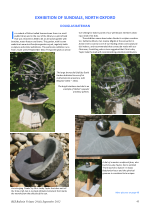
This entry describes a sundial exhibition held from June to September 2012 in the Turrill Sculpture Garden, Summertown, Oxford. It features 11 dials by BSS members, including David Harber's bronze dial and armillary sphere, Chris Lusby Taylor's sculptural "Undial" and "From Sunrise to Sunset" dials, and a cube dial by Harriet James.
Dials: Unusual, The BSS and Members, Dials: Cube, Dials: Armillary Sphere
December 2012
Page 36
Page 36
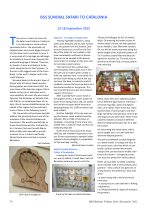
This report details the British Sundial Society's 2012 safari to Catalonia, covering visits to numerous sundials across Girona, Cabrils, Figueres, Barcelona, and other towns. Members explored diverse dials, including modern pillar dials, Salvador Dali's carved stone dial, multi-faceted and unusual museum pieces, showcasing the region's rich gnomonic heritage.
Dials: Multi Faced, Dials: Unusual, Historical Dials, The BSS and Members
March 2010
Page 12
Page 12
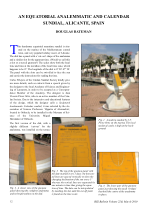
Describes a modern, equatorial meantime sundial on the marina in Alicante, Spain, designed by Juan Vicente Pérez Ortiz. The dial features a 'cut-out' analemma shape and a slot for apparent time, and has scales for both local and time zone time.
Dials: Analemmatic, Dials: Equatorial, Equation of Time
March 2010
Page 21
Page 21
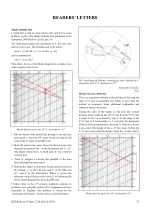
A collection of letters from readers. Topics include a simpler graphical method for using the John Marke altitude dial, a discussion on the nomenclature of mass dials, the 'Sun Position Compass', and the historical connection between clockmakers and dialmakers.
Dials: Mass Dials, Dials: Portable, Mathematics of Dialling, The BSS and Members
June 2010
Page 43
Page 43
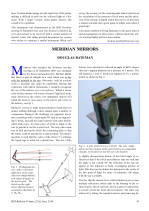
This article presents an alternative construction for Michael Maltin's meridian instrument, which uses two orthogonal mirrors to establish a meridian line. The author describes using an engineering V-block as a ready-made 90-degree angle, adding small mirrors and a spirit level for accurate setup. It discusses refinements like front-silvered mirrors and a hinge for precise spot overlap, highlighting its simplicity and accuracy for determining the sun's azimuth.
DIY Sundial Projects, Dialling Tools, Sundial Design & Layout
December 2010
Page 12
Page 12
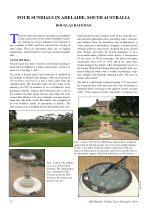
This report details four sundials in Adelaide. It includes the Olde Adelaide Sundial at Carrick Hill House with a unique equation of time reflecting South Australia's time zone, two dials at Seymour College, and an unusual polar meantime dial by Government Astronomer Charles Dodwell in the Pioneer Women’s Memorial Garden.
Dials: Horizontal, Dials: Polar, Dials: Vertical, Historical Dials
June 2009
Page 5
Page 5
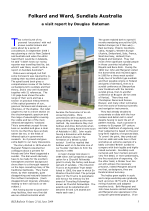
A report on a visit to Sundials Australia, run by Margaret Folkard and John Ward. It covers their design philosophy favouring cast relief dials for longevity, and manufacturing process using photopolymers. The article highlights their diverse work, including horizontal dials, armillary spheres, and international commissions.
Dials: Horizontal, Dials: Vertical, Dials: Armillary Sphere
March 2008
Page 12
Page 12
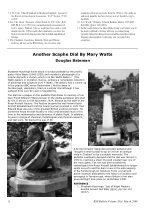
Describes a scaphe dial by potter Mary Watts, similar to one in the Watts Gallery. This particular dial, located in Farnborough, Hampshire, serves as a memorial to aviation pioneer Edward T. Busk, who died in 1914. It was moved in 1970 and is now housed at the Farnborough Air Sciences Trust.
Dials: Scaphe, Historical Dials
September 2008
Page 102
Page 102
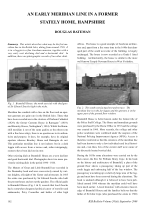
This article describes a meridian line at Bramshill House, Hampshire, believed to be the earliest in the British Isles, dating to around 1720. It also describes a west declining dial and a now-missing horizontal dial.
Dials: Horizontal, Dials: Vertical, Historical Dials, Dials: Noon Lines
December 2008
Page 189
Page 189
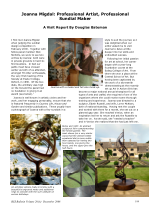
A report on Joanna Migdal, a prominent sundial maker. It covers her artistic training, apprenticeship with Edwin Russell, and her unique methods for creating bronze sundials, including water jet cutting, hand-finishing, engraving with burrs, and chemical patination. The article highlights her award-winning work, design process, and other artistic commissions, and notes her links with the British Sundial Society.
December 2008
Page 193
Page 193
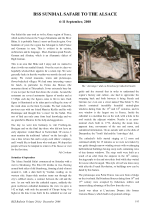
A report on the BSS Sundial Safari to the Alsace region of France, detailing visits to various towns and villages. It describes numerous sundials encountered, including those at Strasbourg Cathedral, Soultz, Guebwiller, St-Marc convent, Colmar, Eguisheim, Riquewihr, Bergheim, Mont Ste-Odile (featuring a polyhedral dial), and Freiburg (Germany), as well as the Kirschgarten Museum in Basel.
Dials: Vertical, Dials: Multi Faced, Historical Dials, The BSS and Members
December 2008
Page 198
Page 198
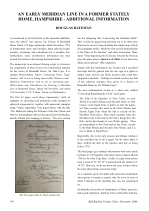
This article provides additional information about a meridian line at Bramshill House, Hampshire. It details a 1770 manuscript by S. Dunn containing notes on spherical trigonometry and meridian line calculations. It confirms the line's date before 1770 and discusses the context of 18th-century mathematical sophistication and notes from Mrs. Gatty that imply the existence of other dials at the location.
Dials: Noon Lines, Historical Dials, Mathematics of Dialling
June 2007
Page 66
Page 66
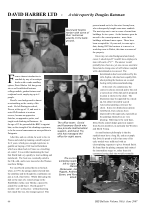
This report details a visit to David Harber Ltd., a successful business specialising in sundials, garden features, and sculpture. It traces David Harber's unconventional career path, his company's business philosophy, preference for polished stainless steel, and notable commissions including several for Oxbridge colleges.
Sundial Design & Layout
December 2007
Page 153
Page 153
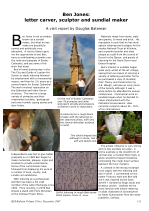
This report profiles Ben Jones, a letter carver and sculptor based in Devon, who has also become a skilled sundial maker. His work, which comprises 25-30% of his commissions, is noted for its artistic and unique designs, ranging from shield-shaped vertical dials to analemmatic dials and multi-faceted columns. He integrates his lettering skills and sculptural form into his creations.
Dials: Vertical, Dials: Polar, Sundial Design & Layout
December 2007
Page 187
Page 187
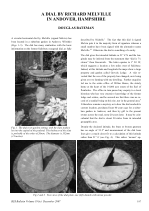
This article describes a rare circular horizontal sundial by Richard Melville (signed Melvin) found in Andover, Hampshire. The dial, dated to around 1860, is unusual for Melville's work due to its circular shape and its mention of a son. It discusses the discrepancy between the declared latitude and the gnomon angle, suggesting mass production, and notes an engraving error and weathering on the dial plate.
Dials: Horizontal, Historical Dials, Sundial Design & Layout
February 2006
Page 20
Page 20
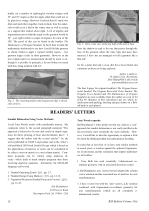
This section contains various reader contributions. Hal Brandmaier and Tony Wood discuss vector methods for sundial delineation. Patrick Powers and Douglas Bateman exchange views on a longitude error on the Kew Garden Cross Dial inscription. Norman Darwood briefly comments on the potential effects of changes in Earth's rotation on sundials.
Dials: Horizontal, Mathematics of Dialling, Equation of Time
September 2006
Page 98
Page 98
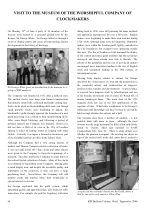
A BSS group enjoyed a guided tour of the Museum of the Worshipful Company of Clockmakers. The report covers the Company's 1631 founding, its extensive collection of horological instruments, and specific sundials including a large horizontal dial by Elias Allen. The museum’s curated displays offer a rich historical perspective on timekeeping.
Historical Dials
September 2006
Page 137
Page 137
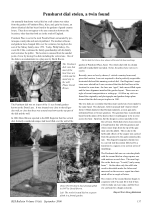
This report details the theft of a distinctive vertical sundial from Penshurst Place in Kent. Coincidentally, an almost identical twin dial was discovered in a private country garden, raising hopes for its potential replication to replace the stolen artifact. The article describes the unique design and features of these large, elegant vertical dials.
Dials: Vertical, Historical Dials, Restoration projects
December 2005
Page 172
Page 172
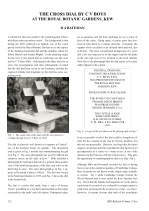
This article investigates the bronze cross dial by C.V. Boys at Kew Gardens, noting its unusual design and puzzling errors in the engraved latitude and longitude. It traces the dial's history, including its temporary display and previous locations within the gardens, and highlights the scientific reputation of its designer, Sir Charles Vernon Boys FRS.
Dials: Polar, Dials: Unusual, Historical Dials, Sundial Design & Layout
March 2004
Page 6
Page 6
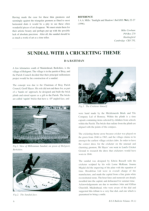
This article describes a millennium sundial project in Holyport, Berkshire, featuring a unique cricketing theme due to the village's history with the sport. Designed by Edwin Russell with cricketer sculptures by Lorne McKean, the dial includes hand-made 'quint' bricks, a time capsule, and hour lines delineated for summer time.
Construction Projects, Dials: Unusual, Sundial Design & Layout
March 2004
Page 38
Page 38
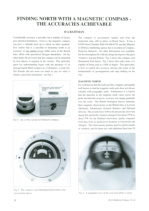
This article details the practical limitations and achievable accuracies when using a magnetic compass to determine true north, especially for diallists. It explains how Earth's magnetic field variations, crustal and external influences, and man-made objects affect compass readings, and provides methods, including online tools, for accurate magnetic variation calculation to assist sundial alignment.
Dialling Tools
September 2004
Page 118
Page 118
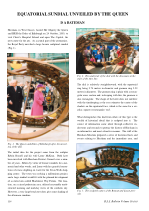
Report of a ceremonial unveiling of a new equatorial sundial: description of the dial type, event context and public/promotional aspects of the installation.
Dials: Equatorial, The BSS and Members
September 2003
Page 124
Page 124
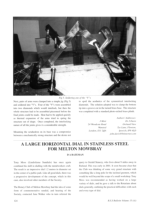
An article describing a large horizontal sundial made of stainless steel for Melton Mowbray Rotary Club. It highlights the dial's features, including an explanatory plaque with instructions on how to read the dial and correct for 'watch time' using the equation of time.
Construction Projects, Dials: Horizontal
December 2002
Page 146
Page 146
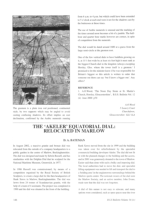
Detailed account of the design, relocation, and symbolism of Edwin Russell’s large equatorial dial now installed in Marlow, including technical specifications.
Dials: Equatorial, Dials: Polar
June 1999
Page 55
Page 55
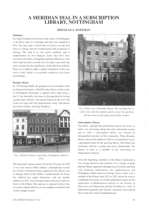
This article describes a rare 1834 meridian dial in Nottingham's Bromley House Subscription Library. It features a brass strip on the first floor, which was covered for 150 years. The dial was used to ascertain Local Apparent Noon and is complemented by two longcase clocks with inscribed time differences. Efforts are underway for its partial restoration, noting its excellent condition in fine surroundings.
Dials: Noon Lines, Historical Dials, Restoration projects
October 1997
Page 51
Page 51
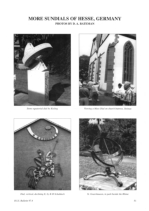
This section provides photographs of various sundials in Hesse, Germany, including a stone equatorial dial by Kieling, a vertical declining dial by Schaldach, a mass dial on a church buttress in Steinau, and a sundial in a park in St. Goarshausen.
Dials: Equatorial, Dials: Mass Dials, Dials: Vertical, Historical Dials