- Home
- /
- Sundial Encyclopaedia
- /
- December 2006
December 2006
The articles link to the specific page in a PDF optimised for speed. If you want the whole issue, you can download it here, but the files from earlier years can be quite large.
December 2006
Page 145
Page 145
The editorial summarises the results of a Readership Survey, noting the introduction of solar ephemeris data and ongoing work for new articles. It highlights the importance of BSS members identifying and proposing restoration for old sundials and draws attention to the BSS Grants Policy.
Restoration projects, The BSS and Members
December 2006
Page 146
Page 146
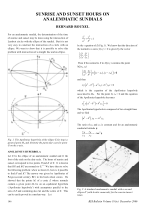
For an analemmatic sundial, the determination of the time of sunrise and sunset may be done using the intersection of Lambert circles with the ellipse of the sundial. However, this is practically difficult and the article explores a simpler solution using the intersection of a straight line and an ellipse.
Dials: Analemmatic, Mathematics of Dialling
December 2006
Page 149
Page 149
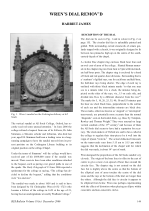
Harriet James recounts the history of Sir Christopher Wren's vertical sundial at All Souls College, Oxford, designed around 1658 with 'stepped transversals' for accuracy. The article details its relocation in 1877 and Dr. John Simmons's long-standing, unfulfilled campaign to restore it to its original position on the chapel, also touching on Wren's early interest in dialling.
Dials: Vertical, Historical Dials, Mottoes
December 2006
Page 156
Page 156
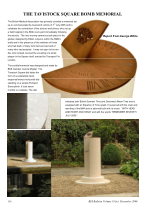
The British Medical Association has privately unveiled a memorial set up to commemorate the bus-bomb victims of 7th July 2005 and to celebrate the contribution of the doctors and others, who set up a field hospital in the BMA court-yard. The Tavistock Square dial takes the form of a substantial handengraved bronze horizontal dial standing on a simple Portland Stone plinth.
Dials: Horizontal
December 2006
Page 157
Page 157
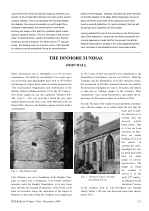
John Wall re-examines the Dinmore sundial, attributing it to the Knights Hospitallers and dating it to the early 14th-century chapel. He identifies the unique symbol as the eight-pointed cross of St John and suggests the dial's purpose was to inform local parishioners of mass times, distinguishing it from simpler mass dials.
Historical Dials, Dials: Mass Dials
December 2006
Page 159
Page 159
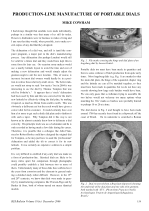
The article reveals that sundial were often produced in batches or using templates to save time and cost. Evidence of this includes manufacturers reusing delineation designs, employing techniques like tilting dial plates to correct for different latitudes, and the presence of matching marks and "prick marks" on components of portable and ivory dials. This suggests a more standardised manufacturing process for many dials, especially from places like Augsburg, Nuremberg, and France.
Dials: Portable, Sundial Design & Layout
December 2006
Page 162
Page 162
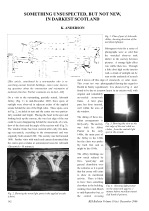
K. Anderson describes unexpected meridian light spots observed at Arbroath Abbey, Scotland, in December 2005. Sunlight streaks through narrow lancet windows create precise light pointers at astronomical noon in the applied arcade and sacristy, confirming early meridional arrangements within the Abbey buildings, dating back to the late 1100s, highlighting ancient astronomical awareness.
Historical Dials, Dials: Noon Lines
December 2006
Page 163
Page 163
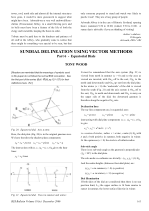
The article describes how the hour lines, declination lines and the sub-style angle are calculated using vectors. There is a summary which includes the assumptions made and the limitations of the method.
Dials: Equatorial, Mathematics of Dialling
December 2006
Page 164
Page 164
Jill Wilson reports on a successful weekend course on 'Understanding Sundials' at Farncombe Estate. The curriculum covered the history of dialling, fundamental theory, design principles, practical delineation using various tools, and the practicalities of installing dials, with a focus on wall declinations. Attendees, from beginners to experienced diallists, gained new insights and appreciation for sundials.
How Sundials Work, Mathematics of Dialling, Sundial Design & Layout, The BSS and Members
December 2006
Page 167
Page 167
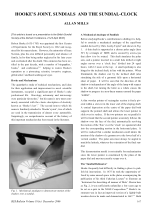
Allan Mills explores Robert Hooke's "Sundial Delineator," an instrument using a cross-shaped interior member (similar to a Hooke's joint) to simulate gnomon shadow motion for sundial delineation. The article details how Hooke's joint can be applied to delineate sundials and, when driven by a clock, create a "sundial-clock," explaining the underlying mathematical principles.
Sundial Design & Layout, Dialling Tools, Historical Dials
December 2006
Page 171
Page 171
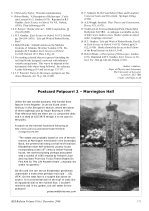
The featured dial can be found under Chirbury in the Shropshire section of the dial register. There are 11 component dials and it is sited at SJ272975 though it is not open to the public. On the west face is a scaphe dial above an anchor. Is it a horizontal dial on the top? It looks like an equatorial dial on the inclined face.
Dials: Multi Faced
December 2006
Page 172
Page 172
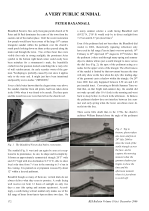
Peter Baxandall details the restoration of the 18th-century triangular sundial on St Peter and St Paul's church in Blandford Forum. The prominent dial, designed by William Bastard, features a unique numerical layout along the base and Aries symbols suggesting an equinoctial line. The restoration, led by Harriet James, preserved its original paintwork and clarified its seasonal indications despite pediment shadows.
Dials: Vertical, Sundial Design & Layout, Restoration projects, Historical Dials
December 2006
Page 176
Page 176
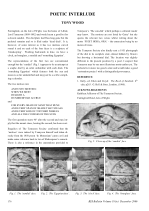
Farringford, on the Isle of Wight, was the home of Alfred, Lord Tennyson (1809-1892) and used to have a sundial. The dial plate itself has long gone but the pedestal remains and has two mottoes carved round it and on each of the four faces is a sculpture of ‘timekeeping’.
Historical Dials, Mottoes
December 2006
Page 177
Page 177
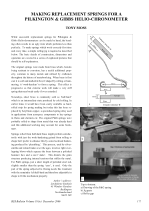
Tony Moss provides instructions for crafting replacement springs for Pilkington & Gibbs Helio-Chronometers. The article outlines using a rolling jig to shape half-hard brass, enhancing its properties through work-hardening and planishing. This ensures the springs function correctly, highlighting traditional metalworking techniques adapted for precise instrument repair.
Construction Projects, DIY Sundial Projects, Dials: Heliochronometer
December 2006
Page 180
Page 180
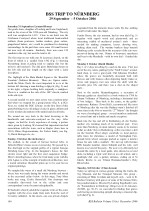
This multi-author report details the British Sundial Society's visit to Nürnberg, exploring historical sundials on sites like St Lawrence church (1502), the Fembo House, and various multi-faced dials in Rothenberg. The trip also included visits to St Rochus Cemetery, where gravestones of famous dial makers feature classical diptych dials.
Dials: Multi Faced, Dials: Portable, Historical Dials, The BSS and Members
December 2006
Page 184
Page 184
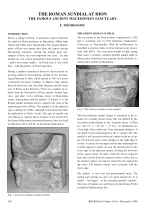
E. Theodossiou describes a unique spherical Greco-Roman sundial discovered at Dion, Macedonia, dating to the 1st century AD. This well-preserved white marble artifact, found in a 'luxurious house', features eleven hour lines and inscriptions dedicating it from I. Granius Felix, a market inspector. It is a significant find for ancient Macedonian archaeology.
Dials: Hemispherical, Historical Dials, Mottoes
December 2006
Page 186
Page 186
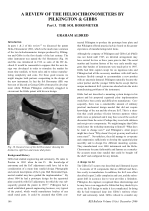
Graham Aldred reviews the Sol Horometer, William Pilkington's 1912 heliochronometer, developed to bypass George Gibbs's patent. It details Pilkington’s unique EoT adjustment mechanism, contrasting it with Gibbs's system, and discusses manufacturing, sighting, and pointer design. The article also compares its performance and rarity to the original Helio-Chronometer, noting the limited sales.
Sundial Design & Layout, Equation of Time, Historical Dials, Dials: Heliochronometer