- Home
- /
- Sundial Encyclopaedia
- /
- December 2007
December 2007
The articles link to the specific page in a PDF optimised for speed. If you want the whole issue, you can download it here, but the files from earlier years can be quite large.
December 2007
Page 145
Page 145
This editorial addresses the sad news of Margaret Stanier's passing, noting her contributions as a former Bulletin Editor and her influence on the sundialling community. It also mentions the inclusion of a solar and lunar data card with the issue and invites photographers to submit suitable cover pictures.
The BSS and Members
December 2007
Page 146
Page 146
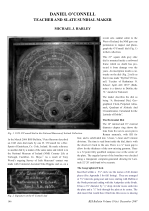
This article details an 1853 slate sundial by Daniel O’Connell, a teacher from Rathmines National School, Dublin, later of Shrule, Co. Mayo. The elaborate dial, now in the National Museum of Ireland, functions as a horizontal dial, geographical clock, perpetual almanac, quadrant of altitude, and circumferentor. It is considered a teaching aid and highlights O'Connell's master engraving skills.
Dials: Horizontal, How Sundials Work, Historical Dials
December 2007
Page 151
Page 151
This report summarises the British Sundial Society's Newbury meeting, which began with a tribute to the late Dr. Margaret Stanier. Presentations included stained-glass sundials, mounting a vertical sundial with a TV bracket, mathematical proofs for hour lines, a schools programme for dialling, universal equinoctial ring dials, dipleidoscopes, dials with vertical gnomons, and hemispherical dials.
Dialling Tools, How Sundials Work, Sundial Design & Layout, The BSS and Members
December 2007
Page 152
Page 152
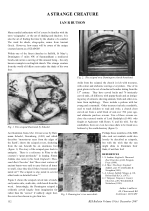
This article explores the mythical creature known as a Sciapod, known for sheltering under its own enormous foot. It highlights a unique 15th-century carving of a sciapod in St Mary’s Church, Dennington, Suffolk, and draws a humorous parallel between sundial enthusiasts and sciapods. The church also features medieval benches and mass dials.
Dials: Mass Dials, Historical Dials
December 2007
Page 153
Page 153
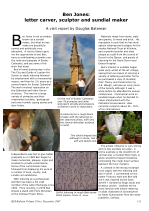
This report profiles Ben Jones, a letter carver and sculptor based in Devon, who has also become a skilled sundial maker. His work, which comprises 25-30% of his commissions, is noted for its artistic and unique designs, ranging from shield-shaped vertical dials to analemmatic dials and multi-faceted columns. He integrates his lettering skills and sculptural form into his creations.
Dials: Vertical, Dials: Polar, Sundial Design & Layout
December 2007
Page 156
Page 156
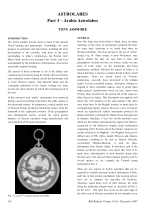
This article, part three of a series, delves into Arabic astrolabes, noting their historical significance in Islamic cultures from before the tenth to the nineteenth century. It describes their general characteristics, such as the use of Arabic scripts, the absence of equal hour scales, and the prominence of astrological scales. It also details specific features like thrones, retes, plates, and scales on the back, including shadow squares and sine/cosine grids.
Dials: Astrolabe, Mathematics of Dialling, Historical Dials
December 2007
Page 161
Page 161
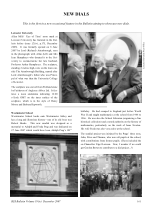
This section showcases several newly completed sundials. It features a memorial dial at Westminster School for Adolph and Freda Prag, an elliptical dial carved in Portland stone, a unique double horizontal dial for the southern hemisphere on Okatjorute Farm in Namibia, a late Saxon memorial sundial for a dog in Macclesfield, and a large analemmatic dial in Pollagh, Co. Galway, Ireland, at Brigit's Garden.
Dials: Horizontal, Dials: Analemmatic, Dials: Double Horizontal
December 2007
Page 164
Page 164
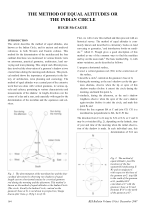
This article describes and historically surveys the method of equal altitudes, also known as the Indian Circle, used for determining the meridian and cardinal directions by observing a gnomon's shadow. It covers the practical steps, potential errors, mathematical analysis of shadow curves (conic sections), and its widespread use in ancient and medieval Eastern (India, China) and Western (Roman, early medieval Europe) cultures for architecture, town planning, and sacred rituals.
Historical Dials, How Sundials Work, Mathematics of Dialling, Sundial Design & Layout
December 2007
Page 172
Page 172
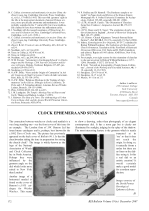
This article discusses the historical connection between clocks, watches, and sundials, referencing an example on the cover. It examines images from J.W. Benson Ltd catalogues featuring sundials, including a horizontal sundial with a truncated gnomon creating a nodus. The author speculates whether these depicted dials are real or artistic creations.
Dials: Horizontal, Historical Dials, How Sundials Work
December 2007
Page 173
Page 173
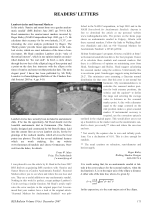
This section contains various letters from readers. Frans W. Maes discusses Lambert circles and seasonal markers on analemmatic sundials. Roger Bailey provides corrections and recommendations for seasonal markers. Frank King confirms a relationship for seasonal marker distance. Ken Head replies to Maes and Bailey. John Lester solves the mystery of a partial sundial motto. Malcolm Barnfield describes the making of a noon cannon sundial.
Dials: Analemmatic, Sundial Design & Layout, DIY Sundial Projects, The BSS and Members
December 2007
Page 176
Page 176
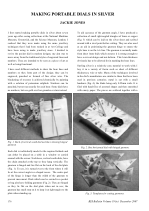
Jackie Jones describes her process of making portable sundials in silver, applying jewellery techniques learned at Art College. Her aim is to create modern, artistic, yet functional pocket dials. She details methods for showing hour lines, blackening recesses, and designing folding gnomons. The article also covers working with sterling silver, hallmarking, achieving different surface textures, and future plans for transparent enamel panels.
Construction Projects, DIY Sundial Projects, Dials: Portable, Sundial Design & Layout
December 2007
Page 178
Page 178
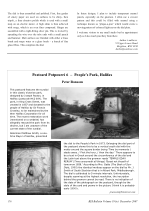
This article describes a sundial featured on a postcard from People’s Park, Halifax. The vertical south dial, presented in 1873, includes mottoes in English, Greek, and Latin. The author notes its similarities to another dial by J. Smith in Albert Park, Middlesbrough, and dates the postcard image to the early 1900s based on its style.
Dials: Vertical, Historical Dials, Mottoes
December 2007
Page 179
Page 179
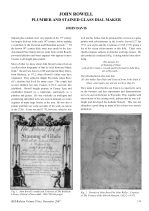
This biography details John Rowell (1689-1756), a provincial plumber and self-taught glass painter who became known for stained glass sundials in the 18th century. It covers his life, business, the influence of his clockmaker father-in-law, and two notable dials: the 'IR 1733' dial at Arbury Hall and the 1734 Purley Hall dial. The latter has undergone restoration, with analysis showing engraving errors and the design of a replacement gnomon.
Dials: Vertical, Sundial Design & Layout, Restoration projects, Historical Dials, Dials: Stained Glass
December 2007
Page 184
Page 184
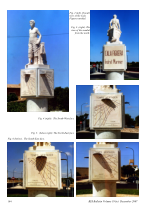
This article describes a monument in Cala Figuera, Majorca, featuring three vertical declining bifilar sundials on the pedestal of a fisherman statue. Two dials face south, one east and one west, and the third faces north, declining east. The article details their bifilar gnomon design (semi-ellipse and straight line), delineation for hours and half-hours, and declination lines, along with the mathematical methods used for their design and calculation.
Construction Projects, Dials: Bifilar, Dials: Multi Faced, Mathematics of Dialling, Sundial Design & Layout
December 2007
Page 187
Page 187
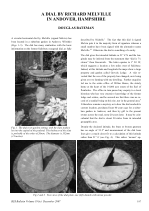
This article describes a rare circular horizontal sundial by Richard Melville (signed Melvin) found in Andover, Hampshire. The dial, dated to around 1860, is unusual for Melville's work due to its circular shape and its mention of a son. It discusses the discrepancy between the declared latitude and the gnomon angle, suggesting mass production, and notes an engraving error and weathering on the dial plate.
Dials: Horizontal, Historical Dials, Sundial Design & Layout
December 2007
Page 189
Page 189
This is a review of 'Catalogue of Sun-dials, Nocturnals and Related Instruments in the Instituto e Museo di Storia Della Scienza, Firenze' by Anthony J Turner. The catalogue details Florence's collection of sundials, nocturnals, and other instruments, categorized using Higgins' classification. The reviewer praises the initiative but criticizes the illustration presentation, including identification, placement, size, and photographic angles.
Book Reviews, Dials: Multi Faced, Historical Dials, Dials: Nocturnals
December 2007
Page 190
Page 190
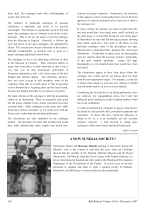
This note introduces Hassaan Ghazali from Lahore, Pakistan, a lawyer who is interested in sundials and plans to form a kindred society in Pakistan. It mentions his visit to the UK where he met Christopher Daniel and visited the National Maritime Museum and Royal Observatory sundials. The British Sundial Society hopes he will become a member.
The BSS and Members
December 2007
Page 191
Page 191
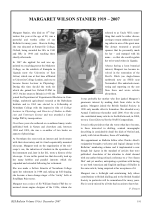
This obituary commemorates Margaret Wilson Stanier (1919-2007), a distinguished physiologist and former Editor of the British Sundial Society Bulletin. It highlights her academic career at Oxford, Makerere College, and Cambridge, her scientific publications, her involvement with the Newnham College observatory, and her various hobbies including bell-ringing and botanical interests. It emphasizes her significant contributions to gnomonics, joining the BSS in 1990, editing the Bulletin with rigor, and writing seminal monographs on Oxford and Cambridge dials.
The BSS and Members
December 2007
Page 192
Page 192
This article calls for a reassessment of scratch (mass) dials, noting the surprising lack of interest despite thousands surviving across Europe. The author, who stumbled upon them while researching local history, is now analyzing the BSS Mass Dial Group's extensive database using mathematical and statistical methods to gain new insights into their original prevalence, use, appearance, evolution, and eventual fate.
Mathematics of Dialling, Historical Dials, The BSS and Members, Dials: Mass Dials