- Home
- /
- Sundial Encyclopaedia
- /
- Mario Arnaldi
Mario Arnaldi
September 2023
Page 2
Page 2

Analyzes the Erfurt rule, a medieval method for designing south-facing wall sundials, found in a 15th–16th-century codex owned by Fra Giocondo of Verona. It discusses the rule's origins (Paris/Germany, c. 1334), its non-empirical numerical angular values for temporal hours, and its later modification to suit equal equinoctial hours.
Dials: Vertical, Historical Dials, Mathematics of Dialling, Sundial Design & Layout
December 2023
Page 20
Page 20
Part 1 of an analysis tracing the evolution of Italian hours (counting from sunset, ab occasu solis) from the ancient unequal hours, noting the influence of mechanical tower clocks in the mid-fourteenth century. It discusses how Italian hours contrasted with Babylonian (ab ortu solis) and Nuremberg hours, addressing historical confusion surrounding ‘Bohemian hours’.
Historical Dials, Mathematics of Dialling, Sundial Design & Layout
September 2022
Page 34
Page 34
A summary of recent international research into medieval sundials. Highlights the Fachkreis Sonnenuhren database (696 German objects) and debates whether scratch dials are pilgrim symbols. Mentions new findings on medieval texts describing unequal-hour sundials and the construction of polar style dials.
How Sundials Work, Historical Dials, Dials: Mass Dials
March 2012
Page 8
Page 8
This second part of the article investigates the Canterbury pendant, a 10th-century portable sundial. It compares its graphic layout with the Libellus de mensura horologii and the Roman cylinder dial of Este, exploring the use of two gnomons for different seasons and their relationship to hour curves.
Dials: Portable, Historical Dials, How Sundials Work, Mathematics of Dialling
December 2011
Page 2
Page 2
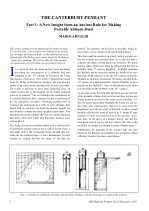
This article summarises the author's attempt to create a clear and correct edition of an ancient text, previously attributed to Bede, on constructing an altitude dial. The findings provide new insight into the famous ‘Canterbury pendant’ and suggest it was made more correctly than previously believed. The text describes a pendant altitude dial, possibly hexagonal, working like a cylinder dial, with specific dimensions and a calendar system.
Construction Projects, Dials: Portable, Historical Dials, Mathematics of Dialling
October 2000
Page 109
Page 109
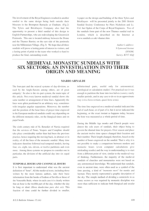
Explores the historical and liturgical rationale behind medieval six-sector sundials, their canonical hour divisions, and theological symbolism.
Dials: Mass Dials, Historical Dials, How Sundials Work, Mathematics of Dialling
February 1998
Page 22
Page 22
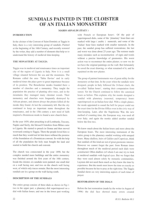
Survey of painted dials in a monastery cloister at Taggia (Imperia), noting multiple faces, canonical hours and decorative treatments, with historical context and observations on preservation.
Dials: Vertical, Historical Dials, Restoration projects
June 1998
Page 14
Page 14
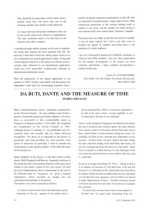
This article discusses the division of the day as described in Dante's 'Divine Comedy' and the commentary by Da Buti, explaining how the church used seasonal hours and placed offices around the hour of midday. It also connects the hourly markers on a sundial to the end of time periods rather than the beginning.
Dials: Mass Dials, Historical Dials
October 1997
Page 13
Page 13
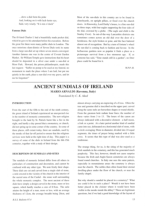
This survey details the unique sundials of early Irish monastic communities (6th-15th centuries), cut from single stone steles and often engraved with crosses. Used by monks for religious services, these dials feature varying hour lines and decorative elements for canonical hours. The article describes specific examples and discusses their construction, placement in cemeteries, and the debate over large gnomon holes.
Dials: Mass Dials, Historical Dials