- Home
- /
- Sundial Encyclopaedia
- /
- June 2008
June 2008
The articles link to the specific page in a PDF optimised for speed. If you want the whole issue, you can download it here, but the files from earlier years can be quite large.
June 2008
Page 49
Page 49
The editor apologises for a change in email address and encourages members to send in photographs of dials for a new 'Picture Gallery' feature and items for 'New Dials'. It also includes corrections for Bonham's sale prices from the previous Bulletin.
June 2008
Page 50
Page 50
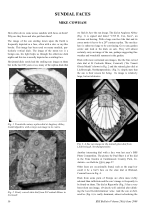
This article explores the depiction of faces on sundials, primarily smiling suns on vertical dials and replica horizontal dials, as well as moon faces and other figures like angels. It showcases various examples from Britain and Europe, discussing their symbolism and design variations.
Dials: Portable, Dials: Vertical, Historical Dials, Sundial Design & Layout
June 2008
Page 54
Page 54
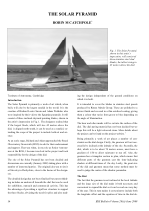
This article describes the design and astronomical calculations for the Solar Pyramid, a proposed large-scale art installation that will also function as the world's largest sundial. It details the design constraints, methods for reading time, and the accuracy of incorporating the Equation of Time over centuries.
Construction Projects, Equation of Time, Mathematics of Dialling, Sundial Design & Layout
June 2008
Page 60
Page 60
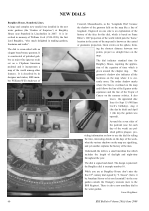
This section introduces new sundials, including the 'Longitude Dial' at Burghley House, designed by William Andrewes, which incorporates a world map and indicates standard time and noon locations. It also describes a brass sundial made by Valery Dmitriev in Russia, designed in a traditional English style using CNC milling.
Dials: Horizontal, Sundial Design & Layout
June 2008
Page 61
Page 61
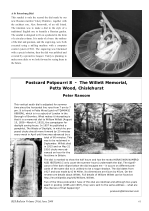
This entry features a vertical sundial in Petts Wood, Chislehurst, dedicated as a memorial to William Willett, the campaigner for daylight saving hours. The dial, dated 1927, is adjusted for summer time and carries the motto 'HORAS NON NUMERO NISI ÆSTIVAS'.
Dials: Vertical, Historical Dials, Mottoes
June 2008
Page 62
Page 62
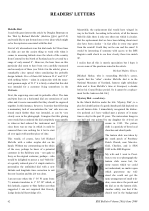
Michael Maltin speculates on the original location and an engraving error of a Melville dial, suggesting it was for the Midlands but ended up in Salisbury. Roger Bowling shares a 'sad story' about a stolen churchyard dial from Prestbury Parish Church, mistakenly printed reversed in the Bulletin, and mentions its appearance in Alice Morse Earle's book.
Historical Dials
June 2008
Page 63
Page 63
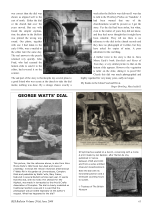
This entry discusses a terracotta dial made by the Arts & Crafts Association of Compton, believed to be modelled on traditional Scottish dials, for the Victorian artist George F Watts RA in his garden at Limnerslease. It poses the question of the dial's current whereabouts.
Historical Dials
June 2008
Page 64
Page 64
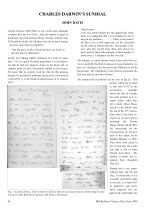
This article details Charles Darwin's horizontal sundial at Down House, used for regulating his clocks. It describes the dial's unpretentious design, its historical context, and recent restoration efforts after two accidents, including the discovery that the gnomon was a replacement.
Dials: Horizontal, Historical Dials, Restoration projects
June 2008
Page 67
Page 67
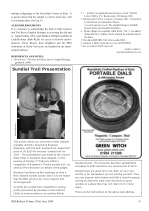
This entry reports on the presentation of the SotI 'Sundial Trail' Award first prize to Rosaleen Robertson for her 'Timaru sundial trail' in New Zealand. It also mentions the joint sponsorship of the 2008 competition by SotI and BSS, encouraging participation in creating sundial trails.
The BSS and Members
June 2008
Page 68
Page 68
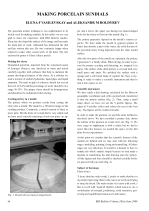
This article describes the sophisticated porcelain artistic technique used to create sundials, from preparing the slurry and casting the pottery to delineating the dial, modelling decorative elements like a 'grapevine river of life', painting with glazes, and multiple firings and enamelling processes.
Sundial Design & Layout, Construction Projects
June 2008
Page 72
Page 72
This entry contains the minutes of the British Sundial Society's 19th Annual General Meeting, held on 30 March 2008. It covers the Chairman's opening remarks, apologies, approval of previous minutes, Council Members' reports and other society activities.
The BSS and Members
June 2008
Page 75
Page 75
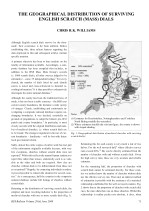
This article analyses the geographical distribution of surviving English scratch (mass) dials using a composite national database. It identifies a marked watershed and regional clustering, with higher survival rates east of the watershed, and discusses the importance of recording churches without dials for statistical accuracy.
Historical Dials, Dials: Mass Dials
June 2008
Page 77
Page 77

This report summarises the 2008 BSS Annual Conference at Latimer, highlighting various talks including Piers Nicholson on Jantar Mantar, Chris Williams on scratch dial statistics, Fred Sawyer on Michnik's bifilar sundial, Celia James on James Richard's dial, Julian Lush on Armenian scallop dials, and John Davis on John Rowley's work.
Dials: Bifilar, Historical Dials, Sundial Design & Layout, The BSS and Members
June 2008
Page 82
Page 82
John Lester describes his extensive project to edit Mrs Crowley's Sundial Sketchbooks of Devon and Cornwall, which involved visiting and photographing all 216 recorded dials. He details the challenges of surveying in the West Country and his efforts to uncover facts about Mrs Crowley's life and methods, resulting in a published edition.
Book Reviews, Historical Dials
June 2008
Page 83
Page 83
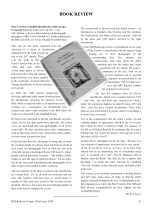
This is a review of 'Mrs Crowley’s Sundial Sketchbooks of Devon and Cornwall', edited by John Lester. It praises Lester's detailed commentaries, photographs, and wit, highlighting its value as a contribution to dialling history and a companion for West Country trips. The book compiles Mrs Crowley's pencil sketches and Lester's updated records of 216 dials.
Book Reviews, Historical Dials
June 2008
Page 84
Page 84
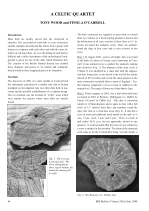
This article investigates five slate mass dials found in 'Celtic' areas (Cornwall, Ireland, Scotland, Wales), which share common features like 15° interval hour lines. It discusses their unusual horizontal forms, 'secretary hand' numerals, and archaeological backgrounds, exploring a potential 'Celtic' connection despite dating challenges.
Sundial Design & Layout, Historical Dials, Dials: Mass Dials
June 2008
Page 88
Page 88
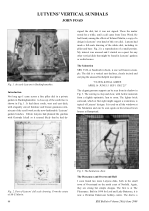
This article explores vertical sundials designed by architect Edwin Lutyens for his gardens and houses, including examples at The Salutation, The Pleasaunce, Overstrand Hall, Tigbourne Court, Hampstead Garden Suburb, Greywalls, and Mothecombe. It highlights his meticulous design, integration with architecture, and use of specific mottoes and materials.
Dials: Vertical, Historical Dials, Mottoes, Sundial Design & Layout
June 2008
Page 91
Page 91
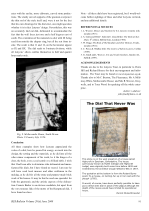
This brief entry describes a stone plaque on a house in Eynsham, Oxfordshire, which, though not a dial itself, occupies a recess where a direct west dial could have been placed. The house was extended by architect Clough Williams-Ellis, and the plaque features a quotation from Robert Burns.
Historical Dials, Sundial Design & Layout
June 2008
Page 92
Page 92
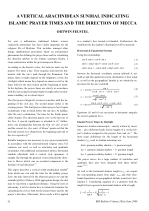
This paper describes the design of a vertical south arachnidean sundial to indicate Islamic prayer times (Zuhr, Asr) and the Qibla (direction to Mecca). It explains the astronomical principles and mathematical formulae used to calculate the specific prayer curves and Qibla curve, making it readable from a significant distance.
Dials: Vertical, Historical Dials, Mathematics of Dialling, Sundial Design & Layout
June 2008
Page 95
Page 95
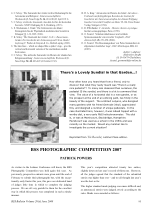
This short piece discusses the common misconception that the pedestal is the sundial, highlighting the importance of the support's beauty. It mentions architect Lutyens' appreciation for pedestals and features a P&G heliochronometer at Marshcourt, posing a question about its current status.
Dials: Heliochronometer, Historical Dials, Sundial Design & Layout
June 2008
Page 95
Page 95
This article reports on the 2007 BSS Photographic Competition, detailing the judging process, scoring criteria, and the results. John Davis's 'Ship's Time' won first place, with Mike Isaacs and John Lester as runners-up. It encourages members to participate in the upcoming 2008 competition.
The BSS and Members
June 2008
Page 99
Page 99
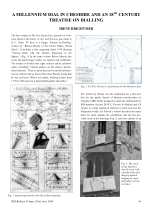
This article links a new millennium sundial at Marbury-cum-Quoisley church in Cheshire, designed by Dr W.E. Flewett and adjusted for longitude and British Summer Time, to an 18th-century treatise by Robert Moody. It also discusses William Emerson, a mathematician and diallist whose work influenced Moody and the millennium dial.
Construction Projects, Historical Dials, Mathematics of Dialling, Sundial Design & Layout