- Home
- /
- Sundial Encyclopaedia
- /
- Dials: Foster-Lambert
Dials: Foster-Lambert
September 2020
Page 21
Page 21
An obituary for Gordon Ernest Taylor (no. 146), the BSS's first Registrar, renowned for his work in astronomy and lunar occultations. Highlights his gnomonic contributions, including a paper on reclining equiangular sundials (Foster-Lambert dial).
Dials: Foster-Lambert, Mathematics of Dialling, The BSS and Members
September 2008
Page 123
Page 123
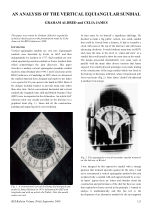
This paper provides a mathematical analysis of James Richard's rare vertical equiangular meantime sundial, designed to resemble a clock with equally spaced hours. It explains the gnomon's upward inclination and daily displacement, allowing for mean time and BST adjustments. The analysis, an alternative to Foster-Lambert theory, aims to stimulate interest in this unusual dial type.
Dials: Foster-Lambert, Dials: Vertical, Mathematics of Dialling, Sundial Design & Layout
March 2007
Page 40
Page 40
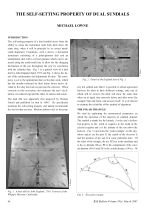
This paper examines the self-setting property of dual sundials, typically consisting of a polar-gnomon dial and an analemmatic dial. It explains the astronomical parameters involved, how rotation affects time indications, and calculates the effectiveness of this alignment method at various latitudes and declinations. It also compares the traditional dual dial with an alternative Foster-Lambert reclining dial.
Dials: Foster-Lambert, Dials: Double Horizontal
October 1991
Page 24
Page 24
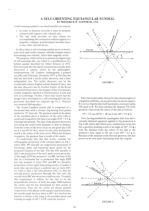
Fred Sawyer presents a self-orienting equiangular sundial, a modification of the Foster-Lambert hybrid dial, capable of correct orientation without external devices. It functions as both a solar clock and a solar compass, determining true celestial north. The design involves a V-shaped gnomon and two sets of hour-markings, allowing for simultaneous readings of Standard and Apparent time and a straightforward orientation process.
Dials: Foster-Lambert, How Sundials Work, Sundial Design & Layout