- Home
- /
- Sundial Encyclopaedia
- /
- March 2001
March 2001
The articles link to the specific page in a PDF optimised for speed. If you want the whole issue, you can download it here, but the files from earlier years can be quite large.
March 2001
Page 3
Page 3
This article explores the history of time measurement, beginning with ancient civilizations like the Sumerians and their development of calendars. It discusses the challenges in harmonizing civil timekeeping with astronomy, including sidereal and solar years, and the division of days into hours. The article also covers the Roman and early Christian calendars, highlighting their inaccuracies and the historical attempts to reform them, such as the Julian and Gregorian calendars and the fixing of Easter.
March 2001
Page 9
Page 9
This article details the design and delineation of a reflective ceiling dial at the Horniman Museum, inspired by a sundial trail lecture. It sets out the mathematical formulation for determining coordinates on the dial, explaining how it relates to an equivalent declining, reclining dial. The authors emphasize that reflective dials are not inherently more complex to delineate than other planar sundials, providing formulas for angle and length calculations, and tables of coordinates for various times and declinations.
Construction Projects, Dials: Reflected
March 2001
Page 13
Page 13
An overview of the sundial located at King's College Chapel in Aberdeen. It covers the historical background of the dial, its unique design features, and any notable events or figures associated with its existence. It may also detail recent preservation or restoration efforts, highlighting the challenges and techniques used to maintain this historical timekeeping instrument.
Historical Dials
March 2001
Page 15
Page 15
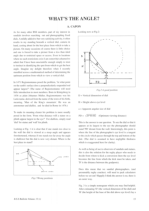
Derives a mathematical method of determining the optimum distance from which to view or photograph a vertical dial, and provides a nomogram to help calculate this distance based on the dial's dimensions and height.
Mathematics of Dialling, Sundial Design & Layout
March 2001
Page 16
Page 16
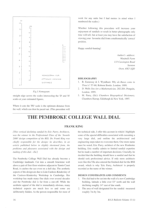
The design and installation of the Pembroke College Wall Dial, emphasizing an uncluttered design and prominent nodus for clear time estimation. It highlights a unique coincidence for Cambridge students cycling past, aligning with lecture times. The article details the construction process, including the sealing of the mounting assembly and the replacement of missing stone, ensuring durability. It also mentions AT&T Research Laboratory's digital camera monitoring for shadow detection.
Construction Projects, Dials: Vertical
March 2001
Page 22
Page 22
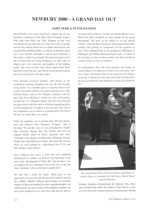
This report details the Newbury 2000 event, a British Sundial Society gathering showcasing various sundial exhibits. Highlights include John Moir's rainbow and bifilar dials, a cycloidal dial, and Piers Nicholson's prototype horizontal dial with accurate alignment features. Tony Wood presented "3 Cheap and Dials" and updated on the mass dial register. Peter Ransom displayed sundial-themed items, and David Young showed eclipse phenomena. The event concluded with an award for the Make a Sundial competition.
The BSS and Members
March 2001
Page 25
Page 25
March 2001
Page 25
Page 25
A. F. Baigent's piece reflects on the "BSS SUNDIAL GLOSSARY," having 'tested' the glossary on six guinea pig subjects for their understanding of 20 words from the glossary. He suggests improvements such as additional tables for equation of time and sun declination, plus more diagrams. The author acknowledges John Davis's hard work on the glossary.
Book Reviews
March 2001
Page 32
Page 32
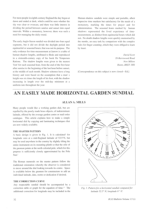
Instructions for making a simple horizontal garden sundial using copying and laminating techniques. It offers a basic design computed for latitude 52.5°N, longitude zero, and explains how to adjust it for different locations by tilting.
DIY Sundial Projects, Dials: Horizontal
March 2001
Page 38
Page 38
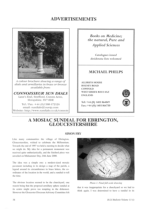
Describes the creation of a mosaic sundial for Ebrington, Gloucestershire, as a Millennium celebration project. Initially planned for the churchyard, it was relocated due to committee concerns. The final design features a mosaic pavement with a parish map, brass lettering, global coordinates, and a sidereal sundial marked in hours and half-hours. The article details the design and construction process, aiming for a permanent and unique village monument.
Construction Projects, Dials: Horizontal
March 2001
Page 41
Page 41
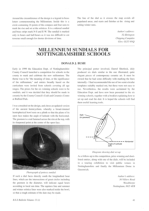
Describes a Nottinghamshire County Council competition for schools to mark the Millennium, with sundials as prizes. The author was consulted on the design, choosing an updated ancient hemicyclium: a hemispherical bowl on a plinth, with a rod gnomon. The ceramic dials, crafted by Danel Sherlock, feature hour, equinox, and solstice lines. A booklet guides setup and reading, hoping the dials will serve as useful learning tools for the winning schools.
Construction Projects, Dials: Hemispherical
March 2001
Page 42
Page 42
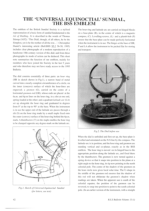
This article explores the "Universal Equinoctial" sundial, highlighting its significance as the emblem of the British Sundial Society. It discusses the historical context and design principles of this type of sundial, explaining its functionality and why it was chosen to represent the BSS.
Dials: Equatorial, Sundial Design & Layout, The BSS and Members
March 2001
Page 44
Page 44
This obituary commemorates the life and contributions of Peter Lamont, a member of the British Sundial Society.
The BSS and Members