- Home
- /
- Sundial Encyclopaedia
- /
- Anthony Capon
Anthony Capon
March 2018
Page 22
Page 22
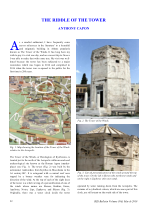
Discusses the newly restored Tower of the Winds (Horologion of Kyrrhestos) in Athens, which features eight exterior sundials and an internal water clock. The main riddle explored is whether the eroded sundials were original to the 1st century BC structure, noting the conflicting evidence of Vitruvius's silence versus the need for sundials to regulate the water clock.
Dials: Multi Faced, Historical Dials, Restoration projects
March 2017
Page 30
Page 30
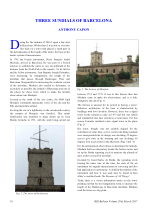
Description of two vertical declining sundials (32° east and 58° west declination) and a modern horizontal dial on the tower of the Montjuïc fortress in Barcelona. The tower was used by Pierre François André Méchain as a trig point for the meridian measurement required in determining the length of the metre in the late 18th century.
Dials: Vertical, Historical Dials
March 2014
Page 8
Page 8
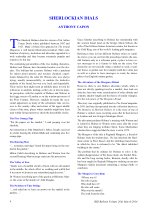
The article examines instances where sundials appear in Sir Arthur Conan Doyle’s Sherlock Holmes stories. Typically, the sundials function as atmospheric features or reference points for leaving messages. The adventure 'The Musgrave Ritual' stands out, as it involves Holmes employing trigonometry to calculate solar altitude and shadow length to solve a coded riddle.
Historical Dials, How Sundials Work
December 2014
Page 8
Page 8
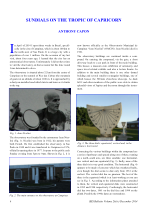
An account of sundials found in and around Campinas, Brazil, specifically mentioning the Observatorio Municipal de Campinas, founded by Jean Nicolini. The observatory site holds three dials (horizontal, vertical, and equatorial), though their condition varies. Other documented dials include one in Parque Taquaral (1962) and two at the Americana Observatory.
Dials: Horizontal, Dials: Vertical, Dials: Equatorial
December 2008
Page 172
Page 172
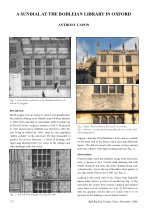
This article investigates the historical existence of a sundial on the south wall of the Bodleian Library, depicted in Loggan's 1675 drawing and a later 1818 engraving. It provides evidence for its reality, discusses its disappearance by 1814-1880 due to redundancy and weathering, identifies Richard Hawkins as its painter in 1641, and suggests its original positioning.
Dials: Vertical, Historical Dials
June 2004
Page 77
Page 77
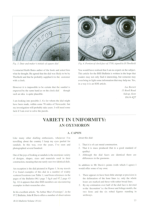
Discussion of a sundial design of which many examples have been found round the country by the author, with a request for information about its designer, date and decoration
Historical Dials
March 2001
Page 15
Page 15
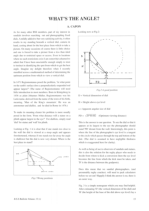
Derives a mathematical method of determining the optimum distance from which to view or photograph a vertical dial, and provides a nomogram to help calculate this distance based on the dial's dimensions and height.
Mathematics of Dialling, Sundial Design & Layout