BRIDOL is the British Sundial Society's Register of Fixed and Mass Dials, which gives detail and photographs of about 8000 fixed sundials and 3000 mass dials in the UK.
Some of these are in private gardens, but the majority are publicly available.
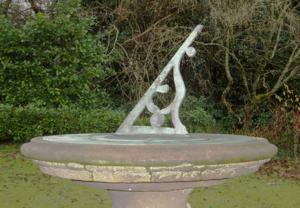
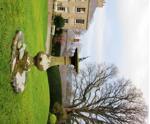
The dial is on a baluster of fine-grained sandstone 1230 high, standing on the south lawn.
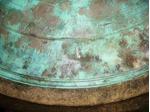
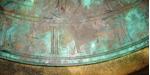
Roman hour numerals read from the inside, 4am to 8pm. Outer ring marked with 5 mins lines and every 10 mins marked in Arabic numbers. Noon gap with ‘SEGROIT’ (a place some miles away from the dial’s present location). At the south ‘MEREDITH HUGHES / Bala Fecit 1767 / Lat 53d 14m’, and above that the motto ’Ex hoc / momento / pendet Aeternitas’.
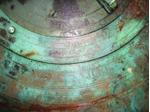
Within the hours ring there are 32 geographical place names and a decorative cross at the half-hour mark. The position of each place name indicates the time at Segroit when it is noon there. Next inwards are EOT rings, with at the south a monogram which may be two intertwined ‘M’s for the Mostyn family who once lived at Segroit and who may have commissioned the dial (research ongoing). Inside this is a once-moveable ring attached by two rivets proud of the plate which probably served to move the ring to correct for the EoT; the moveable ring has four bands of information, which are hard to decipher but one can read ‘scorpio’ ‘cancer’ ‘leo’ etc in one and ‘gnomon’ and ‘number of days between’ in another; the plate within the moveable ring contains the 16-point decorative compass rose, and the plate is attached by 4 screws, one missing.
The dial came here a long time ago (perhaps even before 1800) and has been in two or three different locations in the garden. It has been in its present position for several decades.
Ref: Clockmakers of Llanrwst, Colin and Mary Brown (1993)
Also complete Report 10851.
Ref: BSS Bulletin 34(iv), 16-21 (Dec 2022)