BRIDOL is the British Sundial Society's Register of Fixed and Mass Dials, which gives detail and photographs of about 8000 fixed sundials and 3000 mass dials in the UK.
Some of these are in private gardens, but the majority are publicly available.
Click here for the BRIDOL main page.Lasham Gliding Society, Alton
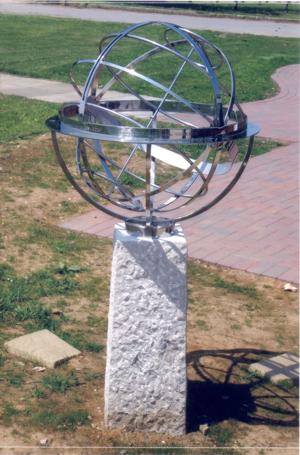
Modern seven ring armillary sphere in stainless steel, in memory of a noted glider pilot.
The sphere has two rings that pass through the poles, made of strap-like strips (armillae in Latin). One is in the (north-south) meridian plane . The other is at right angles to it. These rings support five more rings representing, from top to bottom, the Arctic Circle, Tropic of Cancer, Equator, Tropic of Capricorn and Antarctic Circle. The equator ring is broader than the others and is inscribed with hours.
Running up through the centre of the sphere is an axis, parallel to the earth’s axis, in the centre of which is a small disk. The shadow of this axis on the equator ring tells the time from 6am to 6pm in 15 minute divisions. At noon the shadow of the small disk indicates the date on a scale on the meridian ring.
The sphere has two further rings: a broad horizon ring and a vertical east-west ring. The whole is on a stone plinth and is supported on the horizon ring by two semicircular rings.
The dial is dedicated to a record breaking glider pilot, Alan D Purnell, who lost his life on 26 April 2004 in a mid-air collision. Inscriptions list his considerable achievements such as distances flown and awards.
The horizontal ring gives bearings and distances to other gliding sites in the UK and around the world. There is also a motto attributed to Leonardo da Vinci: ’Once you have flown, you will walk the earth with your eyes turned skyward - for where you have been, there you long to return’.
The 1m tall Purbeck stone pedestal has a plaque: ’The Alpha Lima Armillary Sphere commissioned by his fellow pilots family and friends’ (Alpha Lima was Alan Purnell’s call sign).
Lasham Gliding Society, Lasham Airfield, The Ave, Lasham, Alton, GU34 5SP, Hampshire
| SRN | Year | Recorded | Coords |
|---|---|---|---|
| S6875 | 2005 | 2005 | 51.18944, -1.03250 N 51° 11' 22", W 01° 01' 57" |
| Condition | Type | Access |
|---|---|---|
| Excellent | Equatorial | Open |
| Maker | Materials | Dimensions |
|---|---|---|
| David Harber | s/steel | 700 dia |